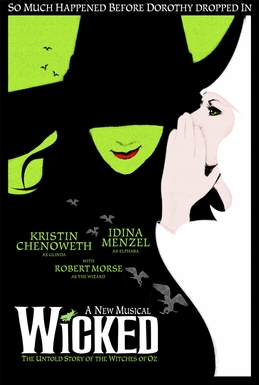
I got to see the Broadway show Wicked tonight.
The show Wicked is based on the novel Wicked by Gregory Maguire. I have not read the novel, so my comments are restricted to the show.
Wicked is the re-telling of the classic Wizard of Oz story from the vantage of Elphaba, the Wicked Witch of the West. Wicked deconstructs the moral plotlines of The Wizard of Oz. In Wicked Elphaba is actually the good witch and Glinda is not a moral exemplar.
Specifically, we see Elphaba and Glinda as reluctant roommates in High School. Elphaba, being green, is shunned and Glinda who is blonde, rich, and beautiful is wildly popular. Thus, we see how the fortunes of birth (because it is not easy being green) affect character and social perception. In the end, Elphaba is called wicked, but she really is not. Why? Because we, the audience, now know her story.
This moral reversal, once the full story is in hand (in the imagination of the author), made be think of Martha Nussbaum’s view that we need to capture a narrative imagination when we approach criminals and criminal behavior. Basically, when we understand people’s stories our capacity for empathy is increased. This does not mean we excuse the behavior or forget the voices of victims. But a narrative understanding—the life story of the “wicked”—helps us understand a bit why people end up in the situations they do. Another good example of this is the book and movie Dead Man Walking where sister Helen Prejean, via her attempt to understand the stories of death row inmates, increases her capacity for empathy.
As we shift to the post-Cartesian world with the rise of weak-volitional models, these narrative approaches to morality will become more and more important. The stories of the wicked will attenuate strong notions of moral accountability.
Obviously, I think this narrative approach has implications for soteriology as well. We are all products of circumstance. We are all wicked to a greater or lesser degree due to the fortunes of birth and environment. Thus, I feel convicted that God will have to take all our contingent histories into account.
God will have to take into account that Elphaba is, well, green, while many of us are poor or abused or raised by non-Christian parents, or are persons of color in a racist world.
And in light of those stories, what is or is not "wicked" is much less clear.
On Harry Potter and Vampire Movies: Sin and Biology
Given the recent Harry Potter craze I thought I’d go with the flow. Here, for your consideration, is an extended meditation on Harry Potter, vampire movies, sin, and biology. This will be one of those odd stews I cook up for you. Enjoy!
My friend Jonathan Wade and I have a quirky habit: We like to go to vampire movies. Once, on the way home from a movie, we began discussing recent trends in vampire movies and graphic novels. The classic vampire genre cast vampires as evil and occult. They are undead. Thus, the classic genre (CG) has a heavy metaphysical overlay where the spiritual forces of good and evil fight it out. Thus, weapons against vampires are holy water and crucifixes (along with the non-spiritual weapons of garlic, sunlight, and silver).
But increasingly, the modern genre (MG) of vampire movies is moving away from these metaphysical and spiritual themes. The MG, in contrast to the CG, is non-metaphysical. The MG is biological. Increasingly, you see biological explanations for vampirism and its symptoms. The vampire bite is analogous to a mosquito or rabid dog bite causing a gene-altering allergic reaction or viral infection. Further, the vampire’s reactions to garlic, sunlight, and silver are increasingly portrayed as hyper-severe allergic reactions.
In a correlated manner, we thus see the decline of the metaphysical weapons against vampires. If you assault a vampire in the MG, holding a crucifix aloft, the vampire will chide you for being superstitious. The supernatural is absent in the modern vampire genre. Biology—with its allergies, viral infections, naturalistic ontology, and genetic mutations—is king in modern vampire movies.
Further, in many of these MG vampire movies we see issues of race and eugenics emerge as significant plot themes. See the Blade series or Underworld as examples. Again, this is a very biological theme. And this brings me to Harry Potter.
Despite concerns from religious fundamentalists, Harry Potter is a very non-metaphysical series. The magic seems to come from nowhere in Harry Potter. The etiology of magic is unspecified. Magic just is. No occult forces are described. No devils, gods, or demons. True, there is dark magic. But the darkness is largely a moral issue speaking to uses and outcomes rather than supernatural source. “Darkness” is a pragmatic issue, not a metaphysical one.
But what you do see in Harry Potter are heavy biological themes. Race issues—pure-bloods versus mud-bloods—feature predominately in the series. Further, magical ability appears to be transferred via some kind of rare recessive gene. For example, two muggle parents can have a magical off-spring (e.g., Hermione). Lastly, magical ability in the Harry Potter series seems to be a matter of genetic talent. Some of the children are naturally good magicians (e.g., Harry) while others are not (e.g., Neville). But it is more complex than that, hard work is also a part of acquiring magical skill. Hermione is a good example of this. In short, what we see in the magic of Harry Potter is not a metaphysical portrayal but the classical biological conundrum of nature versus nurture.
The point? God is dead in Harry Potter and in vampire movies.
What I mean to say is that even in classically supernatural and metaphysical genres (vampire or magic stories) we see this de-emphasis on metaphysics and the rise of the biological (i.e., scientific) worldview. It really is a startling shift: Science as the coin of the realm in classically occult or supernatural tales.
But if we think about it, all this is simply a reflection of our culture. More and more often, our psychological and moral states are being defined by biology rather than spirituality. Sins are now addictions. And moral failures are increasingly traced back to genetic predispositions. Our debates are less about good versus evil and more about nature versus nurture. We are no longer bedeviled by demons but are harassed by genetic determinism and chemical imbalances in the brain.
Obviously, if you are a regular reader of this blog, you know I’ve been infected by this scientific age. I repeatedly filter biblical narratives through my scientific grid. Is this good or bad? I see it as a mixed blessing. A gift with lots of warning labels (e.g., Don’t bathe with your toaster.). I think the main issue is to be self-aware and to keep the situation fluid. To not let science or the bible trump each other in an unthinking and uncritical manner. The goal is to pay attention to the influences that are working upon you. And when you are self-aware and analytical you notice things...
Things like the demise of metaphysics in vampire movies and children’s novels...
Sticky Theology, Part 4: Persuasion and Bivalent Theology
Christianity tends to be an evangelistic faith. Not all facets of Christianity, mind you, are this way. The Amish come to mind. But generally Christians seek to evangelize people to their faith.
This means that folk communications about the faith tend to have persuasion as the main goal. And persuasive speech tends to have characteristics that are relevant for this series.
Generally, persuasive speech tends to manifest bivalent logic: Right versus Wrong or True versus False.
That is, persuasive speech tends to seek a movement from one opinion (the wrong one) to another opinion (the right one). In many folk conceptions, this opinion shift is often called “conversion.”
Obviously, this type of opinional shift is an anemic version of “conversion.” But in my faith tradition, it remains a dominant vision of conversion. But this facet of the folk model isn’t what will concern us here.
Specifically, I wish to note that a persuasive theology will tend to be a black and white theology. A bivalent theology.
The trouble with a bivalent theology, despite its “stickiness,” is that it is a theology that lacks depth and nuance. Worse, depth and nuance are seen as symptoms of unfaith. Complexity is devilish. Witness a comment in these posts where nuanced conversation is deemed “academic” and, by implication, “wrong,” unfaithful, and, again by implication, devilish.
The point is, deep, considered, critical, and reflective theology is NOT sticky. Which poses some problems. Binary, bivalent theology will always mimetically outperform deep theological ideas. Deep theological ideas will be too difficult to communicate via the sound-bite and bumper sticker.
Ecclesially, I think Paul noted this problem. Some people are equipped for evangelism and others for teaching. These are really two different theological tasks. One is bivalent and the other is multivalent. One needs to be mimetically effective (an extrinsic characteristic) while the other can rely on the intrinsic motivations of the audience (the church) to sit through the nuanced and deep theological conversations (presumably because theological education is boring and hard work).
So there are different needs here. However, my concern is that too often the evangelistic, persuasive, and bivalent theology becomes the food for the church as well. Too many Christians are still drinking theological milk when, in the words of Paul, they should be proceeding to solid food. I think this occurs because bivalent thinking may be TOO mimetically powerful. I think the church isn’t noticing this memetic power is thus failing to take prophylactic action demanding more depth from her congregants.
Sticky Theology, Part 3: Metaphors, Emotional Selection, and Penal Substitutionary Atonement
When we consider theological memes we should note that the mind is largely a metaphorical device. Metaphors dominate our thinking. Thus, theology is largely metaphorical. So, to understand theology we must understand a bit about cognition and metaphor. (Note: Much of what follows is copied from a post from my Spiritual Pollution series.)
The linguists and cognitive scientists George Lakoff and Mark Johnson (see their books Metaphors We Live By and Philosophy in the Flesh) have done some very interesting and influential work on the metaphorical nature of human cognition. To be more specific, I do not mean the airy metaphors of poetry. Rather, Lakoff and Johnson note that our cognitive schemas are largely structured by our sensorimotor system. That is, our bodies, and how they interact with the world around us, provide us means to "ground" our more abstract notions (e.g., love, justice, relationships, life) in concrete embodied metaphors.
For example, an orientational metaphor such as Up/Down is used as metaphor for health (e.g., He’s down with the flu), power (e.g., You want to move up in this company), mood (e.g., I’m feeling up today), or morality (e.g., He’s a low-down person). How are these metaphors constructed? Are they random connections? Lakoff and Johnson contend that these metaphors begin with our bodily experiences of rising and lying down, of "orienting" ourselves in a gravity well. For example, being ill causes one to lie "down," whereas being healthy is associated with getting "up." Thus, the metaphorical mapping Bad = Down and Good = Up gets rooted and generalized to specific sources of “goodness” and “badness” (e.g., health, mood, power).
Another example. Abstract "states" are often understood via "container metaphors." Thus, we "fall in" love and "come out of" comas. We are "in" trouble or "getting out of" a romantic relationship. Thus we see how natural and ubiquitous these metaphors are. As Lakoff and Johnson note, we couldn't think without them.
What does this have to do with theology?
Well, we structure our theological constructs via metaphors. All kinds of metaphors. Think of how God is understood. God is King, Fortress, Judge, Father, Mother, Shield, Shepherd, Warrior, Husband. And on and on. How is the Christian experience understood? Life, journey, fight, race, growth. And on and on.
As we see, all these metaphors carry theological weight. They highlight or emphasize a "truth." (And, of course, they can obscure truths or be pushed too far.)
Let's consider a list of Sin/Salvation metaphors in the Bible. The Sin/Salvation metaphors I've noted in the bible are the following:
Metaphor : Sin : Salvation
Purity : Contaminated/Dirty : Pure/Clean
Rescue : Perishing : Saved
Economic : Debt : Payment
Legal : Crime and punishment : Forgiveness
Freedom : Slavery : Emancipation
Optics : Dark : Light
Navigation : Lost : Found
Nation : Alien : Citizen
Health : Illness : Healing
Knowledge : Ignorance : Understanding
Relational : Enemy : Friend
Familial : Orphan : Adoption
Horticultural : Pruned : Grafted in
Vision : Blindness : Sight
Development : Infancy : Maturity
Military : War : Peace
Biological : Death : Life
Ambulatory : Falling/Stumbling : Standing/Walking
Truth : Error/False : Correct/True
Performance : Failure/Mistake : Success
Now, if take this list (and others like it) and connect it with the idea of emotional selection (see post #1 in this series) we can note that a few metaphors stand out for their emotional oomph. These are the rescue and crime and punishment metaphors. That is, although growth metaphors of salvation are huge in scripture (i.e., the notion of sanctification), they just don't pack an emotional punch. Salvation as "journey" is a deep metaphor, but it isn't really emotionally powerful.
But let's say I tell you a story where you are about to die. And someone suddenly (or with forethought) steps in to die in your place. Like falling on a grenade in a WWI foxhole or pushing you out of the way of an oncoming train. Now these anecdotes, expressions of particular metaphors, do have a lot of rhetorical or emotional punch.
Interestingly, these are the very metaphors behind the salvation schema called penal substitutionary atonement (PSA). One of worrisome things about PSA is that it is, at root, simply a metaphor. And as a metaphor it contains some truth. The trouble is that the PSA metaphors are reified and dominate the soteriological conversations in most churches. Why?
Well, I think it is because PSA is a form of sticky theology. It's sticky because it is attached to the metaphors that are most likely to thrive via emotional selection. This is why I think PSA is ascendent in our churches. It is the most emotionally and rhetorically powerful and memorable presentation of the cross. This does not make PSA coherent. But it does make PSA popular, thriving as a memetic form of sticky theology.
Next Post: Part 4
Sticky Theology, Part 2: Sound-bite Theology
If we assume that memetic transmission is in play for folk theology, then beyond emotional selection we might also consider the simplifications that occur to make theological positions more "packaged,"
For memetic transmission to be effective, messages must be simplified so that they can be remembered and communicated with a high degree of fidelity. I'm sure you'll recall that school game where a group of people transmit a message by whispering in their neighbor's ear. By the time the message reaches the last person the message has morphed into something completely different.
Thus, to keep good copying fidelity good memes tend to get compressed, streamlined, simplified, and packaged. Basically, good memes become sound-bites.
Obviously, politicians know this secret. They are masters of the high-impact, simplified "message" that they trasmitt over and over during a campaign. I want to suggest that something similar occurs in sticky theology.
The transmission of theology involves a lot of catechesis, both formally and informally. Preachers, persists, Sunday School teachers, ministry leaders, and parents are all trying to transmit a theological system. All this repetition raises the specter of copying errors. How to maintain high copying fidelity?
Well, we can develop sound-bite theology. Simplistic formulations to convey the faith. We see this all over the place. We see it in TULIP and, in my faith tradition, the Five Steps of Salvation (Hear, Believe, Repent, Confess, Be Baptized). We also find in the standardized (and impoverished) responses to issues like theodicy (the problem of pain).
In sum, sound-bite theology is meeting a need: Copying fidelity. But the problem is also clear: A sound-bite theology is good for transmission but it isn't good for theological reflection. Sound-bite theology is spiritually and intellectually impoverished. Which means that loads of people are trying to solve or confront deep issues in their lives with a theology amounts to a slogan. (BTW, good theological memes tend to make good bumper stickers due to this sound-bite dynamic. Yet another way to see theology-as-slogan or theology-as-advertisment.)
Next Post: Part 3
Sticky Theology, Part 1: Emotional Selection
In thinking through the comments to my last post, I'd like to start a little series reflecting on the nature and dynamics of folk theology.
I think most people are aware of Richard Dawkins's idea of a meme. Dawkins proposed the idea in 1976 in his book The Selfish Gene. A meme is a unit, a piece, of cultural information that can get transmitted or imitated in a population. Think of a good idea (like making a wheel), a cultural trend (like wearing wedding rings), or a juicy piece of gossip. As memes, these cultural replicators spread through populations.
Since 1976, the meme idea has been a fruitful way of looking at cultural phenomena. I'd like to use the idea to think about folk theology.
For a meme to "spread" it needs a characteristic that is the analog to virulence or contagiousness. In his book The Tipping Point, Malcolm Gladwell calls this memetic characteristic "stickiness." That is, once spoken, read, or observed the meme has to "stick" in the mind of a person. And more, the meme must be deemed worthy of transmission or imitation. Think of a very bad joke or idea. These memes are not very "sticky" and thus die the death of poor memes: They are forgotten.
Here is my point. If we think of theology as a meme then the most successful folk theologies will be those that "stick." Sticky theology will be the dominant theology.
Well, what makes theology, or any meme for that matter, "sticky"?
An interesting article by Heath, Bell, and Steinberg published in the Journal of Personality and Social Psychology entitled Emotional Selection in Memes: The Case of Urban Legends suggests that emotional selection may be involved in meme propagation. Heath, Bell, and Steinberg define emotional selection as the tendency of memes to be "selected" (i.e., remembered and transmitted) because they "evoke an emotional reaction that is shared across people." The point is that if a meme can create a strong emotional response it is more likely to be remembered and shared. Better still, if the meme elicits a strong shared emotional response then it is even more effective.
I think all this has application for folk theology. That is, we may ask "Why are very poor theological ideas ascendant in our churches?" One answer is that these theological formulations, although poor on theological grounds, are effective on emotional grounds. That is, folk theology has gone through generations of emotional selection where the configurations that are the most emotionally evocative tend to get remembered and repeated.
Interestingly, Dawkins himself recognized this dynamic. In The Selfish Gene, Dawkins says this about some religious memes:
“…an aspect of doctrine that has been very effective in enforcing religious observance is the threat of hell fire. Many children and even some adults believe that they will suffer ghastly torment after death if they do not obey the priestly rules. This is a particularly nasty piece of persuasion, causing great psychological anguish throughout the middle ages and even today. But it is highly effective…The idea of hell fire is, quite simply, self-perpetuating, because of its own deep psychological impact. It has become linked with the god meme because the two reinforce each other, and assist each other’s survival in the meme pool.” pp. 197,198
If we put issues of hell to the side for a moment, we can see Dawkins's point: Some theological ideas stick with you for non-theological reasons. As we see with Dawkins's example, some theological ideas might propagate for purely emotional reasons. Sticky theology is emotional theology.
Next Post: Part 2
On the Irascibility of God
i·ras·ci·ble (adjective)
1. Prone to outbursts of temper; easily angered.
2. Characterized by or resulting from anger.
Lately, I've been thinking about folk conceptions of sin. I fully understand that folk conceptions pale in comparison to fully worked out, academic, systematic, and theologically rigorous notions of sin. But as a psychologist I live in the world of folk theology and I seek to understand its nature.
(Note, when we put the word "folk" in front of some area of academic study, as in "folk psychology" or "folk theology", we are speaking of notions "on the street." That is, we are speaking of commonly held conceptions. Thus, a folk theology is not found in the halls of the Academy but in the pews of church buildings and Sunday School classes. Sometimes folk and academic theologies clash, sometimes they agree. As a psychologist, I'm particularly interested in the disagreements.)
When we explore folk conceptions of sin, they tend to cluster around notions of God's irascibility. That is, certian actions (or thoughts) are deemed to be displeasing to God, evoking God's anger, wrath, and judgment. In this formulation, what is sinful is what angers God.
The implications of this formulation are obvious. If sin is associated with God's irascibility then the Christian walk is largely about managing the psychology of God. That is, God's temperment sets the agenda and holy living is about managing the nuances of God's moods. In the language of the pews, we seek to be "pleasing" to God.
If we poke at the folk conception we may ask "Why is God so irascible?" The folk answer (and I believe the acadmeic answer agrees on this point) is an appeal to God's holiness. That is, God isn't iracible, God is holy. And violations of God's holiness cause God to respond in wrath and judgment.
I have heard this appeal to holiness for years, but, to speak candidly, I don't know what people are talking about. What is holiness and how is it linked to notions of sin?
Generally, holiness is about God's Separateness, God's Otherness. As far as this goes, I'm fine. God is Ontologically Strange. But the idea gets extended. It is extended it two ways which sets up the irascible outcome:
1. God's Presence is a place that is "pure" and "undefiled."
2. God is protective of his "holiness."
With each of these in place the irascible outcome follows: In the presence of sin (a defilement) God's protectiveness lashes out. This seems to be the theological configuration that "explains" God's irascibility.
But I have a few issues with this formulation.
1. The Biblical Imagination
First off, it is within the biblical imagination that God's Presence can tolerate the presence of Satan. Witness the story of Job. Apparently, it is possible to imagine Satan entering God's Presence and God not defending his Holy Pretense. Thus, if Satan can talk to God in his throneroom, I expect that a mere mortal, however sinful, can be in God's Presence without God throwing a temper tantrum.
2. Jesus as Hermeneutic
If Jesus is our hermeneutical norm (i.e., to interpret the bible we must filter it through the life of Jesus) then it seems clear that God is not irascible. God isn't defensive about contact with sinners. His Holiness can't be contaminated. It's robust and intrinsic. God's holiness isn't situational. That is, it doesn't matter if God is close or far away from sin. Situationally, it doesn't matter. His holiness needs no defending or protecting. Again, witness Jesus' table fellowship with sinners.
3. Omnipotence, omnipresence, and omniscience
I don't subscribe to these Greek adjectives for God, but the folk theology does. So I'll use them to argue with the folk ideas on holiness. Specifically, if God is everywhere then I don't see how he would be irascible in the presence of "sin." Second, if God in omniscient it seems that the advent of sin would have been on his epistemic horizon. Thus, his righteous indignation at sin seems, well, overly dramatic and histrionic. Finally, if God is all-powerful we must ask if he has control over his own personality. Can he, in the presence of sin, even if he is holy, restrain himself and deal with the person in a loving and charitable manner? Or are the better angels of his nature overthrown by the holy impulse to destroy sinners who find themselves in his Presence?
4. Circular Reasoning
The folk formulations of sin and holiness are circular. It goes like this:
Q: Why does God destroy/punish sin?
A: Because he is holy.
Q: But what does that mean, "God is holy"?
A: It means that God will destroy/punish sin.
Basically, "holiness" isn't an explanation for God's irascibility. It's just another description of it. To invoke "holiness" doesn't add anything to the conversation.
Conclusions
I think the whole folk theology regarding sin and holiness has got to go. It's incoherent and spiritually dysfunctional. Phrased more sharply and provocatively, the whole idea of "pleasing" or "displeasing" God is the worm at the core of most Christian (mainly folk) belief systems.
Election Day, November 1884
Election Day, November, 1884
If I should need to name, O Western World, your powerfulest scene and
show,
'Twould not be you, Niagara--nor you, ye limitless prairies--nor
your huge rifts of canyons, Colorado,
Nor you, Yosemite--nor Yellowstone, with all its spasmic
geyser-loops ascending to the skies, appearing and disappearing,
Nor Oregon's white cones--nor Huron's belt of mighty lakes--nor
Mississippi's stream:
--This seething hemisphere's humanity, as now, I'd name--the still
small voice vibrating--America's choosing day,
(The heart of it not in the chosen--the act itself the main, the
quadriennial choosing,)
The stretch of North and South arous'd--sea-board and inland--
Texas to Maine--the Prairie States--Vermont, Virginia, California,
The final ballot-shower from East to West--the paradox and conflict,
The countless snow-flakes falling--(a swordless conflict,
Yet more than all Rome's wars of old, or modern Napoleon's:) the
peaceful choice of all,
Or good or ill humanity--welcoming the darker odds, the dross:
--Foams and ferments the wine? it serves to purify--while the heart
pants, life glows:
These stormy gusts and winds waft precious ships,
Swell'd Washington's, Jefferson's, Lincoln's sails.
--Walt Whitman
Being Jesus
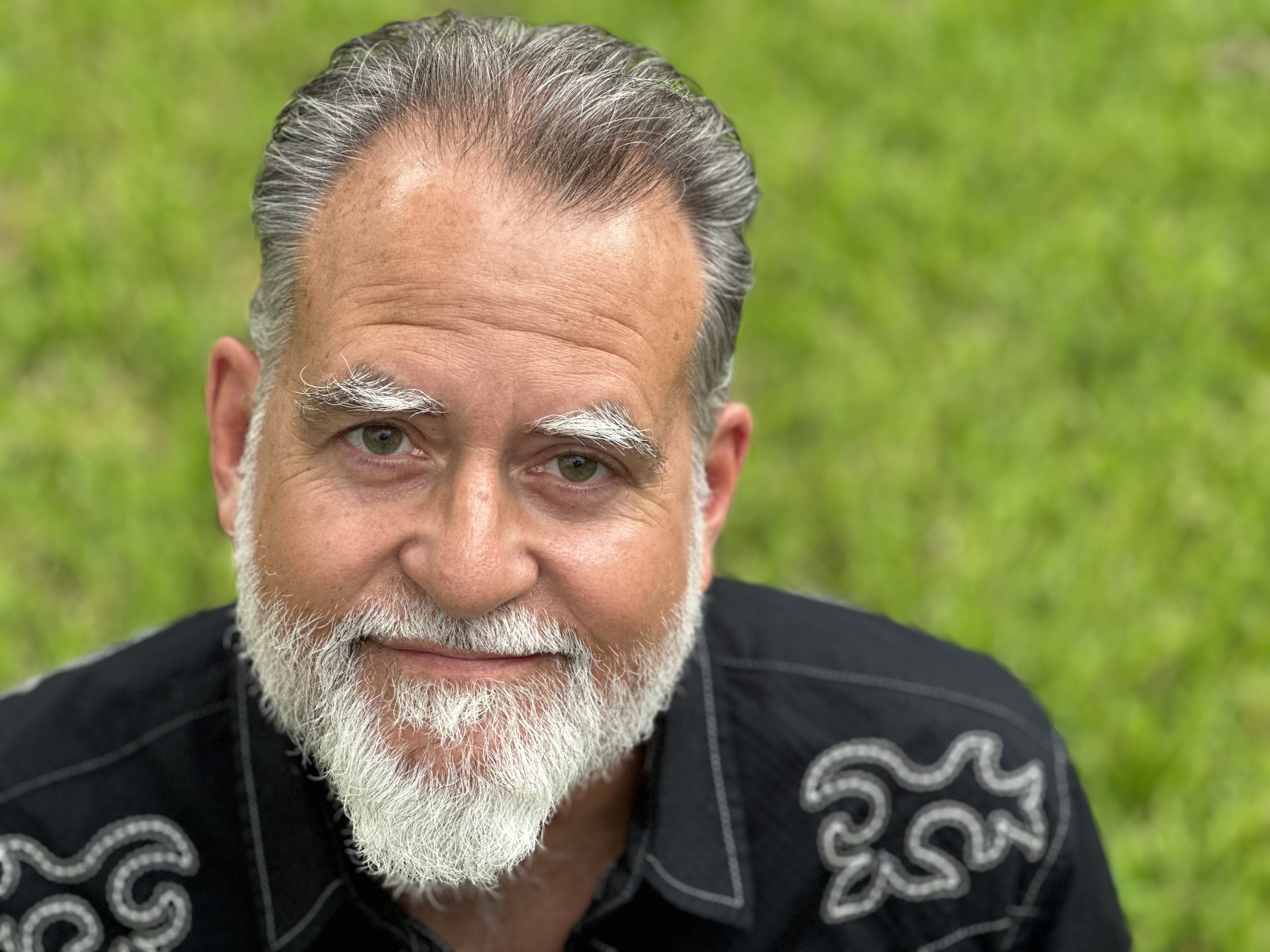
Because of my beard (and a wee bit of drama experience) I've played the role of Jesus a lot. In the past I've played Jesus in passion plays. But my more recent roles playing Jesus have been at the Bible Times Marketplace at the Highland Church of Christ in Abilene. The picture here is of me playing Jesus this year. And if you would like to see more you can follow this link to the main video from this year's Marketplace. The Marketplace is when we turn the church into a 1st Century town. The children dress in "bible times" costumes and go around to various booths, like carpentry, scribe, pottery, and metal working shops. They shop for food with shekels and live in little Jewish families for the day learning the customs of the time. After the main video you can click on the Walkthrough Video to get a tour of the Marketplace.
I have a few rules when I play Jesus:
Rule #1: Don't wear a white robe with a blue or red sash.
I always go for earth tones, greens and browns. Basically, avoid a holy look. Look more like a peasant.
Rule #2: Don't act like you're high.
Too many people play Jesus as if he is smoking something. He's spacy, overly mellow, and not really connected with the immediate going's on. I think people do this to convey that fact that Jesus is somehow "not of this world" and in constant communion with the "spiritual realm." I go the opposite direction. I play a Jesus rooted in the moment. I play Jesus as very aware, sharp, and energetic.
Rule #3: Don't be overly sweet, sentitmental, gentle, or maudlin.
You don't want your Jesus to be sticky sweet. Avoid the cotton candy Jesus.
Rule #4: Talk normally.
To convey emotion, too many people try to do it with their voice, mostly by making it too airy or whispery. Or, they may try to make their voice bigger. Either way you don't sound normal or natural.
Rule #5: Act like yourself.
Rule #5 is my big secret. The key to playing Jesus isn't to be different. The key is this: Be yourself.
The point is this. You are never closer to being Christ-like than when you are at your best. Think of yourself when you are feeling compassionate or generous or merciful and ACT LIKE THAT. Being the Imago Christi isn't hard. It's just being you.
I once told a adult Sunday School class the following: When you are at your best, not even Jesus could do it better. They looked startled. Why? Because we tend to think Jesus is bringing to the human encounter some special Jesus-Ingredient that we, mere mortals, don't have. But most of the things we are called to do are mundane and straightforward. Do them, do them well, and not even Jesus could perform them better. You don't need to be the Incarnate God to give a thirsty person a cup of cold water. Just give them a cup of cold water. It's not magical. If someone needs a kind word, then speak a kind word. It's not rocket science. If someone needs forgiveness then say "I forgive you." It's not superhuman.
Being Jesus, in my estimation, is easy. So I don't think we do people favors by making being the Imago Christi something only super-spiritual saints are capable of. Sometimes being Jesus is just listening over coffee. The point is, for large parts of the day you ARE being like Jesus. We need to recognize and own those moments so that we can leverage them into the more difficult areas of spiritual formation.
True, there are aspects of being Jesus that are very, very hard. Loving enemies comes to mind. So I am simplifying here. But my point is simply this. If you want to be like Jesus don't try to be different.
Be yourself.
The Experimental Theology Salon: Theology on the Subtle Edge
Note to Readers:
Frequently on this blog the comments to my posts are better than the posts themselves. I have learned an amazing amount by interacting with all of you.
Because of this there have been times when I've wanted some of the comments to come "out front" as it were. Recently, in response to my series on William James, Tracy asked me a few questions about my interpretation of James. As became quickly clear to me, Tracy was the better person to make these observations. So I asked Tracy to send me something to post for your consideration. Below you'll find his very interesting essay.
BTW, if others of you ever wish for have me or readers here interact with an essay of yours or poem or quote or book review, please feel free to send them to me. We can turn this place into a salon.
Richard
Theology on the Subtle Edge
Guest contribution by Tracy
Open a book by William James and you find a smorgasbord of enticing ideas and delectable quotes. Richard has served up some of James’ finest. But hinted at in various places is a dish of great delicacy that James never served, though its recipe can—I believe—be deciphered from a close look at two hints gleaned from the single passage below.
Commenting on the great range of religious and theological conceptions of the divine, James noted:
Some are gross and idolatrous; some are the most sustained efforts man’s intellect has ever made to keep still living on the subtle edge of things where speech and thought expire. (“Reflex Action and Theism” in The Will to Believe)
The first hint that we can take from this quote is that James seemed to think that it is the mark of excellence in theology to be located on that “subtle edge…where speech and thought expire.” The second is that this quote is found in an essay entitled “Reflex Action and Theism.” To begin, what did James mean by his “subtle-edge” comment?
It turns out that the comment is seasoned with a generous portion of Kantian metaphysical skepticism, a wonderfully subtle form of doubt. Kant’s Critique of Pure Reason (1781) influenced the entire century of work to follow in Western philosophy and theology, and his goal in the famous tome (stated in the Preface to his 1787 edition) was “…to remove knowledge, in order to make room for belief.” The statement is odd, in that knowledge would seem to be better than mere belief.
So, what’s up? It is in his section on “the antinomies” that Kant’s knowledge-removal operation takes place (a knowledgectomy?—sometimes it seems I’ve have had one!). There he incises—or so he thinks—the last presumptions of Medieval metaphysics from philosophy and theology. He does so by taking the famous arguments for the existence of God (and other metaphysical positions) and demonstrating that “reason” supports both sides of the big metaphysical debates equally. In fact, it is at the limit of “reason” where one sees that both positions (i.e., God/No God) are on the same, albeit equivocal, footing. Philosophers still debate the question of whether Kant accomplished his goal. But that does not matter to us. For us it is enough to see that Kant’s famous Critique informs James’ esteem for “the subtle edge” where thought expires.
But if reason no longer supplies a secure basis for knowledge about God, does that make belief and unbelief in God as arbitrary as it is equivocal, at least in Kant’s view? It’s a critical question, and the succeeding work to the Critique of Pure Reason was the Critique of Practical Reason, where Kant tackled that question. True to the title, he argues that belief in God is justifiable on practical grounds. Immediately a second connection to James’ thought jumps out. The Kantian turn from metaphysical speculation toward practical considerations informs the historical backdrop to James’ pragmatism—including, of course, his pragmatic assessment of religion and faith.
With this smidgen of historical context in place, we are ready to turn to the second hint, the unusual title, “Reflex Action and Theism,” of the essay where James admires theology done on the subtle edge. A quick and easy critique of Kant will help us see that there is also a post-Kantian aspect to the recipe we seek.
The quick and easy way to find fault with Kant is to simply note that his ideas about the human mind were quickly superseded. He thought that he had outlined the architecture of the human mind, in his first critique, thereby showing what it can hold and what it cannot (metaphysical knowledge). Unfortunately he took classical logic and geometry to be defining elements of the mind’s architecture. So when new ways of doing logic and geometry arose early in the century to follow, his monumental work took on the air of a Stonehenge or Great Pyramid. It is amazing, but it belongs to an earlier age.
Now I am an amateur scholar, meaning you should take my comments on advisement, but this is where I believe James’ equally monumental work—The Principles of Psychology—strikes a masterful historical counterpoint to Kant. For it equals Kant’s great Critique in its attempt to produce an exhaustive account of the human mind’s structure and functions. Only James’ account is not static, as if the human mind had architecture in the same way a house does. James’ account is plastic and assumes that the mind changes and adapts as each individual human being learns and develops habits of character and mind. If Kant drew the lineaments of the mind’s architecture and thought his job was done, James understood that the architecture is alive and grows and diversifies. Here is a snippet from the chapter on attention in the Principles to give you the flavor of James’ account: “…we can see why it is that sustained attention is the easier, the richer in acquisitions and the fresher and more original the mind. In such minds, subjects bud and sprout and grow.”
I here submit for your sustained attention that a religion that claims the critical need to believe in and attend to and be discipled in accord with the revelation of the Word of God needs a conception of the human mind and person that stresses how a subject under our sustained attention can “bud and sprout and grow” in us. In short, I submit that we need a faith that connects “Reflex Action and Theism.” I also submit that a religion that makes faith the crucial human response to the Word of God needs a theology that understands the crucial role that faith plays in human life, as James did. Last, I submit that if we value faith over knowledge in theology, as Christians must, we need a faith that stresses the fruits of belief, as James did. In short, we need the faith hinted at in James’ appreciation of theology that is “made to keep still living on the subtle edge of things where speech and thought expire.” I want a piece of that pie!