 Advent Conspiracy:
[Worship Fully]
[Spend Less]
[Give More]
[Love All]
Advent Conspiracy
1

Advent Conspiracy:
[Worship Fully]
[Spend Less]
[Give More]
[Love All]

Many believe the ban is a product of Islamaphobia. From the BBC article:
The president of Zurich's Association of Muslim Organisations, Tamir Hadjipolu, told the BBC: "This will cause major problems because during this campaign mosques were attacked, which we never experienced in 40 years in Switzerland.Nate Silver does an analysis of the Swiss vote finding a strong relationship between Christianity and voting for the ban:
"Islamaphobia has increased intensively."
And there was dismay among Switzerland's Muslims upon hearing the result.
Farhad Afshar, president of the Coordination of Islamic Organisations in Switzerland, said: "The most painful thing for us is not the ban on minarets but the symbol sent by this vote.
"Muslims do not feel accepted as a religious community."
Elham Manea, co-founder of the Forum for a Progressive Islam, added: "My fear is that the younger generation will feel unwelcome.
"It's a message that you are not welcome here as true citizens of this society."
There may be variables other than religious and linguistic status at work here -- I can't exactly claim to be expert on the demographics of Switzerland. But it appears at first glance that this indeed reflects some degree of fear, dislike, or anxiety about Muslims -- and by Christians.Silver goes on to wonder if similar bans aren't in America's future. America has a strong history of religious tolerance, but some of the teabag paranoia about our country being taken over by Muslims makes me wonder. The whole "Christian nation" deal on the right, the longing for a theocracy, makes me think, if the Muslim population grows in the US, that such bans will start to show up on American ballots.
 In the last post in this series we noted the close association between the demonic and the political. This may seem to have been an odd association. Demons, in our Hollywood imaginations, seem to have nothing to do with nations or political forms of power. Given that assumption in this post I want to continue to explore the association between the demonic and the political by discussing the angels of the nations in the biblical witness.
This story starts with a consideration of the varieties of Hebrew cosmology. We generally think the Old Testament writers were monotheists. It is true that there are Old Testament passages that seem to support a strict monotheistic cosmology, where one God and only this one God exists in the heavenly realm. But there are many more Old Testament passages that suggest that the Hebrews held a polytheistic cosmology. In this cosmology Yahweh was the patron god of Israel while other nations had their own patron deities. Consequently, wars between nations were also viewed as cosmic conflicts, as a fight between the two nation gods. And the war on "earth" was determined by the outcome of this war in "heaven," won by the nation with the stronger god. Take, as an example, the Exodus. Pharaoh wasn't just a king. Pharaoh, according to Egyptian cosmology, was a god. Thus, the conflict in the book of Exodus isn't between Moses and Pharaoh. The conflict is between Yahweh and Pharaoh, between two nation gods. This is why we have the ten plagues. The plagues show Yahweh to be the greater god.
Let's pause here to note the conflation of "nation gods" and the political, how the "spiritual warfare" in "the heavenly realm" is the mirror image of a political warfare on earth. The Exodus was both a political conflict--the emancipation of slaves--and a spiritual conflict (the war between two nation gods). This is the same conflation we noted in the biblical language of "the principalities and powers." The cosmic conflict is manifested in a political conflict.
Returning to Hebrew cosmology what we mostly find in the Old Testament is a blend of monotheism and polytheism. Yahweh isn't one among many gods. Yahweh is the High God, the Supreme One among the nation gods. This cosmology, a High God ruling over lesser deities, is sometimes called henotheism or monarchical polytheism. A good example of Hebrew henotheism comes from the image of the divine counsel in Psalm 82:
God presides in the great assembly;In Psalm 82 we find Yahweh presiding over a counsel of nation gods. Yahweh goes on to judge and rebuke the nation gods because they are ruling unjustly. These nation gods don't defend the weak, poor and needy. Rather, they favor the wicked and powerful. The psalm ends with the psalmist encouraging God to "judge the earth" and the "nations." Once again we see the conflation of the spiritual and the political. In Psalm 82 we see the political machinery of a nation as governed by spiritual/cosmic forces. Consequently, standing up for the rights of the poor demands that Yahweh "rise up" against the nation gods. The spiritual combat is a political combat and vice versa.
he gives judgment among the "gods":
"How long will you defend the unjust
and show partiality to the wicked?
Defend the cause of the weak and fatherless;
maintain the rights of the poor and oppressed.
Rescue the weak and needy;
deliver them from the hand of the wicked.
"They know nothing, they understand nothing.
They walk about in darkness;
all the foundations of the earth are shaken.
"I said, 'You are "gods";
you are all sons of the Most High.'
But you will die like mere men;
you will fall like every other ruler."
Rise up, O God, judge the earth,
for all the nations are your inheritance.
When the Most High gave the nations their inheritance,God, then, appoints a "prince"--an angel or god--over each nation. Eventually, this idea was used to explain the existence of human suffering. The nations--the angelic princes--rebel against God, bringing chaos and suffering to earth. This is the gist of Psalm 82.
when he divided all mankind,
he set up boundaries for the peoples
according to the number of the sons of God.
For the LORD's portion is his people,
Jacob his allotted inheritance.
At that time I, Daniel, mourned for three weeks. I ate no choice food; no meat or wine touched my lips; and I used no lotions at all until the three weeks were over.What we see in Daniel 10 is how the early Hebrew henotheism began to develop into the angelology and demonology familiar to the New Testament (and, incidentally, Frank Peretti novels). We see in Daniel 10 prayer affecting the movements of and conflict between angelic beings. Daniel's messenger is delayed from responding to Daniel by the "prince of the Persian kingdom." Only when Michael, the "chief prince", comes to his aid is the messenger able to escape the "king of Persia." All this sounds very much like the "spiritual warfare" language found in many churches, how many Christians envision Ephesians 6.12: "For our struggle is not against flesh and blood, but against the rulers, against the authorities, against the powers of this dark world and against the spiritual forces of evil in the heavenly realms."
On the twenty-fourth day of the first month, as I was standing on the bank of the great river, the Tigris, I looked up and there before me was a man dressed in linen, with a belt of the finest gold around his waist. His body was like chrysolite, his face like lightning, his eyes like flaming torches, his arms and legs like the gleam of burnished bronze, and his voice like the sound of a multitude.
I, Daniel, was the only one who saw the vision; the men with me did not see it, but such terror overwhelmed them that they fled and hid themselves. So I was left alone, gazing at this great vision; I had no strength left, my face turned deathly pale and I was helpless. Then I heard him speaking, and as I listened to him, I fell into a deep sleep, my face to the ground.
A hand touched me and set me trembling on my hands and knees. He said, "Daniel, you who are highly esteemed, consider carefully the words I am about to speak to you, and stand up, for I have now been sent to you." And when he said this to me, I stood up trembling.
Then he continued, "Do not be afraid, Daniel. Since the first day that you set your mind to gain understanding and to humble yourself before your God, your words were heard, and I have come in response to them. But the prince of the Persian kingdom resisted me twenty-one days. Then Michael, one of the chief princes, came to help me, because I was detained there with the king of Persia. Now I have come to explain to you what will happen to your people in the future, for the vision concerns a time yet to come."
Again, the devil took him to a very high mountain and showed him all the kingdoms of the world and their splendor. "All this I will give you," he said, "if you will bow down and worship me."This temptation only makes sense if we understand the "nations" to be under the rule of Satan, in rebellion against God. The rebellious princes of the nations--demons--are servants of Satan. And, once again, we see the conflation of the demonic with the political. Political power is the reward for Satan worship. Satan worship isn't about wearing black, drinking blood or drawing pentagrams, the stuff of Hollywood imagination. Satan worship, biblically understood, is joining the "the nations" (America included!) in their oppression of the poor and weak.
 The Advent Season begins today.
In my blog header you'll see that I'm using Luc Olivier Merson's Rest on the Flight into Egypt (1879) as my Advent banner.
This is one of my favorite Advent paintings.
I love Rest on the Flight into Egypt for a couple of reasons. First, the scene is haunting and full of fatigue. Joseph is asleep on the desert floor. One imagines his mental and physical exhaustion fleeing danger and trying to take his wife and baby across deserts to a foreign land.
And what awaits them at journey's end? Will they find friends in Egypt? Work? And when will it be safe to go back home? Sitting on the Sphinx, in a striking juxtaposition and lending an exotic touch to the scene, is Mary and the baby.
The baby. The only source of light in the painting.
What I like about Rest on the Flight into Egypt is how it depicts, from the very beginning of his life, the homelessness of the Messiah. God is a refugee, an immigrant, a stranger in a strange land, a person of exile.
Rest on the Flight into Egypt is a model for the life of the church. We are people of exile. Strangers among the nations. All we carry across the wastelands of this earth is the Christ Child. We have nothing else to offer.
This note is echoed in John Howard Yoder's book The Jewish-Christian Schism Revisited where he suggests that the church should model its existence after the Jewish diaspora. The church is to embrace a "cosmopolitan homelessness" and accept "dispersion" among the nations as a part of its "mission." The church is to embrace "galut as calling." Galut is a Hebrew word for the situation of living in a state of exile or homelessness. I think Rest on the Flight into Egypt vividly captures the experience of galut.
Yoder uses the phrase "galut as calling" to describe the landless missionary existence of Christians. The biblical models for this existence in the Old Testament are Joseph, Daniel and Esther. Joseph, Daniel and Esther each lived as exiles, as resident aliens. Each labored alongside the people of a nation to which they did not belong, each working elbow to elbow "seeking the welfare of the city" (Jer. 29.7).
We can add Mary and Joseph to this list while they lived and worked in Egypt with the baby Jesus.
That is my wish for the church this Advent season, that "non-Christians" find us, in every place, working side-by-side with them, as partners, seeking the welfare of the city. The church isn't a fortress or a gated community or a community of snobbish like-mindedness and self-righteousness. The church is a mission as we live in exile among the nations. Purposely scattered, in jobs and neighborhoods across the world, to work alongside our neighbors to bring peace on earth and good will to all.
Wishing you a blessed start to the Advent season.

At this the spirit raised a frightful cry, and shook its chain with such a dismal and appalling noise, that Scrooge held on tight to his chair, to save himself from falling in a swoon. But how much greater was his horror, when the phantom taking off the bandage round its head, as if it were too warm to wear in-doors, its lower jaw dropped down upon its breast.
Scrooge fell upon his knees, and clasped his hands before his face.
'Mercy!' he said. 'Dreadful apparition, why do you trouble me?' 'Man of the worldly mind!' replied the Ghost, 'do you believe in me or not?'
'I do,' said Scrooge. 'I must. But why do spirits walk the earth, and why do they come to me?'
'It is required of every man,' the Ghost returned, 'that the spirit within him should walk abroad among his fellow-men, and travel far and wide; and if that spirit goes not forth in life, it is condemned to do so after death. It is doomed to wander through the world-oh, woe is me!-and witness what it cannot share, but might have shared on earth, and turned to happiness.'
Again the spectre raised a cry, and shook its chain and wrung its shadowy hands.
'You are fettered,' said Scrooge, trembling. 'Tell me why?'
'I wear the chain I forged in life,' replied the Ghost. 'I made it link by link, and yard by yard; I girded it on of my own free will, and of my own free will I wore it. Is its pattern strange to you?'
Scrooge trembled more and more.
'Or would you know,' pursued the Ghost, 'the weight and length of the strong coil you bear yourself? It was full as heavy and as long as this, seven Christmas Eves ago. You have laboured on it, since. It is a ponderous chain!'
Scrooge glanced about him on the floor, in the expectation of finding himself surrounded by some fifty or sixty fathoms of iron cable: but he could see nothing.
'Jacob,' he said, imploringly. 'Old Jacob Marley, tell me more. Speak comfort to me, Jacob.'
'I have none to give,' the Ghost replied. 'It comes from other regions, Ebenezer Scrooge, and is conveyed by other ministers, to other kinds of men. Nor can I tell you what I would. A very little more is all permitted to me. I cannot rest, I cannot stay, I cannot linger anywhere. My spirit never walked beyond out counting-house-mark me!- in life my spirit never roved beyond the narrow limits of our money-changing hole; and weary journeys lie before me.'
It was a habit with Scrooge, whenever he became thoughtful, to put his hands in his breeches pockets. Pondering on what the Ghost had said, he did so now, but without lifting up his eyes, or getting off his knees.
'You must have been very slow about it, Jacob,' Scrooge observed, in a business-like manner, though with humility and deference.
'Slow!' the Ghost repeated.
'Seven years dead,' mused Scrooge. 'And travelling all the time?'
'The whole time,' said the Ghost. 'No rest, no peace. Incessant torture of remorse.'
'You travel fast?' said Scrooge.
'On the wings of the wind,' replied the Ghost.
'You might have got over a great quantity of ground in seven years,' said Scrooge.
The Ghost, on hearing this, set up another cry, and clanked its chain so hideously in the dead silence of the night, that the Ward would have been justified in indicting it for a nuisance.
'Oh! captive, bound, and double-ironed,' cried the phantom, 'not to know, that ages of incessant labour by immortal creatures, for this earth must pass into eternity before the good of which it is susceptible is all developed! Not to know that any Christian spirit working kindly in its little sphere, whatever it may be, will find its mortal life too short for its vast means of usefulness! Not to know that no space of regret can make amends for one life's opportunity misused! Yet such was I! Oh! such was I!'
'But you were always a good man of business, Jacob,' faltered Scrooge, who now began to apply this to himself.
'Business!' cried the Ghost, wringing its hands again. 'Mankind was my business. The common welfare was my business; charity, mercy, forbearance, and benevolence, were, all, my business. The dealings of my trade were but a drop of water in the comprehensive ocean of my business!'
One of those weird American traditions. The Annual Presidential Pardoning of the Turkey:
Visit msnbc.com for Breaking News, World News, and News about the Economy
 More history on the Presidential Pardon here.
 Let's return to the question raised in the first post of this series: What are we to do with the passages about demons in the bible?
I, personally, find Walter Wink's work in his book Naming the Powers a good place to start in answering this question. Specifically, in Naming the Powers Wink presents us with an exhaustive word study examining how the biblical authors describe "the powers." I'll be summarizing Wink's analysis.
The phrase archai kai exousiai--translated "principalities and powers"--occurs ten times in the New Testament. In the gospel of Luke, the only occurrences of the phrase in the gospels, the pairing "principalities and powers" occurs twice. In both occurrences the phrase refers to human political institutions:
Luke 12:11The other eight occurrences of archai kai exousiai occur in the epistles:
"When you are brought before synagogues, rulers and authorities, do not worry about how you will defend yourselves or what you will say...
Luke 20:20
Keeping a close watch on him, they sent spies, who pretended to be honest. They hoped to catch Jesus in something he said so that they might hand him over to the power and authority of the governor.
1 Corinthians 15.24One notices a couple of things about these passages. First, there are times when the language of the powers is referring to "spiritual" agents (e.g., Eph. 6.12). And on other occasions the power is clearly human, generally a political power (e.g., Titus 3.1). But most of the passages tend to blend the two. For example, Colossians 1.16 clearly refers to both visible and invisible powers, powers in heaven and on earth.
Then the end will come, when he hands over the kingdom to God the Father after he has destroyed all dominion, authority and power.
Colossians 1.16
For by him all things were created: things in heaven and on earth, visible and invisible, whether thrones or powers or rulers or authorities; all things were created by him and for him.
Colossians 2.10
...and you have been given fullness in Christ, who is the head over every power and authority.
Colossians 2.15
And having disarmed the powers and authorities, he made a public spectacle of them, triumphing over them by the cross.
Ephesians 1.21
...far above all rule and authority, power and dominion, and every title that can be given, not only in the present age but also in the one to come.
Ephesians 3.10
His intent was that now, through the church, the manifold wisdom of God should be made known to the rulers and authorities in the heavenly realms...
Ephesians 6.12
For our struggle is not against flesh and blood, but against the rulers, against the authorities, against the powers of this dark world and against the spiritual forces of evil in the heavenly realms.
Titus 3.1
Remind the people to be subject to rulers and authorities, to be obedient, to be ready to do whatever is good...
 Fascinating and sad article over at Slate. Check out Ray Fisman's article Illegal Contact: Does watching football lead to domestic violence?
Fisman reviews recent research that suggests that when the home team has a painful defeat we see an uptick in domestic violence, with angry male fans taking out their NFL frustration upon their wives. From Fisman's article:
Card and Dahl found that on Sundays during the regular season, losses by favored teams—that is, painful losses—are associated with an 8 percent increase in intimate partner violence. (For, say, the Commonwealth of Massachusetts, with a population of nearly 6.5 million, this translates into an extra seven incidents on a Sunday when the Patriots unexpectedly lose.) These extra cases appear in the hours immediately following the game—3 to 6 p.m. for games with a 1 p.m. start time, and 6 to 9 p.m. for those with a 4 p.m. start—further bolstering the case that postgame rage may take the blame. The spikes in violence are nearly twice as big in emotionally charged matchups between traditional rivals, like the annual Bears-Packers matchup, and also in games with lots of turnovers and penalties.Awhile back, in a series about Freud, I wrote a bit about football as a cultural outlet for human aggression. That is clearly true, but what happens if that aggressive drive is frustrated? As when the home team loses? Freudians would expect that aggression to get displaced onto another target, perhaps the wife. This research appears to back up that analysis. Further, a Freudian would predict that the new object of aggression would be weak and "safe" target. Interestingly, this prediction is also supported by other research Fisman discusses:
In a study forthcoming in the American Economic Review, Aizer shows that potential female earnings are a critical determinant of spousal violence. Such violence declines as wages in female-dominated sectors—such as hospitality services—increase relative to male-dominated ones (e.g., construction). Aizer argues that high-earning women feel more empowered to walk out on potential abusers, since they're less dependent on a man's paycheck to get by. (Men will also be less inclined to chase away an extra breadwinner.)
The Daily Dish wonders if this rap act is serious or not. I think it's supposed to be funny but they mean what they are saying. You decide:
I actually have playfully mused a bit on the non-verbals of Christian welcome. For more on the Christian side hug see this entry from Stuff Christians Like which comes with an handy illustration for non-Christians or new Christians who don't know how side hug:
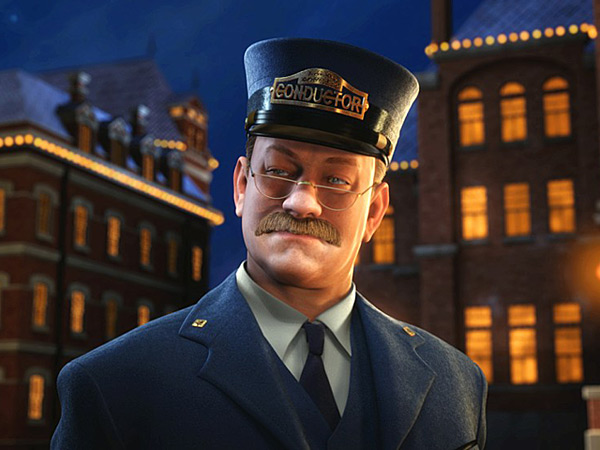 Christmas is coming. Bookstores are putting out the Christmas books and Walmart is bringing the Christmas films out front by the checkout isles.
Looking over theses books and movies you'll probably see the book and movie The Polar Express. The book is a family favorite. The movie is, for me at least, kind of creepy.
I'm not alone in thinking that there is something visually askew in the movie The Polar Express. The characters are well-drawn but they seem to stand in between cartoon and human. They look almost-human and, thus, kind of freaky.
Many have speculated that some of the visual weirdness in computer animated films aiming for realism (rather than stylized characters) is due to a phenomenon known as the uncanny valley. The uncanny valley was proposed in the 70s by the Japanese roboticist Masahiro Mori. It is the idea that if you plot approximation/realism of the human form against emotional comfort you get a U-shaped curve. Imagine a Raggedy Ann doll. It's a human form but not very realistic. Consequently, we feel comfortable with the doll. But imagine that I start making the doll more life-like and realistic. Eventually, the doll becomes quasi-human or almost-human. Objects on this threshold seem freaky and strange. There is something not quite right with these objects. They aren't far enough away from realism to be obviously not human, but they are not fully human either. They are just a shade off. And this slight difference causes comfort with these objects to drop. This is the uncanny valley. We come out of the valley when we move fully into the human. But right before this threshold objects look uncanny. In short, according uncanny valley theory we have to beware in robot design and computer animated movies to not get too close to approximating the human. If we get too close and can't get to the other side we fall into the uncanny valley and produce a creepy product. Many think this is what plagued the movie The Polar Express. Visually, due to the uncanny valley, a film like that loses its softness and innocence and conveys menace where none is intended.
Here's the hypothetical curve from the Wikipedia article depicting the uncanny valley. Notice that as one moves from the left to the right in increasing human likeness there is a big drop--the uncanny valley--in the horizontal "familiarity" dimension:
I was reminded of all this reading a wonderful article entitled Into the Uncanny Valley by Joe Kloc (H/T Andrew Sullivan). In the article Kloc reviews the history of the uncanny valley and its influence upon robot design, particularly in Japan. Kloc also reviews Freud's seminal (if perplexing) treatment of the uncanny where he linked the uncanny with our fear of death. This might be why we see zombies and corpses in the valley in the graph above. From Kloc's article:
According to Freud, the phenomenon that would later be called the uncanny valley stems from a primitive attempt of humans to skirt death and secure our own immortality by creating copies of ourselves—such as wax figures and, later, life-like robots. He quotes his colleague Otto Rank in saying that this “doubling” behavior is “an energetic denial of the power of death” and suggests the idea of the immortal soul was the first double of the body. Our uncanny response follows from the fact that most of us no longer believe we can secure our own immortality by making copies of ourselves, but we haven’t yet shaken the primitive habit of trying to do so. The sad consequence of this is that, in Freud’s words, “The double reverses its aspect. From having been an assurance of immortality, it becomes the uncanny harbinger of death.” The copies we feel compelled to make only serve to remind us why we began making them in the first place: We are, inevitably, going to die.Interestingly, when Mori proposed the uncanny valley he made a move similar to Freud's by linking the uncanny valley to death. As Kloc writes:
While the purpose of Mori’s paper was to inform robot design, in a concluding paragraph he cannot resist offering his own theory about the origins of the uncanny valley. He writes: “When we die, we fall into the trough of the uncanny valley. Our body becomes cold, our color changes, and movement ceases.” Human models fall into the uncanny valley because they remind us of death. “It may be important to our self-preservation,” he concludes.However, Kloc goes on to discuss recent research with animals which suggests that the uncanny valley response may have less to do with death than with perception. That is, our species-recognition system, found in most animals and important for mating and predator avoidance, might be off-put by almost-human looking objects. In short, death might have nothing to do with it. We might just be uncomfortable with stimuli that send us mixed messages: I'm human! Not I'm not! Here's another article about the animal research concerning the uncanny valley: It's entitled "The Polar Express" Would Creep Out Monkeys Too?)
 Let me add a few clarifications to my last post.
The point I was making wasn't that modern people can't use the term "evil." Nor am I denying that once the term "evil" is admitted into human discourse that it might end up doing more harm than good. It might be safer, sociologically speaking, to keep the category evil on the shelf. This was, incidentally, the major theme of my series on monsters. It was the recognition that, while the monster category names something real in our experience (malevolent and violent Otherness), it is very often misused and applied to innocent people. This is vividly on display in the gospels. Jesus is accused of being demon-possessed and in league with the devil. Jesus is crucified and, thus, "cursed." And yet, Jesus is declared innocent by the Roman solider at the foot of the cross. This is the key to Rene Girard's reading of the gospel: Jesus, the innocent one, exposes how humans use religion (the Sanhedrin) and politics (Pilate and Herod) to justify violence.
All this is granted.
The point of the last post is that science has created means--biology (medicine, genetics) and the social sciences (psychology, sociology, anthropology)--to explain human behavior. And when science has done its work with cases like Hitler we still feel that there is a residual, that some aspect of Hitler cannot be reduced to a scientific account. What we call evil is the experience of that residual. And, thus, by definition, evil can't be a scientific term. Evil is the malevolent residual that cannot be "explained" by the disciplines of psychology or psychiatry.
Again, to be clear, I'm not granting ontological status to this residual, saying that the residual is real. Of course, it could be. But science would deny that claim. That is all well and good. But what I am speaking about is phenomenological, the experience of a residual. Leaving metaphysics aside, it is a fact that the experience of this residual is real and pervasive, among the religious and non-religious. And, like it or not, the vocabulary of science, by definition, can't speak to or describe this experience. That's no fault of science. I'm just saying that science isn't poetry. Science is wonderful at describing the physical structure of the world but it does a crappy job at describing human experience.
By definition, religion is the vocabulary of the residual. Religion provides us language that is metaphysical or supernatural. Language of the residual. This is why I made the point in the last post that evil is a religious term, religion and evil speak to the experience of the residual, what lies outside the categories of science.
And yes, as I said above, I am aware of the dangers of reifying the category of evil. But I think everyone can agree that, as a phenomenological term, evil is speaking to the experience of a malevolent residual.
And here's my second point: This assessment is widely granted. It is simply one of the widely recognized symptoms of modernity. In a disenchanted age we lack the language to name our experience of the residual. We all have residual experiences but the only language that names these experience is "superstitious," the vocabulary of enchantment.
Let me give an example of what I'm talking about. Consider the movie Silence of the Lambs. It is a movie about evil and the experience of the residual. Hannibal Lecter, M.D. is the incarnation of evil. He is also one of the world's leading psychiatrists. Consequently, we are told in the movie, Dr. Lector can't be assessed or diagnosed with psychological and diagnostic tests. Lector can beat these tests. It's language of conquest. More, Lector can defeat, on their own terms and at their own game, the world's best forensic psychologists. In short, in Lector we see the defeat of science. Evil tosses around the tools of science as if they were child's toys, mere playthings. There is something in Lector that cannot be captured by psychology or science. Lector is a silver screen depiction of the residual. And we recognize and name that residual evil.
And this is only one example. In movies, novels and TV shows we see this same theme emerge time and time again. The truly evil character defeats the scientific experts. These experts often, then, turn to religious figures. They might wander into a church looking for answers or consult a priest. The character might start to pray. The experience of evil--the residual--draws the characters, as a last resort, to the religious vocabulary. Why? Because the person they are chasing is beyond criminal, beyond human categories. And, just as often, we see the truly evil antagonist defeat these religious shock troops. Hollywood knows it needs the language of the residual, the vocabulary of religion, to make movies which speak to human experience. Screenwriters are artists, not scientists. So they get what I'm talking about. But that doesn't mean that Hollywood is going to embrace organized religion! So priests in the movies are often killed by the evil figure (usually because the priest is a hypocrite). Regardless, the defeat of evil is going to rely on some sort of self-sacrificing goodness. The main plot of the movie is figuring out where that goodness is going to come from.
In sum, I don't think what I'm saying about evil, science and religion is all that new or controversial. It's simply an observation of what we see all around us.
Just go to the movies.
On to Part 4
 I've seen two references to the amazing poem The Last Day by the Australian poet Kevin Hart. One at Ben Meyer's blog and also over at Brad East's blog (two theologian-bloggers who love poetry).
Hart's poem is a beautiful eschatological meditation.
The Last Day
When the last day comes
A ploughman in Europe will look over his shoulder
And see the hard furrows of earth
Finally behind him, he will watch his shadow
Run back into his spine.
It will be morning
For the first time, and the long night
Will be seen for what it is,
A black flag trembling in the sunlight.
On the last day
Our stories will be rewritten
Each from the end,
And each will hear the fields and rivers clap
And under the trees
Old bones
Will cover themselves with flesh;
Spears, bullets, will pluck themselves
From wounds already healed,
Women will clasp their sons as men
And men will look
Into their palms and find them empty;
There will be time
For us to say the right things at last,
To look into our enemy’s face
And see ourselves,
Forgiven now, before the books flower in flames,
The mirrors return our faces,
And everything is stripped from us,
Even our names.
--From The Flame Tree
My favorite part?
There will be time
For us to say the right things at last...

Psychology and psychiatry tend to frame mental and behavioral issues using what is called "the medical model." That is, we frame mental and behavioral issues in the language of medicine. Susan is diagnosed with depression (i.e., Major Depressive Disorder), which is a form of mental illness. If her symptoms get bad enough she will need to see a therapist, and even admitted to a psychiatric hospital where the mentally ill are treated by doctors often with medication.
Medical model language is so ubiquitous we often don't even notice it. But let's be clear, it is a model. And as a model it often obscures as much as it illuminates. For some disorders, such as schizophrenia, the medical model fits very well. But what about a child with ADHD? Is that child mentally ill? If not, why are they going to a medical doctor for a prescription? And what about gambling? Many people say gambling is an illness. Gambling is an addiction. But is that the best model for understanding gambling? Addiction is a physiological diagnosis (characterised by tolerance and withdrawal symptoms). So what is a psychological addiction? Does that concept even make sense? How is a "psychological addiction" any different from a temptation?
One of the concerns with the medical model is that what used to be framed in moral terms is now being framed in medical terms (e.g., addiction). This is worrisome for a couple of reasons. First, it undermines personal responsibility. I'm not bad, I'm just ill. I can't, because of this illness, be held accountable for my actions. Second, if I'm ill my treatment is in the form of a pill. But no pill creates virtue. In short, the medical frame causes us to look for "treatment" in all the wrong places.
And there is another side to all this. Given that the church has lost much of its moral authority to regulate behavior many have argued that the mental health industry has stepped in to take the place of the church. Psychiatry, then, like the church, becomes a form of social control, the stick that keeps us on the straight and narrow. Diagnosing people as "mentally ill" becomes a way of creating a warrant to effectively jail or "treat" social non-conformists. You see a version of this argument in the novel and movie One Flew Over the Cuckoo's Nest. Jack Nicholson's character isn't mentally ill. He's just a rebel and non-conformist. Psychiatry is portrayed in One Flew Over as a form of social control. The psychiatric establishment becomes a secular church, using Electroconvulsive Therapy as a modern form of exorcism. This argument is similar to the one made by Michel Foucault in Madness and Civilization and by Thomas Szasz in The Myth of Mental Illness.
The point in all this is that as we have moved from an enchanted to a disenchanted world the language of sin has been replaced with the language of medicine. We aren't bad, we are sick. We aren't evil, we are ill. This trend has had both good and not-so-good effects. On the good side we don't treat schizophrenics with exorcism anymore. On the bad side we've lost the language of evil and the demonic. The notion of evil is from an ancient enchanted world and it struggles to find a place in the world of psychology, sociology and biology. And yet, we still want to use the term. There are deeds and people who seem to warrant the label evil. For example, we want to apply the word evil to Hitler and to call the Holocaust demonic. But what, in a scientific era, do we mean by those terms?
Science seeks to explain things. To identify causes and reduce phenomena to underling mechanisms. To approach Hitler scientifically is to try to understand, sociologically and psychologically, why Hitler did what he did. We examine his family life, his genetic makeup, his culture. But in trying to explain evil, identifying its causes, we unwittingly tame it. To explain evil, to understand evil, is to lessen evil. True evil can't be explained by psychology or history. Evil is inherently inexplicable. That is the source of its horror.
It short, we don't want to hear about Hitler's family life. We don't want to be informed about the traumas in his life. Because even if we knew of such "explanations" (excuses?) for his behavior we would instinctively feel that Hitler's actions could not be reduced to these psychosocial causes. What Hitler did cannot be captured by the language of medicine, psychology, or sociology. What Hitler did was evil.
This is, in my opinion, one of the advantages of the religious worldview relative to a non-religious worldview. The religious worldview has language that can capture our intuitive feelings about Hitler, horrific murders, child sexual abuse, or genocide. The scientific worldview can only diagnosis Hitler. Most of us find that inadequate.
In short, even as a psychologist, committed to identifying the causes of behavior, I feel the need to keep this superstitious term, this term of darkness from an ancient enchanted era. A era of angels, devils and demons. A era of good versus evil.
On to Part 3
H/T to Mike Cope for this humorous meditation on contemporary Christian culture:
 A couple of posts ago, John pointed us to a recent article in The Atlantic--Did Christianity Cause the Crash?--by Hanna Rosin. The article explores the rise and continued influence of the prosperity gospel (the belief that God will financially bless the faithful) in American Christianity. From Oral Roberts to Joel Osteen, it is a much wider phenomenon than one realizes. From Rosin's article:
Among mainstream, nondenominational megachurches, where much of American religious life takes place, “prosperity is proliferating” rapidly, says Kate Bowler, a doctoral candidate at Duke University and an expert in the gospel. Few, if any, of these churches have prosperity in their title or mission statement, but Bowler has analyzed their sermons and teachings. Of the nation’s 12 largest churches, she says, three are prosperity—Osteen’s, which dwarfs all the other megachurches; Tommy Barnett’s, in Phoenix; and T. D. Jakes’s, in Dallas. In second-tier churches—those with about 5,000 members—the prosperity gospel dominates. Overall, Bowler classifies 50 of the largest 260 churches in the U.S. as prosperity.The issue that Rosin's article explores is the role of the prosperity gospel in bringing about the recent housing crisis in America. A bigger and better home is one of the common images in prosperity gospel sermons, a clear sign of God's Providence and blessing. More, the faithful should aspire to such houses. In short, did many congregants of prosperity gospel churches end up "stepping out in faith" right into a risky subprime mortgage? It's hard to tell if there is a direct link, but there is a circumstantial case linking the prosperity gospel and home foreclosures:
Demographically, the growth of the prosperity gospel tracks fairly closely to the pattern of foreclosure hot spots. Both spread in two particular kinds of communities—the exurban middle class and the urban poor. Many newer prosperity churches popped up around fringe suburban developments built in the 1990s and 2000s, says Walton. These are precisely the kinds of neighborhoods that have been decimated by foreclosures, according to Eric Halperin, of the Center for Responsible Lending.The scariest part of the article is how shady loan officers would come to prosperity churches to do "wealth building seminars" for the membership. With the sanction of the church these loan officers would use the seminars to sign up a bunch of subprime mortgages:
Zooming out a bit, Kate Bowler found that most new prosperity-gospel churches were built along the Sun Belt, particularly in California, Florida, and Arizona—all areas that were hard-hit by the mortgage crisis.
The idea of reaching out to churches took off quickly, Jacobson recalls. The branch managers figured pastors had a lot of influence with their parishioners and could give the loan officers credibility and new customers. Jacobson remembers a conference call where sales managers discussed the new strategy. The plan was to send officers to guest-speak at church-sponsored “wealth-building seminars” like the ones Bowler attended, and dazzle the participants with the possibility of a new house. They would tell pastors that for every person who took out a mortgage, $350 would be donated to the church, or to a charity of the parishioner’s choice. “They wouldn’t say, ‘Hey, Mr. Minister. We want to give your people a bunch of subprime loans,” Jacobson told me. “They would say, ‘Your congregants will be homeowners! They will be able to live the American dream!’”There are almost no words for this. What makes it all so sad is how the prosperity gospel manipulates the poor and middle-class. First by making them ashamed and then encouraging them to take financial risks. All in the name of Jesus.
 Last week I got to thinking about demons. First of all, I went and saw Paranormal Activity. Second, some friends in a bible class at church were talking about Jesus casting out the demon Legion and sending it into the pigs. Some of them asked me about my take on that story. Since some of these same friends read this blog from time to time I thought I'd devote a few posts to try to answer that question.
To start, I'm calling these posts "notes" as I'm not going to be making an argument of any sort. Just a collection of observations. Plus, I'm mainly going to be summarizing material from theologians--Walter Wink, William Stringfellow and John Howard Yoder--who I find helpful in thinking about this topic. People with theology degrees will have read all this stuff already. These notes are aimed at a general church audience, someone unfamiliar with the literature on The Powers.
So, to start, how are we to think about demons? How are we to approach passages about The Powers, most notably Ephesians 6:11-13:
Put on the full armor of God so that you can take your stand against the devil's schemes. For our struggle is not against flesh and blood, but against the rulers, against the authorities, against the powers of this dark world and against the spiritual forces of evil in the heavenly realms. Therefore put on the full armor of God, so that when the day of evil comes, you may be able to stand your ground, and after you have done everything, to stand.To start, let's describe two approaches at opposite ends of a spectrum. Let's call the first approach the Literalist position. The Literalist takes the passages in the bible about demons and spiritual powers literally. The Literalist, thus, has a robust notion of spiritual warfare and believes in the reality of demonic possession (although they might believe this to be a very rare and extreme event).
We moderns cannot bring ourselves by any feat of will or imagination to believe in the real existence of these mythological entities that traditionally have been lumped under the general category "principalities and powers." We naturally assume that the ancients conceived of them and believed in them the same way we conceive of and disbelieve them. We think they thought the Powers quite literally as a variety of invisible demonic beings flapping around in the sky, occasionally targeting some luckless mortal with their malignant payload of disease, lust, possession, or death...I'm picking quotes around Wink's main point, that this disbelief isn't necessarily a good thing, but his point here is well-taken: It's hard for many of us to take the biblical accounts of demons very seriously.
When we read the ancient accounts of encounters with these Powers, we can only regard them as hallucinations, since they have no physical referent. Hence we cannot take seriously their own descriptions of these encounters...
It is as impossible for most of us to believe in the real existence of demonic or angelic powers as it is to believe in dragons, or elves, or a flat world...
As Sandy sat on the sofa in Langstrat’s apartment, her face full of joy and rapture, gleaming talons penetrated her skull as the black and gnarled hands of a hideous demon held her head in a viselike grip. The spirit leaned over her and whispered the words to her mind…As fiction I don't mind this. But there is a moral problem in seeing your neighbors in cahoots with the devil, demons filling them like maggots or inserting talons into their heads. Ironically, by seeing demons everywhere you begin to demonize the people around you. In short, in the effort to fight demons our neighbors and coworkers end up as collateral damage in our spiritual warfare.
There were fifteen of them, packed into Carmen’s body like crawling, superimposed maggots, boiling, writhing, a tangle of hideous arms, legs, talons, and heads. They began to squirm. They moaned and cried out, and so did Carmen, her eyes turning glassy and staring blankly.
The cosmology of the New Testament is essentially mythical in character. The world is viewed as a three storied structure, with the earth in the center, the heaven above, and the underworld beneath. Heaven is the abode of God and of celestial beings -- the angels. The underworld is hell, the place of torment. Even the earth is more than the scene of natural, everyday events, of the trivial round and common task. It is the scene of the supernatural activity of God and his angels on the one hand, and of Satan and his demons on the other. These supernatural forces intervene in the course of nature and in all that men think and will and do. Miracles are by no means rare. Man is not in control of his own life. Evil spirits may take possession of him. Satan may inspire him with evil thoughts...History does not follow a smooth unbroken course; it is set in motion and controlled by these supernatural powers. This æon is held in bondage by Satan, sin, and death (for "powers" is precisely what they are)...Modern Man, Bultmann continues, cannot accept this mythological structure. Some bits from Bultmann:
Can Christian preaching expect modern man to accept the mythical view of the world as true? To do so would be both senseless and impossible. It would be senseless, because there is nothing specifically Christian in the mythical view of the world as such. It is simply the cosmology of a pre-scientific age...Given that Modern Man cannot take the mythological world of the bible seriously, the goal for a modern reader of the bible is to focus on the existential aspects of the text, how the text speaks to our spiritual and moral condition:
Man’s knowledge and mastery of the world have advanced to such an extent through science and technology that it is no longer possible for anyone seriously to hold the New Testament view of the world...
Now that the forces and the laws of nature have been discovered, we can no longer believe in spirits, whether good or evil...
It is impossible to use electric light and the wireless and to avail ourselves of modern medical and surgical discoveries, and at the same time to believe in the New Testament world of spirits and miracles.
Our task is to produce an existentialist interpretation of the dualistic mythology of the New Testament along similar lines. When, for instance, we read of demonic powers ruling the world and holding mankind in bondage, does the understanding of human existence which underlies such language offer a solution to the riddle of human life which will be acceptable even to the non-mythological mind of today?Bultmann would answer yes to that question. The language of demons isn't speaking to a ontological situation (the "dualistic mythology" of physical and spiritual). Rather, demons are speaking to an existential situation, feeling enslaved to dehumanizing and violent forces. We understand demons existentially rather than literally.
 I grew up in Pennsylvania before there were national Mexican food chains. So the first time I ever went to a Mexican restaurant was when I came to college in Texas. I found the menu completely baffling. I could order tamales, burritos, enchiladas, chimichangas, fajitas. I had no visual image what any of this even looked like. I didn't know what queso was, so the phrase con queso just flew right past me.
I eventually got my bearings.
After getting a handle on the menu I thought I was finished. But then I would hear people say things like, "I don't like Mexican. But I love Tex-Mex." Apparently, all this time I had been eating in two different kinds of restaurants. Some were Mexican. Some were Tex-Mex. But to my eyes the menus looked the same. How could I tell which restaurant was Tex-Mex and which was Mexican? "Well," people would say, "a Tex-Mex restaurant combines Mexican food with a Texas influence." That much seemed obvious to me. I'm not an idiot. So, I would ask, "And what, exactly, is the 'Texas influence' part? How is the 'Mexican' menu different due to the 'Texan' twist?" No one, you might be surprised, had an answer. Everyone around me was saying the word "Tex-Mex" with some even claiming they preferred "Tex-Mex" without, it seems, having any clear idea what they were talking about. Which, I guess, is not surprising as I think this is how 99% of the world operates: Just saying stuff without really knowing what you are talking about.
Finding this situation unsatisfactory I did what I like to do best: Research. So I began to hunt for the origins of Tex-Mex and the differences between it and Mexican food.
The story goes back to the Great Depression. Mexican food began to make big inroads into White culture in the decades before the Great Depression. Much of this was happening in Texas. However, during the Depression certain modifications happened to Mexican dishes that created the fusion we now call "Tex-Mex." Two of the most important were the following:
1. The Introduction of ChiliOf course, over time Mexican and Tex-Mex dishes have been so blended that it's hard to tell sometimes if a given establishment is one or the other. Regardless, the cheese and chili markers are the best way I know of to distinguish between the two.
During the Great Depression meat quality dropped. So, to make meat edible chilies were made. This both softened tough meat and covered the flavor of poor meat with lots of spices. The proliferation of chili eventually lead to it becoming combined with Mexican dishes. One of the clearest differences between a Mexican restaurant and a Tex-Mex restaurant is seen in how they serve an enchilada. In a Mexican restaurant the enchilada comes with a red sauce on top. This is traditional. By contrast, a Tex-Mex restaurant will have chili on top of an enchilada. In short, when people say they prefer Tex-Mex what they are talking about, if they know it or not, is that they like chili on their dishes rather than red or green sauces.
2. Yellow Cheese
During the Depression the US government, to help with food shortages, would issue big blocks of American cheese. This yellow cheese was, because it was available, also incorporated into Mexican dishes. Traditional Mexican dishes use a white cheese. In short, another clear sign you are in a Tex-Mex restaurant is that all the cheese and queso are yellow rather than white.
1. Cream & Peas Over ToastNone of this has anything to do with psychology or theology. I was just musing today about making due, living simply and being creative with what you have.
Ever had this? I love it. It's just toast covered with a simple cream gravy with peas in it. I still love this dish. When I was a first year Assistant Professor Jana and I were broke. So we had this dish quite a bit. It was very cheap and I loved it.
2. Fried Bologna
This is more a childhood memory. Anyone ever have fried bologna as a kid? When meat was scarce or too expensive my mom would fry bologna for us. It is an attempt to make the bologna into a thin sort of steak or pork chop. It's not really the same of course, but I do remember liking it as a kid. I can still hear the bologna sizzling.
 I'm going to confess. I'm a Pelagian at heart. With Erasmus over Luther. And Joseph Arminius over Calvin.
Part of this is my religious heritage. The Churches of Christ are Arminian and we don't teach the doctrine of original sin (sorry Augustine!). But part of this is also my conviction that I think people, generally speaking, are pretty decent. I know it's easy to point to cases of total depravity and evil, but 99% of the people in the world today got along with their neighbors. They went to work, did their job, and went home to dinner. Note that I'm not claiming that any of these people were Mother Teresa. Most of these people gossiped, lusted, or acted on some prejudice or stereotype. So I guess it's a matter of standards. For the most part, I tend to think that most of what counts as human "sin" is the product of stupidity rather than vice. Folly and foibles rather than "total depravity."
I was reminded of this today while reading a great article in Slate about the psychology of subway behavior. The article, Underground Psychology, is by Tom Vanderbilt. The article surveys the quirky, surprising and illuminating research conducted by psychologists looking at how we behave in the mass transit "laboratory":
So it's no surprise that, over the years, subways have regularly been the scenes of applied psychology experiments. Indeed, for a time in the late 1960s and early 1970s, as theories of "personal space" percolated through sociology, Edward T. Hall's study of "proxemics" was having its heyday, and the field of environmental psychology was coming into its own, it seemed that any New York City subway rider might be some psychologist's "confederate" and everyone else a possible bellwether of la condition humane. A banal note from a 1969 article titled "Good Samaritanism: An Underground Phenomenon?" from the Journal of Personality and Social Psychology captures the spirit: "About 4,450 men and women who traveled on the 8th Avenue IND in New York City, weekdays between the hours of 11:00 A.M. and 3:00 P.M. during the period from April 15 to June 26, 1968, were the unsolicited participants in this study."One of the surprising things these studies reveal is that people are not as bad as we think they are. Two examples from Vanderbilt's article:
On Giving Up Your Seat for a Stranger:Maybe humans are depraved. But if Saint Augustine collapsed on a New York subway people, complete strangers, would rush to help him.
In one of the most well-known studies, social psychologist Stanley Milgram had students spontaneously ask subway riders to give up their seats. As Thomas Blass recounts in The Man Who Shocked the World, this experiment arose from the seeming erosion of a subway norm. As Milgram's mother-in-law had posed it to him: "Why don't young people get up anymore in a bus or a subway train to give their seat to a gray-haired elderly woman?"
Milgram wanted to know: What if you simply asked them to? And so students in his experimental social psychology class took to the underground to ask for seats, under a number of conditions (either with no justification, or offering a rationale like "I can't read my book standing up"). People were surprisingly compliant—a total of 68 percent either got up or moved over in the "no justification" condition.
On Helping:
The crucial context for many of the 1970s studies was the Queens murder of Kitty Genovese, whose cries for help were purportedly ignored by her neighbors. The Genevose story became the ur-narrative of uncaring urban pathology (even if its details were later called into question). The subway offered a perfect testing ground for the emerging subfield of "bystander studies." The aforementioned "Good Samaritan" paper, for example, had a Columbia University student stagger and collapse on a subway train, "looking supine at the ceiling." In some trials, the subject acted drunk; in others, ill. (People were more likely to help in the latter condition.) Interestingly, that study found no support for the so-called "diffusion of responsibility" effect—the idea, per the Genovese murder, that the more bystanders were present, the less likely it was that any one person would help. In fact, the reverse was found.
 A edited version of a recent essay of mine is up at The Jesus Manifesto. Please check out the site and their wonderful array of resources, essays, conversations and reflections. And a warm thanks to Mark for inquiring about and helping with the essay.
 Welcome to the blog of Richard Beck, author and professor of psychology at Abilene Christian University (beckr@acu.edu).
