Holy Saturday

I have lost sight of you,
you who have been my light
and life.

These are the hours measured in shadow
and eclipse.
This is the season where I take the sounding
of despair
too deep for comprehending.

I am searching
and I cannot find you.

Where have you gone, my love?

Journal Week 13: The Stations of the Cross

I've written about this before, about how I attended Catholic schools from the 6th-12th grades. I was a Church of Christ kid, so I can't say, from a religious perspective,  I had an open heart about the Catholic Church during those years. I judged most of what I experienced as wrong.

But I loved the Stations of the Cross. I'd never experienced anything like it. The Stations of the Cross remain my favorite liturgical activity.

Maybe that's morbid, but I think I had a keen sense from a very young age that life was filled with sadness, brokenness and tragedy. And nothing I had experienced spoke into that pain like the Stations of the Cross.

So today, here on Good Friday, I'll be making my way to a Catholic Church to walk once more through the Stations.

Step by step with Jesus all the way to Calvary.

On Tribes and Community: Part 4, Can You Have a Tribe Without All the Bad Stuff?

I started this series on tribes because of a conversation in our small group. Jana and I are a part of a small group at our church, a group of four couples who gather on Sunday nights to share life and prayer together.

One night we were talking about our shared experiences growing up in smaller, conservative Christian communities. (We all grew up as members of smaller, more fundamentalist Churches of Christ, and now attend a larger, much more liberal Church of Christ.)

The stories we shared growing up were all wonderful. All those great stories and experiences being in a small little tribe. True, there were hard stories and sad stories. But most of us look back on those times with great fondness.

And when to turned to talk about our larger more liberal church it paled in comparison with those memories. True, a lot of this comparison is likely due to childhood nostalgia. But we also felt that there was something missing in the larger, more liberal church that we experienced in the smaller, more fundamentalist church.

There was a disjoint between agreement and community. Theologically, we disagreed with the churches of our youth. But we loved the community we experienced there.

By contrast, we agree with the liberal stances of our current church, but find it lacking in community and intimacy.

Pondering this contrast, my friend Grant asked, "Is it possible to have that sense of community and intimacy we experienced in those small, fundamentalist churches without bringing along all the bad stuff?"

I've been thinking about that question ever since.

Because it seems like one has to pick their poison. We flourish in tribes, but tribes require loyalty and submission to the group along with a clear sense of in-group/out-group boundaries. But submission and boundaries have a very dark side. So you embrace a liberalism where there are no boundaries between you and anyone else in the world and refuse to give loyalty to the group that could trump your personal autonomy and choice. Such moves most definitely expel the temptations of tribalism by effectively disbanding the tribe. We've become inclusive and tolerant, we're now liberals, but we've become homeless, isolated, and adrift. We've lost the tribe and long for it.

Thus Grant's question. Do we have to choose here? Is it really an either/or?

Can you have a tribe without all the bad stuff?

On Tribes and Community: Part 3, Can Progressive Christians Form a Tribe?

So the root of post-evangelical nostalgia seems to be our deep, human longing for a tribe.

Progressive post-evangelicals look back at their time as being a part of a tribe as a time when they belonged and worked alongside others with a sense of shared, common purpose. And all those things are highly correlated with happiness.

So why, it might be asked, don't post-evangelicals just create a new tribe? Why not leave behind the bad stuff in evangelicalism and keep all the good stuff?

The trouble, it seems, is that progressive Christians struggle with tribes. Religiously and psychologically.

Religiously speaking, given their bent toward inclusion and cosmopolitanism, progressives bristle at the very notion of tribe, especially a religious tribe. Tribes create tribalism, a line between insiders and outsiders, something that progressives are working very hard to eliminate.

Psychologically speaking, following the work of Jonathan Haidt regarding the moral roots of liberals and conservatives, liberals do not privilege the moral foundations of ingroup loyalty, sacredness, and respect for authority (which includes respect for traditional authority). And those three things, I expect you'll have noted, are critical ingredients for creating and maintaining a tribe. Loyalty to the group. A shared sense of sacred purpose. Respect for tradition and authority. Lacking these binding ingredients, progressives tend toward individualization.

Liberalism, I like to say, has an aerosolizing effect upon groups, it atomizes and disperses us, separating and isolating us as individuals. When liberalism hits a tribe that tribe isn't going to last very long.

Beyond these religious and psychological reasons, post-evangelicals also have their own personal stories that make them wary of tribes. Having been hurt by the evangelical tribe, many post-evangelicals are very reluctant to join any group that has a strong, tribe-like dynamic. It's too triggering. Too many ghosts.

Incidentally, can you see how this makes it hard for progressives to think and act like Christians, as described in places like Acts 2 and 4? Mutual love, covenantal fidelity, and koinonia all require a communal imagination and commitment, putting the interests of the group above your own. But any request that sounds remotely like "Hey, the group needs you to do this." pushes many post-evangelicals into a panic. And in the face of that panic there's just no capacity to create Christian community.  

All of these dynamics push post-evangelicals to run as lone wolves rather than with a pack. Religiously speaking, progressives see tribes as antithetical to Jesus' inclusive vision of love. Psychologically, progressives lack the critical ingredients--loyalty to the group, reverence for the sacred, respect for authority and tradition--required to form a tribe. And personally, post-evangelical Christians just have too many scars to make joining another tribe desirable or attractive.

So yes, while progressives long for a tribe, as everyone does, they struggle mightily to create and participate in one. And even if they can, these communities are often fragile, fleeting or failing. Witness the frequent progressive lament about trying to find, start, or grow a progressive church.  

And yet, to echo the prior post, tribes are necessary for human flourishing. We feel unmoored, lonely and adrift as isolated, aerosolized individuals living life in late-modern capitalism. Social media might lessen a bit our felt sense of isolation as we "connect" online. But as we all know, a hashtag isn't a home.

Surfing from screen to screen will never heal the ache we feel separated from the tribe.

On Tribes and Community: Part 2, On Homecoming and Belonging

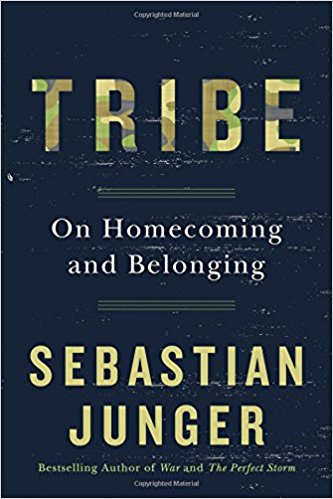
Sebastian Junger's recent book Tribe: On Homecoming and Belonging makes the argument that the great source of suffering in our modern world is the loss of tribe, the loss of belonging to a tight knit community that grounds us, supports us, and gives us a sense of home and purpose.

In the first part of the book Junger discusses the curious case of white people on the American frontier running off to live with the Native Americans, and even returning to the tribe after being rescued from captivity. The tribe had a captivating allure that the town apparently lacked. For example, while many whites went to live with the natives, the reverse almost never happened. Native Americans weren't attracted to the ways of the white man. As Junger writes:
The proximity of these two cultures over the course of many generations presented both sides with a stark choice about how to live. By the end of the nineteenth century, factories were being built in Chicago and slums were taking root in New York while Indians fought with spears and tomahawks a thousand miles away. It may say something about human nature that a surprising number of Americans—mostly men—wound up joining Indian society rather than staying in their own. They emulated Indians, married them, were adopted by them, and on some occasions even fought alongside them. And the opposite almost never happened: Indians almost never ran away to join white society. Emigration always seemed to go from the civilized to the tribal, and it left Western thinkers flummoxed about how to explain such an apparent rejection of their society.
What was the source of the attraction? According to Junger, the Western world made a devil's bargain with the Industrial Revolution: Material affluence over the tribe. The factories of the Industrial Revolution required a mobile source of labor, peasants who were uprooted from land and kin, dislocated from the tribes that for generations grounded their lives and identities with purpose and meaning. True, standards of living began to rise, the poorest of city dwellers having access to luxury goods previously only available to nobility and royalty. But the price of this material affluence was a loss of the tribe, the loss of tight-knit community.

For a time on America's frontier, the contrast between tribes and affluence was starkly visible, two ways of life living side by side. But eventually, the tribe lost and all that remains in America is a rootless collection of isolated individuals. Affluent individuals, to be sure, but tribeless, and now suffering the psychological effects of the fateful choice the modern world had made. Loneliness. Anxiety. Depression. Addiction. Meaninglessness. As Junger writes:
And as society modernized, people found themselves able to live independently from any communal group. A person living in a modern city or a suburb can, for the first time in history, go through an entire day—or an entire life—mostly encountering complete strangers. They can be surrounded by others and yet feel deeply, dangerously alone. The evidence that this is hard on us is overwhelming. Although happiness is notoriously subjective and difficult to measure, mental illness is not. Numerous cross-cultural studies have shown that modern society—despite its nearly miraculous advances in medicine, science, and technology—is afflicted with some of the highest rates of depression, schizophrenia, poor health, anxiety, and chronic loneliness in human history. As affluence and urbanization rise in a society, rates of depression and suicide tend to go up rather than down. Rather than buffering people from clinical depression, increased wealth in a society seems to foster it.
In the second half of Tribe Junger, who is a war correspondent, turns to an analysis of the psychology of soldiers, especially their trouble in returning home after a tour of duty. Junger's discussion turns on two observations.

First, war is hell, but many soldiers look back at their time in a "band of brothers" as also one of the most significant and meaningful times of their lives. Not the horrors of war, of course, but the solidarity of a tribe where everyone was willing to sacrifice and die for each other. There is nothing in the modern world that even comes close to replicating this experience. Thus, many veterans, to echo the last post, describe their tour of duty as "the best of times and the worst of times."

Second, Junger goes on to argue that the rising rates of PTSD among veterans is not simple exposure to trauma. Junger argues that PTSD is less about trauma than about reintegration into society. PTSD rates were lower in WWI and WW2. And while it could be argued that this was simply a product of a poor understanding of what "shell shock" involved back then, Junger makes a different observation. Because of the draft and the industrial support the wars required back home, WWI and WW2 were national, collective experiences. The trauma was shared.

Consequently, it's no surprise that PTSD first started getting diagnosed with the Vietnam War, where vets faced a chilly and even hostile reception back home. In a similar way, most Americas don't serve in the military, causing our professional military personnel to feel increasingly isolated and dislocated from American society. In short, PTSD incidence climbs less because of the trauma but because the trauma isn't being shared by the tribe. As additional evidence for this point, Junger cites the low PTSD rates among the Israeli military, where over half of the nation serves, at some point, in the military. In Israel the trauma is shared by the tribe.

Junger's observations about the military make two points about tribes. First, as his observations about shared trauma illustrate, it's not just that tribes make us happier. Tribes help us carry our pain and suffering. The best treatment for trauma is a tribe.

Second, beyond sharing trauma, vets struggle to reintegrate back into society because nothing in society compares to the shared, sacrificial purpose vets experience in the "band of brothers" during military service. The thin, vapid, solitary, and commercialized existence of modern life--where life is lived moving from screen to screen and from one Super Bowl party to the next--just can't compare to the courage, valor, solidarity, and shared purpose vets experience in the tribe of their military units.

In short, our need for a tribe isn't about reducing loneliness, about how nice it would be to have a few friends over for dinner tonight. Tribes run deep into the human psyche. Tribes are integral to human flourishing. Tribes help us carry our suffering and pain, and they give us a sense of shared purpose and meaning.

Tribes give us a home.

And this, I would argue, is the deep source of post-evangelical nostalgia. They have memories of being a part of a tribe.

Yes, tribes create tribalism, and there are toxic, dysfunction, and abusive tribes. But without a tribe there is listlessness, loneliness, and pain.

On Tribes and Community: Part 1, Progressive Loss and Nostalgia

It's not news to anyone that many progressive, post-evangelical Christians are obsessed with evangelicalism.

They are, after all, post-evangelicals.

Which means they are working out who they are in relation to evangelical Christianity. So there's a lot of "That is no longer me" contrasting in post-evangelical, progressive Christianity. I no longer read the Bible like that. I no longer see the atonement like that. I no longer think of LGTBQ persons like that. And so on.

Who you are now is defined by what you were then.

And all this is experienced as a great gain and joy. And yet, there's also a sense of nostalgia and loss among post-evangelical Christians. A part of the reason post-evangelicals have a hard time emotionally moving on from evangelicalism is that a part of them misses it.

They don't miss all the bad parts they've moved on from. What they tend to miss is the community. This ache was poignantly expressed in Rachel Held Evan's 2012 lament "Who will bring me casseroles when I have a baby?" 

I know Rachel has since found a faith community and has had a beautiful baby boy, with another baby on the way. Congrats Rachel! So I hope someone did and will continue to bring her casseroles. But that lament in 2012 perfectly captures the longing for community that seems so elusive for many progressive Christians.

Another recent example of this ache is Peter Enn's post-evangelical lament "The Hardest Thing for Me about What I Do":
What’s hard is losing friends, a community, a sense of belonging, a shared narrative.

It’s not so much about friends becoming enemies, but the more subtle disorientation of not really fitting anywhere.
What I want to do in a few posts is talk about tribes and this post-evangelical ache for community, where it comes from and why it seems to be so elusive, why it's so hard to leave all the bad stuff and keep all the good stuff. And the start of our exploration is this simple truth. If you ask post-evangelicals to talk about their childhood and early adulthood growing up in evangelicalism, many will describe it like this:

"It was the best of times, it was the worst of times."

And in that mixture of nostalgia and loss is a complicated story about tribes, about why we leave them and ache for them at the very same time.

Journal Week 12: Rugged Rosaries

Regular readers know I like to use prayer ropes and beads to pray.

I'm hard on prayer beads. I carry them in my pocket wherever I go. So I've broken a few strands.

Looking for something more sturdy and durable, I was directed to Rugged Rosaries, makers of "unbreakable paracord rosaries."

Rugged Rosaries markets itself as a maker of rosaries for manly types. They have rosaries like the Rattlesnake Paracord Military Rosary and the Memento Mori Skull Rosary. If that vibe puts you off, don't let it. They make a great product.

Plus, as the author of The Slavery of Death, I kind of want a Memento Mori Skull Rosary.

But because St. Francis is important to me, I opted to get the San Damiano Rosary (pictured here). And to add a little Christus Victor flavor to the rosary, I had them add St. Benedict and St. Michael medals. You can add all sort of medals to customize your rosary.

Now, I don't actually pray the rosary with these prayer beads. I use the beads to say the Lord's Prayer and the Jesus Prayer. The reason I opted for this product is because, well, it's rugged. I'm not particularly manly, but these are prayer beads that can take a beating and will last for years. I carry them in my pocket wherever I go.

Stranger God Discussion Guide Now Available!


Fortress Press asked me to create a discussion guide for Stranger God so that the book can be easily used by churches interested in moving more deeply into the practices of hospitality. The discussion guide can be used by teachers, equipping leaders, and discussion groups to facilitate conversation and reflection about hospitality while reading Stranger God together.

So if you're at a church that's interested in welcoming the people in your pews and city, consider using Stranger God and its discussion guide to start those conversations and help your church take those first steps.

You can download the discussion guide here at Fortress Press' Stranger God's website.

Here's the introduction letter I wrote for the discussion guide:
Dear Readers and Discussion Leaders,

This discussion guide is for groups who have some shared interest in the practices of hospitality and who are reading Stranger God together. I expect this guide will mainly be used by classes, small groups, or reading groups associated with churches or faith-based organizations. However, the topics and the discussions prompted by the book and this guide are applicable to a wide variety of organizations—and even for individuals reading on their own. Please feel free to adapt or adjust the wording of any question to fit your context.

I wrote many of the questions and discussion prompts to facilitate a lot of storytelling. I hope your group embraces the storytelling. I think sharing and listening to stories is a practice of hospitality. So share your stories, and listen well to each other. God will show up. I also hope many of the questions and prompts promote rich and deep discussions about how we might better “welcome each other as Christ welcomed us” (Romans 15:7).

If I have any overarching goals for the book and this discussion guide, they are these:

First, when we think about hospitality, we tend to think of one of two things: having people over for dinner or volunteering with a ministry or service organization. To be sure, hospitality takes place in those locations. But I’d like us to explore hospitality as a 24/7 experience, as something that begins in our hearts and can be practiced every second of every day, even with those closest to us at home and at work.

Second, I’d like readers of the book and those using this discussion guide to spend some time mapping the emotional terrain of their hearts. If we want to become more hospitable, we have to start by shining a light into those darker corners where hospitality isn’t quite as easy or natural. When I look in the mirror, I’m not as welcoming, kind, or loving as I could be. I expect you feel the same when you look in the mirror. As uncomfortable as it may be, let Stranger God and this discussion guide bring you to that place of honesty. The journey of hospitality begins right there.

Third, and this is my big agenda, I’d like for you to start thinking of hospitality less as an event you put on (like a dinner or a block party) or service you perform (like volunteering at a food bank) and more as an intentional, daily, habit-forming practice. I’d like for you to think of hospitality as a spiritual discipline that is teaching you how to love. A practice you can do anytime, anywhere, with the person standing right in front of you.

To help with this, some of the chapters have “Hospitality Homework” associated with them, little practices your group can try for a week and report back on. These homework assignments might be the most formative experiences you’ll have with the book and each other. So, let me encourage you to take them on. These practices changed my life. And my final prayer is that they will soon lead you to a meeting with our stranger God.

Blessings on your journey!

--Richard

The Authenticity of Faith: Part 9, Turning Toward Reconstruction

So The Authenticity of Faith concludes with what Van Tongeren, Davis, Hook, and Johnson describe as a trade-off between anxiety and hospitality. Doubts are an emotional burden to carry, but they make you open to difference.

So that's where the The Authenticity of Faith ends. But for many readers, and eventually myself, that ending is unsatisfactory.

The issue goes to what I've been talking about more and more on this blog, the need for reconstruction after a season of deconstruction. The Authenticity of Faith is a book for the season of deconstruction, it pushes a reader to confront defensive, fear-driven beliefs. This is a hard emotional labor, but there are benefits, the trade-offs. And yet, is this the end of the road? A life filled with existential angst, open to others, yes, but filled with unease and anxiety?

These were the questions that haunted me after the publication of The Authenticity of Faith. Was anxiety to be our lot in life if we want to love and be open to others?

This didn't seem quite right to me. As I thought about Jesus's psyche and contemplated mature faith as its described in the Bible, I saw love and hospitality coupled with peace, tranquility and joy. And what of Jesus' repeated injunctions "do not be afraid" and "do not worry"? Anxiety and angst, it seems, are not supposed to be the ruling emotions of the mature spiritual life. Doubt does crack a defensive faith open, but it doesn't seem that the resultant anxieties produced by doubt are the ultimate end game. Doubt is an important stop on the journey, but doesn't seem to be the final destination. 

But that presents us with a bit of a psychological puzzle. Is it possible to retain the hospitable openness of doubt yet leave the anxiety behind? Is it possible to experience peace, joy, and comfort from faith without slipping back into a defensive dogmatism?

Is there something beyond the trade-off described at the end of The Authenticity of Faith?

I felt there was, so I kept exploring. And the fruit of that exploration was eventually published in my book The Slavery of Death, which I consider to be the sequel to The Authenticity of Faith.

I don't want to go into an a review of the argument made in The Slavery of Death, feel free to pick up the book. I just wanted to conclude this series by saying that I consider The Slavery of Death to be a continuation of the journey started in The Authenticity of Faith. If The Authenticity of Faith is the journey of deconstruction, The Slavery of Death picks up from there and begins the journey of reconstruction, pushing through the anxiety/hospitality trade-off to envision a hospitable and loving faith that rests into peace, joy, and grace.

The Authenticity of Faith: Part 8, The Trade-Off of Anxiety and Hospitality

Once again, the big issue tackled in The Authenticity of Faith is assessing the claim of Sigmund Freud that religious belief is solely motivated by a need for comfort and consolation. Tackling that question requires a new sort of apologetics, a turn away from debating metaphysical propositions to examining the psychological motivations of religious believers.
So, was Freud right?.

Taking a cue from William James, the answer is no. There appear to be varieties of religious experience.

So, William James was right and Sigmund Freud was wrong. That conclusion, I think, is worth the price of the book. Still, this exploration of religious psychology only really matters if the these religious experiences differ in how they affect behavior.

Again, fear makes people behave badly. This includes Christians. So our interest here is if religious experiences are associated with a variety of behavioral outcomes. And, of course, we're most keenly interested in how religious believers treat other people, especially people who are different.

So having identified the Winter and the Summer Christian types in The Authenticity of Faith, I go on in the final part of the book to explore, in studies I have published, how these believers react and respond toward things like outgroup members, artwork, and the body.

The big take-home message is that Winter and Summer Christians do respond differently to the world. Winter Christians, in the studies I've published, are more tolerant of difference, have different aesthetic sensibilities, and are more comfortable with the human body.

Summarizing this work, in the final chapter of The Authenticity of Faith I make the argument that religious experience involves a trade-off between anxiety and hospitality.

Certainty, conviction, and dogmatism reduces our anxiety in the face of life. Having all the answers feels good. That's the upside. The downside is that certainty, conviction, and dogmatism makes you suspicious and wary toward people who have different beliefs. And that suspicion sows the seeds of intolerance.

In contrast, if you don't have all the answers in the face of uncertainty and tragedy, if you can't tie a neat theological bow on top a cancer diagnosis or a hurricane, there is an emotional price to be paid. You will carry a burden of anxiety. Meaning will be harder to secure. Life will be more uncertain and perplexing.

But there is an upside here. If your questions outweigh your answers, you're in a much more open posture toward people who have different beliefs. If you don't have all the answers, maybe they can be of help. In short, doubt can make you more hospitable.

The trade-offs explored in the final chapter of The Authenticity of Faith have recently been independently summarized and given empirical support by Van Tongeren, Davis, Hook, and Johnson (2016) in their article "Security Versus Growth: Existential Tradeoffs of Various Religious Perspectives."

Van Tongeren, Davis, Hook, and Johnson describe the religious experiences we've been exploring (Summer vs. Winter Christians, healthy-minded vs. sick soul) as Security versus Growth. Security-focused beliefs are focused on dealing with existential anxieties and concerns, providing us comfort and consolation. By contrast, growth-oriented beliefs are beliefs that are concerned with bridging the  ideological divides that separate groups. This is the same dynamic explored in the final chapter of The Authenticity of Faith.

Van Tongeren, Davis, Hook, and Johnson have a nice summary illustration of the trade-offs between Security and Growth-focused beliefs:
This is a great visual for the trade-offs involved. Security-focused beliefs have greater meaning, less anxiety and more comfort. But there is a price-tag: Less tolerance.

By contrast, growth-focused beliefs have greater tolerance, but pay an existential price (greater struggle for meaning, more death anxiety, less existential comfort).

So, summarizing the last eight posts (BTW, there's one more post tomorrow about where my work went after The Authenticity of Faith), in the words of Ecclesiastes, what is the conclusion of the matter?

Two conclusions.

First, Freud was wrong. There are religious varieties. There is more to religious belief than existential consolation.

Second, this debate matters because there is a trade-off in religious experience between anxiety and hospitality.

As I write in final paragraph from The Authenticity of Faith:
Perhaps, then, in the final analysis, faith, dogmatically understood, must be traded off for love. Doubts are the burden the believer must carry to keep her eyes opened to the suffering of others. It is as Moltmann described it, “The more a person believes, the more deeply he experiences pain over the suffering in the world.” What, then, might be the ultimate proof of the authenticity of faith? Perhaps it is as simple as St. Paul suggested in the First Epistle to the Corinthians:

And now these three remain: faith, hope and love. But the greatest of these is love.

The Authenticity of Faith: Part 7, Winter Christians and Religious Commitment

In my last post, I introduced you to the Defensive Theology Scale (DTS), a scale I developed and published in 2004. The goal of the DTS is to assess a suite of beliefs within Christian populations that reduce or buffer existential anxiety.

Now, the issue raised in the last post was if there are Christians who score low on the DTS, Christians who eschew the beliefs the DTS assesses.

The answer, obviously, is yes.

For example, in the face, say, of a childhood cancer diagnosis, there are Christians who would reject any assertion that God willed or had a plan for giving that child cancer. In fact, there are many Christians who would be highly offended at the suggestion that God has a hand in childhood cancer.

In short, yes, there are Christians who reject the beliefs assessed in the DTS, some strongly so. William James calls these Christians sick souls, and in my research I call them Winter Christians.

Since its publication in 2004, the DTS has been used by many other researchers to investigate existential dynamics at work in Christian samples, to sort people into religious types. It's exciting to see the DTS being put to good use.

That said, the DTS has some issues that researchers are reckoning with.

To understand these issues, we need to dig into the dynamics I'm decribing with the label "Winter Christian." I discuss these dynamics in Chapter 6 of The Authenticity of Faith.

The heart of my analysis regarding Summer and Winter Christians begins by comparing what I call the polar versus circumplex models of faith and complaint.

Many Christian communities and believers implicitly or explicitly work with a polar model when it comes to relating complaint to faith. Complaint toward God involves experiences of lament, protest, disappointment, frustration, anger, and doubt toward/about God. According to the polar model these experiences and expressions of complaint are symptomatic of faith problems, and are, thus, the polar opposite of faith. According to this model, then, strong faith should be characterized by a lack of complaint. No lament. No protest. No doubt.

In short, the polar model suggests that faith and complaint are antithetical impulses:
In contrast to the polar model, I describe in The Authenticity of Faith a model that argues that the relationship between communion/engagement with God and compliant may be circumplex, not as polar opposites but as two dimensions existing at right angles. This model suggests that communion/engagement with God and complaint can co-mingle and co-exist. Faith, in short, can be a complex mixture of communion and compliant with God:
Again, as I described in Part 5 of this series, if you know your Bible and church history, you're very aware that faith and lament regularly mix together. So the circumplex model is a better map of religious experience than the polar model.

When we go on to label the quadrants of the circumplex model, we can become very specific about what we mean by Summer versus Winter Christians:
As you can see in the top two quadrants, the distinction between Summer and Winter Christians is not a distinction between those who are engaged and in communion with God versus those who are not. Rather, the distinction between the Summer and Winter Christian is the degree to which complaint, lament or doubt intermingles with faith, communion and engagement with God. Summer Christians are those whose communion with God is generally free of doubt and lament. Winter Christians are those whose communion with God is infused with doubt and lament.

So, how does the Defensive Theology Scale fit into this scheme?

The DTS mainly assesses the complaint dimension. Those scoring high on the DTS (those endorsing consoling beliefs) would be low on the complaint dimension, moving them in the Summer Christian direction. Those scoring low on the DTS (those rejecting consoling beliefs) would be higher on the complaint dimension, moving them in the Winter Christian direction.

But the circumplex model is two-dimensional, and the DTS doesn't help in assessing the vertical, communion dimension, the degree to which one is engaged with God. For example, an atheist would score low on the DTS, simply because he rejected any and all beliefs about God. Consequently, a low score on the DTS, by itself, couldn't distinguish the Winter Christian from the non-believer.

That creates problems for researchers who want to use the DTS to identify Winter Christians. This issue was pointed out to me by Ron Wright, Paul Jones and the psychology faculty from Southern Nazarene University, who have used the DTS extensively in their research. Ron Wright knows more about using the DTS in Christians samples than I do.

The way Ron and the SNU research teams get around this issue with the DTS is that, alongside the DTS, they also assess religious commitment in their research with Christian samples. Religious commitment scales assess the degree to which one engages in religious activities and practices, like going to church, praying, and studying the the Bible. The measure of religious commitment assesses the vertical, communion/engagement dimension of the circumplex model. (An aside to researchers: I also think a measure of intrinsic religiosity would tap this dimension.) Winter Christians, as assessed by those at SNU, are those who score low on the DTS (high complaint) and high on religious commitment (high communion).

All that to say, to answer the question raised in the last post, yes, there are Christians who eschew the beliefs assessed by the DTS. There are Winter Christians.

That said, as the researchers at SNU have pointed out, one can't use the DTS all by itself to identify these sorts of believers. The DTS assesses only one dimension of the two-dimensional circumplex model, so a measure of communion/engagement with God (e.g., religious commitment, intrinsic religiosity) is also needed.

And with that question answered, we reach the final, most pressing question. Summer and Winter Christians might believe different sorts of things about God and cancer diagnoses, but do they behave differently?

Journal Week 11: My Book About the Little Way

A lot of people have described Stranger God as a popular version of Unclean. That's not how I see it.

It is true that in Part 2 of Stranger God "The Emotional Battlefield" I present some of the material from Unclean describing many of the emotional triggers that cause us to become unwelcoming toward strangers. Specifically, I talk about disgust, contempt and fear. The presentation in Stranger God is much more straightforward and practical, but readers of Unclean will be familiar with most of this material. But once we get to the second half of Stranger God, the book moves away from Unclean.

I don't think of Stranger God as a popular version of Unclean, I think of Stranger God as my book about the Little Way.

As long time readers of the blog know, I discovered the Little Way of Thérèse of Lisieux in the years after the publication of Unclean. Since that discovery, the Little Way has helped me bring a more practical approach to conversations about hospitality as I've worked with churches. As I describe in Stranger God, the Little Way shows us how hospitality can be practiced as a spiritual discipline.

And that's the great intellectual contribution of Stranger God. Given it's popular, conversational tone, most readers of Stranger God won't notice that some creative, academic work is taking places on its pages, especially if you're unfamiliar with the literature about Thérèse and the Little Way.

Specifically, most of the writing about Thérèse has been done by Catholics for Catholics. And most of this writing describes the Little Way as a practice of humility and self-mortification. By contrast, Stranger God argues that, yes, the Little Way is little, it is a small, humble path that can crash into our ambitions to live a heroic spiritual life. But the heart of the Little Way isn't humility, it's love.

Consequently, Stranger God describes the Little Way as a practice of hospitality. Readers of Stranger God who are unfamiliar with Thérèse, which I expect will be most readers, will be unaware that in the pages of Stranger God they are getting a fresh, creative and new reading of Thérèse and her Little Way.

Connecting the Little Way to hospitality is the creative, intellectual work of Stranger God, the work that makes Stranger God unique in the literatures both on Thérèse and Christian hospitality. As a scholar and academic, that contribution is what I'm most proud of in Stranger God. Stranger God isn't just a practical book about hospitality and kindness. Stranger God is a academic contribution as well.

The Authenticity of Faith: Part 6, The Defensive Theology Scale

Having set out the rival hypotheses of William James and Sigmund Freud--Are there religious experiences that are not motivated by providing us existential consolation and comfort?--the fifth big move in The Authenticity of Faith was figuring out a way to assess the issue empirically.

The biggest problem here, obviously, is that you just can't walk up to people with the question "Do you believe in God because you are afraid?" and expect to get good responses. If Freud was correct, and we've admitted that he was, religious belief can have a defensive aspect. Consequently, direct questions about the role of existential consolation are going to tend to elicit defensive, anxious answers.

Again, this isn't news. We've all encountered this. When you start to question sacred things, people start getting nervous. Emotions come to the surface and rational conversation ends. And when you see that happen you're looking at precisely what Freud pointed out: Underneath religious belief is a lot of anxiety.

And yet, if William James is to be believed, this doesn't explain everything about religious belief and its underlying motivations. So how to sort all this out? How can you separate Christians into the sick souls versus the healthy-minded, the Winter Christians from the Summer Christians?

In my empirical research this was the approach I adopted.

First, let's admit that religious beliefs can reduce anxiety. Okay, then what specific sorts of beliefs (I was focusing on Christians) would reduce anxiety? What sort of beliefs are comforting and consoling? Let's identify these beliefs and then see who strongly endorses them versus who denies them. That was my strategy.

So in 2004 I published a scale called the Defensive Theology Scale (DTS). The DTS was designed to assess five sorts of beliefs that provide existential comfort and consolation. These beliefs are: 
1. Special protection 
Theme: The belief that the believer will experience less misfortune than non-believers due to God's protection.
Anxiety-reducing function: Creates an aura of "safety," allowing for equanimity in a painful, tragic world.

2. Special Insight
Theme: The belief that we can clearly discern the actions of God in life and the will of God in personal choices.
Anxiety-reducing function: Reduces the existential burden of freedom and choice (e.g., "God opened a door for me."). Further, allows seemingly chaotic circumstances to be "explained" by God's Providence.

3. Divine Solicitousness
Theme: The belief that all our needs and requests, even the most trivial, are of import to God and demand God's attention and intervention.
Anxiety-reducing function: Makes the mundane issues of life cosmically significant. Creates a sense of "specialness" to have the Deity acting as a Cosmic Butler.

4. Special Destiny
Theme: The belief that God has a very specific, providential plan for your life.
Anxiety-reducing function: Allows life to be experienced as intrinsically meaningful and heroic. A heroic "destiny" is handed to a person rather than a life that involves uncertainty, risk, and the prospect of failure.

5. Denial of Randomness
Theme: The belief that God's hand is involved in all the events around us. Nothing is random or accidental. Thus, even tragedy is meaningful and good.
Anxiety-reducing function: Unpredictability is inherently scary. Further, chaos and suffering makes us feel that God is not in control. Thus, by banishing randomness/chance/accidents/chaos/tragedy from the world we maintain equanimity. 
For many readers of The Authenticity of Faith, the Defensive Theology Scale is the hardest part of the book. The beliefs surveyed in the DTS are very common and widely shared. So it's a bit jarring to have your beliefs--and vital, cherished beliefs at that--held up as exemplars of "defensiveness."

So a quick comment about that. The DTS wasn't created so assess theological or biblical truth. The issue, when you look at the DTS themes, isn't, for our purposes here, to debate the truth of any given belief. Does God, for example, have a specific, predetermined plan for your life (special destiny)? Does God will that hurricane, car accident, or cancer diagnosis (denial of randomness)?

Theologically, we can debate those questions. But the point of the DTS is simply to say that, if you do believe that God has a providential plan for your life or that God has a plan for that cancer diagnosis, that these beliefs are comforting and consoling. They reduce our anxiety. Conversely, if you feel that God doesn't have a detailed, worked out plan for your life, or that God doesn't have a plan for the cancer, well, those conclusions are more distressing. A life lived under those sorts of beliefs is more risky, uncertain, and fragile. And that makes us anxious.

All that the say, while a person can object to the DTS on theological grounds, I think it's pretty obvious that certain sorts of beliefs can reduce (or increase) anxiety. That doesn't make a given belief right or wrong, theologically speaking. It's just the simple recognition that beliefs affect us psychologically. Beliefs have emotional consequences.

So the strategy behind the DTS was this. Christians who strongly endorse the DTS themes would have a very comforting, anxiety-reducing suite of beliefs. Christians who do not, to some degree, endorse the DTS themes would have a suite of beliefs that would make them more vulnerable to anxiety.

Framed in terms of the William James vs. Sigmund Freud debate, the people we are most interested in looking at are Christians who would tend to reject, partly or wholly, the DTS beliefs. These would be Christians who would be pushing away existential comfort and consolation. Consoling beliefs are on offer--"This cancer diagnosis was God's will and plan."--and these Christians are rejecting that consolation.

In fact, I would argue that belief in God, while rejecting a consoling belief in the face of a cancer diagnosis, exacerbates the existential burden, making it heavier. Biblically, we call this additional burden lament.

Two questions follow from this strategy of using the DTS to sort Christians into these types.

First, are there actual Christians who reject the DTS beliefs? Could such a person even be considered Christian? I mean, what sort of Christian denies that God has providential plan for their life?

Second, even if we could, using the DTS, sort Christians into two different types, do these groups of Christians behave any differently?

That is a hugely important question. Like we said in an earlier post, the reason any of this matters is because of how we see Christians behaving badly in the world, intolerantly and even violently. Our suspicion, following Freud, is that fear is driving all this bad behavior. So even if we could use the DTS to sort Christians, if these Christians didn't behave any differently then this whole exercise isn't going to amount to much. If non-anxious Christians behave just as badly as anxious Christians then this whole inquiry becomes merely an academic exercise.

The next two posts will tackle these two questions in turn.

First, are there Christians who don't endorse the DTS beliefs?

And second, do they behave any differently from Christians who do?

The Authenticity of Faith: Part 5: Sick Souls, Winter Christians, and Saints of Darkness

The fourth big move of The Authenticity of Faith is exploring the religious experiences of sick souls, Winter Christians, and saints of darkness.

Again, if Sigmund Freud is correct religious belief is involved in providing us comfort and consolation.

And yet, it seems that there are religious believers who seem to be anything but consoled. If anything, these believers find their experiences with God to be searing, wounding, or distressing. God is absent or antagonistic. The believer feels abandoned, betrayed, and even hurt by God.

Anyone remotely familiar with the Bible or church history knows all about this. These dark and distressing experiences with God aren't obscure or hidden. They are quite common. How Freud missed this huge swath of religious experience I can only attribute to his bias and failure as an scientist. The data was there, he chose to ignore it.

Still, many people might find distress and darkness to be antithetical to faith. Consequently, Part 2 of The Authenticity of Faith is devoted to exploring James' sick soul type, what I have described in the research literature as a "Winter Christian."

The whole distinction between Summer and Winter Christians is pastorally useful. The labels and the religious types they describe have been helpful to many churches I've done equipping sessions for. A one-size-fits-all worship style or teaching ministry tends to fail either Summer or Winter Christians, but generally Winter Christians as contemporary worship and teaching is often characterized by Summer Christian spirituality (i.e., optimism, certainty, praise).

But my eye isn't on the church in The Authenticity of Faith. My focus is upon the rival theories of Freud vs. James, about if there are, in fact, religious experiences that don't seem to provide existential consolation. Because if these experiences exist, by definition religious belief in these instances must be motivated by something other than comfort and consolation.

And that observation tips the verdict toward William James over Freud.

The Authenticity of Faith: Part 4, Sigmund Freud vs. William James

The third big move of The Authenticity of Faith is pitting Sigmund Freud against William James.

As I pointed out in my last post, we have to admit that Freud got some things right about religious belief. Religious belief, perhaps even most of religious belief, has a defensive aspect. That is, religious belief is often aimed at providing us existential consolation. That means that religious belief is often driven by fear, and that fear makes religious believers prone to behaving badly, even violently.

But the pushback here is this: Sure, faith can be comforting and consoling, but is that all there is to religious belief?

Freud most definitely thought so. In this, Freud's theory is both comprehensive and reductionistic. All religious belief--100% of it--is motivated by a need for existential consolation.

In The Authenticity of Faith I turn to the work of William James for an alternative viewpoint.

In his book The Varieties of Religious Experience James saw the same dynamics that Freud saw. Faith can have an defensive aspect. But James saw more than Freud. James, per the title of his book, saw religious varieties, different types of religious faith. James saw more in religious believers than Freud's one-size-fits-all theory that faith is 100% about existential consolation.

Consequently, in The Authenticity of Faith I pit Freud vs. James as two rival theories about the role of existential consolation in religious belief. When it comes to existential consolation, is there a single, one-size-fits-all religious experience, as Freud supposed, or are there varieties of religious experience as James proposed?

For example, William James describes two sorts of religious experience--the sick soul versus the healthy-minded--that handle existential issues very differently. The healthy-minded believer pushes the darker aspects of existence out of mind. Thus, the healthy-minded believer is an example of Freud's assessment that religious belief is aimed at provided comfort and consolation.

By contrast, the sick soul experience focuses upon and dwells upon the darker, more painful aspects of existence. Here, according to James, is a religious experience that doesn't avoid but actively seeks out the darkness and pain.

Freud, apparently, never considered that possibility. And it's here where I think Freud failed as a scientist, letting his prejudice and ideology get in the way. James didn't have an atheistic axe to grind, and that allowed him to approach religious belief more objectively and scientifically.

All that to say, the big question that The Authenticity of Faith tries to tackle is this issue posed by Freud vs. James: When it comes to existential consolation, are there religious varieties? Specifically, are there sick souls out there?

Because if there are, then Sigmund Freud was wrong.

And that's no small conclusion.

The Authenticity of Faith: Part 3, Why Christians Need to Take Freud Seriously

The second big move of The Authenticity of Faith is that I insist we have to take Freud seriously.

That insistence startles and disorients many Christian readers of the book. A lot of Christians would like to dismiss Freud. Wasn't Freud an atheist? If so, why should we listen to him?

Well, because Freud was right about a lot of stuff. So if you want to offer a credible assessment of Freud's analysis of religious belief, you have to admit where he got things right.

Reflective and self-aware Christians have always known that Freud has a point. Religious belief does provide existential consolation. As the saying goes, there are no atheists in foxholes. In the face of suffering, meaninglessness, and death religion is a balm. No doubt about that.

Of course, the issue that we need to talk about is if providing consolation is the only thing religion is doing. Freud's theory is very reductive. More on that in the next post. But before we get to that issue, we have to admit that existential consolation is involved in religious belief, just as Freud pointed out. We can't assess Freud properly unless we are willing to admit he got some things right about this.

But this isn't just about being able to assess Freud's claims honestly and scientifically. There's a more important reason why Christians need to take Freud seriously.

The issue isn't just if Christians believe in comforting illusions. If that's all that is at stake it's not all that interesting. People believe all sorts of strange things, from food to health to conspiracy theories to spirituality to aliens to parapsychology. If all we were doing was lumping traditional religious belief into this list the debate doesn't matter all that much. Religion is just one more strange thing people believe. Live and let live.

But Freud's critique of religion has a darker aspect that Christians must attend to with deadly seriousness. Specifically, if religious belief is being driven by a need for consolation and comfort then that means that religious belief is being driven by anxiety and fear. And a fear-driven religion is a very worrisome thing.

Think about the evidence here and how worrisome it is.

Do we see evidence around us that Christians are being motivated by anxiety and fear? I think we do.

Do we see evidence that this fear is causing Christians to behave badly? I think we do.

Do we see evidence that this fear makes Christians vulnerable to fear-mongering and demagoguery? I think we do.

I talk about how fear hurts our ability to show hospitality to strangers in Chapter 7 of Stranger God.

This is where Freud can be extraordinarily helpful to Christians, why Christians need to take Freud seriously.

Because if Freud is right, and I think he was, fear can drive religious belief, and this fear is the source of the darkness we see within Christian communities.

Journal Week 10: Switcheroo

I have a lot of conversations with people about the style and tone of my last two books. Many readers report being caught off guard.

My first three books--Unclean, The Authenticity of Faith, and The Slavery of Death--were written for academic, classroom, and seminary audiences. So people who followed me and read my books had a notion about what a "Richard Beck book" would be like.

And then I hit them with Reviving Old Scratch and Stranger God.

Reviving Old Scratch and Stranger God were written for Fortress Press as a part of their Theology for the People imprint. Theology for the People is aimed at a popular, general audience market. And that demands a different sort of writing. More whimsy (Scoobydoification, anyone?), more stories, and less jargon.

Some readers of my earlier books found this change of style jarring. They tell me they prefer my earlier books.

But for every reader who prefers Unclean to Stranger God, I can tell a story of a reader who gave up reading one of my early books because they were "too hard." "I needed a dictionary!" is what I often hear.

In fact, the origin of Stranger God came from one of these conversations.

I was planning to speak at a church to talk about radical hospitality, like I do, and the church had recommended that members check out Unclean prior to my visit. Mrs. Azalee, an older member at the church, did so.

But when I came to the church Mrs. Azalee confronted me angrily, "Why is your book so hard to read!?" She was legitimately frustrated. I apologized and said the book wasn't really written to be handed out widely in a church. We chatted and left reconciled.

That conversation with Mrs. Azalee was the moment I decided to write a more accessible book about hospitality, a book Mrs. Azalee would like.

So, to all my nerdy, academically inclined readers, yes, Reviving Old Scratch and Stranger God are a bit of a switcheroo. And I hope that we, too, can be reconciled.

Because sometimes you just have to write a book for Mrs. Azalee.

The Authenticity of Faith: Part 2, A New Apologetics

When my editor read the first chapter of The Authenticity of Faith he pushed back on my claim that I was calling for and attempting a "new apologetics." That's a bold, ambitious claim.

Was I being serious?

I was being serious.

The first big move of The Authenticity of Faith is that with the rise of thinkers like Darwin, Marx and Freud, among others, the debates about religious belief had shifted in a way that effectively shelved classical apologetics.

In classical apologetics the focus is upon the truth of religious propositions. For example: Does God exist? True or false?

By contrast, with thinkers like Freud the question shifted away from the truth of religious propositions toward the social and psychological functions of religious belief.

Freud's answer was clear, and his answer still packs a punch: The function of religious belief is to provide us existential consolation. Life is terrifying and full of suffering. Life can also seem meaningless, especially with the prospect of death and non-existence. So, according to Freud, religion steps in as an existential narcotic. Religious belief is an anti-anxiety medication.

The task of of apologetics--defending the faith--is changed by accounts like Freud's. We are no longer talking about truth and evidence, we are talking about psychology, about motivation and anxiety. Consequently, if you want to determine if Freud was right, you have to take up the task of assessing the psychological dynamics at work in religious belief: Was Freud correct, is religious belief being driven by fear?

Questions like these have changed the game. When it comes to mapping the inner terrain of religious psychology the experts of classical apologetics--theologians, logicians, philosophers, historians, archaeologists and Bible scholars--are useless.

Freud's claims where about psychology, so you need psychology to test them.

So, yes, I told my editor. We need a new apologetics.

The Authenticity of Faith: Part 1, Introduction

The Authenticity of Faith is my least read book by the general public. The book is mainly used in undergraduate classrooms for psychology of religion courses.

Some of the reason the book isn't more widely read is that it's a more academic book that was written for an academic press.

Another reason is that I wish the book was better written and edited. The book pulled together a lot of different journal articles I had written and turned them into chapters. I worried about the disconnections between these articles, and so spent too much time at the beginnings and ends of chapters recapping and reviewing the argument. That makes the book very tiresome in spots with its repetition and redundancy. I think the book could be slashed by 50% to great effect.

Still, The Authenticity of Faith contains some of my most important and influential research if we use journal citations as a measure how how one's work is impacting the field.

And so, if you've never picked up (or were unable to get through) The Authenticity of Faith, I'd like to devote some posts working through what I consider to be its main moves, highlights, arguments, insights, provocations, and conclusions. As we do this, I'd also like to point to ways this research is evolving and being extended by others.

To get us started, a short video promo I did back in 2012 about the book:

The Merciful Heart

What is a merciful heart?

It is a heart on fire for the whole of creation,
for humanity,
for the birds,
for the animals,
for demons,
and for every created thing.

And at the recollection and sight of them, the eyes of a merciful person pour forth tears in abundance.

By the strong and vehement mercy that grips such a person’s heart, and by such great compassion, the heart is humbled and one cannot bear to hear or to see any injury or slight sorrow in any in creation.

--St. Isaac of Nineveh

Journal Week 9: My Old Friend Lucifer Came

Regular readers will note that in my blog header I've also included a quote about the devil from Johnny Cash's song "Redemption":
My old friend Lucifer came
Fought to keep me in chains
But I saw through the tricks
Of six-sixty-six

And the blood gave life
To the branches of the tree
And the blood was the price
That set captives free
And the numbers that came
Through the fire and the flood
Clung to the tree
And were redeemed by the blood
On Fridays I've been reflecting a bit about my transition to being a "stranger Christian," hard to locate in a Protestant world divided between progressives and evangelicals. A part of my journey into stranger things has been my engagement with the devil.

Readers of my books will likely have noted how Reviving Old Scratch marked a turn for me. Progressive readers of my books were caught a little off guard by the book. I've had some interesting conversations with progressive readers who liked my early work but who didn't like bumping into the devil all that much in Reviving Old Scratch. Talk of the devil brings back too many ghosts for post-evangelicals.

But astute readers will have detected my stranger turn happening in an earlier book, The Slavery of Death.

The Slavery of Death is, after all, a whole book devoted to Hebrews 2.14-15:
Since therefore the children share in flesh and blood, he himself likewise partook of the same things, that through death he might destroy the one who has the power of death, that is, the devil, and deliver all those who through fear of death were subject to lifelong slavery.
Like Johnny Cash and Flannery O'Connor--who described her fiction as being focused on the action of grace in territory controlled by the devil--I've been thinking about the devil for quite some time.

Holiness = Love: Part 4, The Most Holy Person Who Ever Lived

I find it shocking that we've come to think that holiness is unrelated to love. Even worse, that holiness is the opposite of love.

But the fact that holiness and love go hand in hand is easily demonstrated.

It's really quite simple.

Who was the most holy person who ever lived?

And who was the most loving person who ever lived?

Christians answer "Jesus" to both questions.

If you want to be holy you live like Jesus.

So let me ask again: Raise your hand if want to be holy.

I got my hand raised.