Christ and the Ghost Dance: Part 4, Liberation Theology

In his famous book Jesus and the Disinherited Howard Thurman describes the appeal of Christianity for oppressed peoples. As Thurman writes, "The masses of men live with their backs constantly against the wall. They are the poor, the disinherited, the dispossessed. What does our religion say to them?"

Thurman argues that what the oppressed find in Jesus is that God is for them, that God stands with them as they stand with their backs against the wall. 

This was the Jesus of the Ghost Dance. As the Native Americans stood with their backs against the wall the Jesus they encountered in the circle stood for and with them. As Louis Warren writes in God's Red Son, "The Christ of Ghost Dance visions seemed to represent a friendly, protective, and encouraging figure who greeted believers, not with the solemnity befitting the Son of Man, but with the warmth and intimacy of a personal friend in heaven, much like the old spirit protectors who functioned as personal friends and guardians for individual Lakotas." Warren goes on to describe one vision a Lakota woman had in the Ghost Dance as she was taken to Christ by Eagle:

A young woman said when she fell an eagle hovered over her and picked her up carrying her to a house, the door being open eagle went in first and she followed, and saw Christ and shook hands with him three times and said He was glad to see her as she had been there before.

Intimacy with Jesus also embodied a political critique. As Warren writes, "By idealizing the Messiah's love and pity toward Indians, believers could implicitly critique the distant, powerful, and often callous congressmen and officials who left them on the verge of starvation."

Thus, beyond spiritual comfort, for many Ghost Dance prophets "the new religion seemed to fulfill the prophecy extolled by the Americans that Christ would return to redeem the poor and the dispossessed--meaning Indians." In this, the Ghost Dance was an early expression of what would later be called "liberation theology," God's preferential concern for the poor and oppressed. The Christ of the Ghost Dance was on the side of the Native Americans and not with their white oppressors. Because of this, some Ghost Dancers saw white opposition to the dance as an attempt to delay the coming of the Messiah and his judgment upon whites. As one army officer wrote to his superiors in Washington:

They believe that the "Messiah" dance is a prayer to the "Messiah" to come and bless them, and they want to know why the whites object to their dance (prayer), and will naturally soon think that they (the whites) are afraid of his coming, and are trying to prevent it by preventing the Indians dancing, i.e., praying for him to come.

The ancient Christian prayer "Maranatha!" ("Come, O Lord!") is a cry for liberation and justice in the mouths of the oppressed. The Ghost Dance was just such a prayer. But Judgment Day would hold terror for others. 

Which brings us to the most controversial aspect of the Ghost Dance religion, the status of whites in the coming new world. According to the teachings of Wovoka, the coming age would be a world of peace and harmony. But as the new religion spread among the Lakota, the Ghost Dance prophecies came to foretell a world that would be inhabited only by Indians. In this Lakota vision, it wasn't clear what would happen to the whites upon the return of the Messiah. Were they left behind? Sent to hell? Destroyed? Or taken to their own sort of heaven? In some imaginations, the whites would become Indians. 

That whites would become Indians seems fitting given how US policy was bent upon "killing the Indian" in the souls of Native Americans in an effort to "civilize" them. 

The American government wanted to make the Indians white. The Messiah of the Ghost Dance, by contrast, would transform the white man into an Indian. 
Maps of Meaning with Jordan Peterson: Week 5, Why You Should Study the Bible

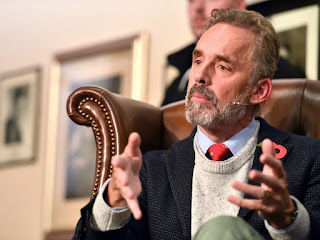
Having argued that myths, as maps of meaning, create for us a forum of action, Peterson goes on to describe the paradox at the heart of Western civilization. 

One the one hand, we reject, on scientific grounds, the truthfulness of the Judeo-Christian myth. And yet, on the other hand, we continue to operate within the "forum of action" that was created by the Judeo-Christian myth. The truth of the Judeo-Christian tradition isn't endorsed metaphysically but behaviorally. We all live "as if" the Bible were true.

Peterson starts this argument by describing how the scientific mind striped affect, value, and meaning from perception, from our descriptions of reality. Having lost value we destroyed our "map of meaning," lost our "forum of action": 

The medieval man lived, for example, in a universe that was moral--where everything, even ores and metals, strived above all for perfections. Things, for the alchemical mind, were therefore characterized in large part by their moral nature--by their impact on what we would describe as affect, emotion or motivation; were therefore characterized by their relevance or value (which is impact on affect)...It was the great feat of science to strip affect from perception...We have removed the affect from the thing, and can therefore brilliantly manipulate the thing...We have lost the mythic universe of the pre-experimental mind...

Prior to the time of Descartes, Bacon and Newton, man lived in an animated, spiritual world, saturated with meaning, imbued with moral purpose. The nature of this purpose was revealed in the stories told each other--stories about the structure of the cosmos and the place of man. But now we think empirically (at least we think we think empirically), and the spirits that once inhabited the universe have vanished. The forces released by the advent of the experiment have wreaked havoc within the mythic world...

But myths are not so easily avoided. Since meaning, value and morality are encoded behaviorally, we still operate, implicitly, according to the Judeo-Christian myth:

The fundamental tenets of the Judeo-Christian moral tradition continue to govern every aspect of the actual individual behavior and basic values of the typical Westerner--even if he is atheistic and well-educated, even if his abstract notions and utterances appear iconoclastic. He neither kills nor steals (or if he does, he hides his actions, even from his own awareness), and he tends, in theory, to treat his neighbors as himself. The principles that govern his society (and, increasingly, all others) remain predicated on mythic notions of individual value--intrinsic right and responsibility--despite scientific evidence of causality and determinism in human motivation...

Our systems of post-experimental thought and our systems of motivation and action therefore co-exist in paradoxical union. One is "up-to-date"; the other, archaic. One is scientific; the other, traditional, even superstitious. We have become atheistic in our description, but remain evidently religious--that is, moral--in our disposition. What we accept as true and how we act are no longer commensurate. We carry on as if our experience has meaning--as if our activities have transcendent value--but we are unable to justify this belief intellectually. We have become trapped by our own capacity for abstraction: it provides us with accurate descriptive information but also undermines our belief in the utility and meaning of existence...

We find ourselves in an absurd and unfortunate situation...It seems impossible to believe that life is intrinsically, religiously meaningful. We continue to act and think "as if"...We still act out the precepts of our forebears, nonetheless, although we can no longer justify our actions. Our behavior is shaped (at least in the ideal) by the same mythic rules...This means that those rules are so powerful--so necessary, at least--that they maintain their existence (and expand their domain) even in the presence of explicit theories that undermine their validity. That is a mystery.

This passage from Maps of Meaning explains a lot about why Peterson is interested in the Bible and how he interprets the Bible. 

Specifically, the Bible is the great myth of Western civilization. So if you're living in Western civilization you're living out this myth, operating within its forum of action. Everyone lives "as if" this myth is true, even atheists. This myth imbues life with value, and therefore with morality and meaning. Studying the Bible, therefore, is absolutely necessary as it maps the meaning of your life and the society you live within. If you want to understand yourself, you have to study this map. To change the metaphor, the Bible is the operating system of your mind and society, so if you want to understand your life you need to look at the computer code. That's why you should study the Bible.

But the other thing to note in Peterson's passage above is that Western civilization is a house of cards, an existential ticking time bomb. Why? Peterson says it plainly, "We carry on as if our experience has meaning...but we are unable to justify this belief intellectually." That is the problem in a nutshell. We carry on as if life has meaning but have become unable to justify this belief intellectually. We're existential zombies. 

But the situation is even worse than that. It's not simply that we cannot justify the meaning of our life. We are actively undermining our ability to justify this belief. As Peterson notes: We've embraced science because "it provides us with accurate descriptive information" but this very embrace "undermines our belief in the utility and meaning of existence." Our modern vision of "truth" is slowly, inexorably, evacuating life of meaning.

Listen. Do you hear that sound? 

That's the sound of us sawing the branch we are sitting on.

Christ and the Ghost Dance: Part 3, A Unity Movement

In the last post, I described the massacre at Wounded Knee as a failure of missiological imagination. 

To be sure, there were aspects about the Ghost Dance that were worrisome to federal authorities. The Ghost Dance did promise liberation from white oppression. And when tied to the recent depravations and the taking of Lakota land in South Dakota, the Ghost Dance did have have a political aspect to it, giving voice to growing resentments. To that issue we'll turn in the next post. But the ethic of the Ghost Dance, as preached by Wovoka, was to live at peace with the whites. Any expected liberation would come from the Messiah, not a bloody uprising. But such theological distinctions were lost on federal authorities.

But before turning to the emancipatory aspects of the Ghost Dance, I wanted to note another failure of missiological imagination in white attitudes toward the circle.

Specifically, intra-tribal tensions had always been a part of the Native American experience. And life upon reservations had exacerbated those. Native Americas were constantly fighting amongst themselves about how best to respond to the crisis of white colonial expansion. Should they capitulate, move to the reservations, take up farming and send their children to white schools? Or should they go to war like Geronimo? Such choices had to be made over and over and over again. And with each crisis tribal leaders found themselves upset and angry with each other given their different choices.

Into those tensions came the Ghost Dance. One of the allures of the Ghost Dance was that it healed these tribal conflicts. The Ghost Dance was a pan-Indian movement, expressing shared laments and dreams. As Louis Warren describes it, the Ghost Dance was "a unity dance."

And it is here where the Christianity of the Ghost Dance was more Christian than the Christianity of the missionaries. Specifically, as missionaries from Christian denominations arrived on the reservations they brought with them their sectarian squabbles. Catholics fighting with Protestants, and Protestant denominations fighting with each other, each claiming to be the "true" faith. 

Pushed and pulled by this fractious sectarianism, forced to choose among the Christian churches, the Ghost Dance united all the Native American Christians on the reservations. The circle included every Native American, no matter their denominational affiliation or belief. All were welcomed in the circle, both believers and non-believers, converts to Christianity and those who espoused traditional beliefs. Even whites were welcomed. As Warren summarizes,

The attraction of the Ghost Dance may have been that it allowed [Native Americans] to heal sectarian divisions that emerged in the wake of the church missions...By the 1880s, and probably before, Christian pluralism had become key to Lakota understanding of Christian religion and American politics...

...[The Ghost Dance embodied] a pervasive Lakota desire to be at peace with other Lakotas over religious matters and avoid "that strife": the denominational disputes that so divided White Robes and Black Robes, Protestants from one another and from Catholics, and all Christians from followers of the old Lakota religion...[The Ghost Dance was involved in] minimizing the potential for internal religious conflict.

Which makes what happened at Wounded Knee even more tragic, for if Jesus was, for many, encountered in the Ghost Dance, the Christianity of the circle was more Christian than the Christianity found in the sectarian Christian churches. 

Christ and the Ghost Dance: Part 2, Christianity and the Old Spirits

From the very start, Christianity has always interacted in creative ways with pagan culture.

For example, Christianity has been indelibly marked by its interaction with Greek philosophy. It has also been argued that Jewish thought was greatly influenced by its encounter with Zoroastrianism during the exile and intertestamental period which later impacted the New Testament. 

As another example, in Hunting Magic Eels I describe how Celtic Christianity was a unique blend of Christianity with the paganism of the Celts in Ireland.

Lastly, we've also seen how Catholicism has blended with indigenous spiritualities in places like Africa and Latin America. 

The Ghost Dance religion was a similar fusion, blending Christianity with traditional Native American spiritualities. As Louis Warren writes in God's Red Son, "Christ was everywhere in Ghost Dance visions as Christian teachings became embedded in or engulfed by the new religion." Many Native Americans even reserved the Ghost Dances for Sunday as a form of Christian worship. As mentioned in the last post, many Ghost Dancers connected Wovoka's prophecies of a coming Messiah, as did Wovoka himself, with Jesus. As Warren observes, "most Ghost Dancers believed that they were seeing the same spirit presence evoked in the New Testament." 

Thus, the Ghost Dance "was effectively a new religion that incorporated a Messiah figure--for some, Christ himself--alongside older spirit powers." Warren summarizes the fusion and the desire to create a uniquely textured faith:

By 1890, missionaries counted nearly 5,000 Lakotas as Christian; thus, they were taken aback that growing church attendance in an "Indian country dotted over with chapels and schools" was followed by a surge in Ghost Dancers. Their only explanation was that many of their Christian converts had not yet understood Christian teachings. But the simultaneous enthusiasm of church attendance and the Ghost Dance was a paradox only if believers had to choose one or the other--Christianity or the old spirits. The Ghost Dance expressed not only the belief that the two religions could be combined but also their longings to do just that...

...[The Ghost Dance] elevated Eagle, Buffalo, and Bear to the same plane as Christ and made him a "friend" to Indians, like one of the guardian spirits of old...The Ghost Dance combined old spirits and a new redeemer...To believers, it was exhilarating...To authorities and most missionaries, it was terrifying.

That terror, we know, led to the massacre at Wounded Knee. But some observers, even some missionaries, were able to look upon the Ghost Dance with a more generous cultural perspective, as an attempt to fit Christianity into Native American culture. True, this process was messy and uneven. Not every Ghost Dancer was Christian. And theologians would be rightly worried if Christ became, for Ghost Dancers, just one among many spirit guides and guardians. If it hadn't been violently suppressed by the US government on the reservations, how the Ghost Dance would have evolved as it interacted with Christianity remains a tantalizing mystery. Regardless, what the Ghost Dance clearly showed was a desire for a uniquely Native American expression of Christianity, something that the Christian missionaries just were not providing. 

In short, a part of the tragedy of Wounded Knee was a failure of missiological imagination. Christianity for far too many reservation missionaries was culturally European in both content and practice. The goal was to get Native Americans to sit in wooden pews in a church building to pray from a pulpit and sing hymns out of a hymnal. Christianity most definitely wasn't a traditional Native American circle dance. 

But at Wounded Knee it was.

Christ and the Ghost Dance: Part 1, Jesus at Wounded Knee

I've finished Louis Warren's book God's Red Son: The Ghost Dance Religion and the Making of Modern America and wanted to devote a few posts to the subject of Christianity and the Ghost Dance. My interest here is exploring how Christianity mixed, interacted with, and affected Native American religion.

To start, what was the Ghost Dance? And what part did it have to play in the massacre at Wounded Knee?

Let me start with the second question. You may have heard of the famous book by Dee Brown, Bury My Heart at Wounded Knee. Published in 1970, the best-selling Bury My Heart at Wounded Knee is a classic treatment documenting American atrocities that displaced and destroyed Native Americans and their way of life. The title refers to the 1890 massacre of almost 300 Sioux Indians, many woman and children, near Wounded Knee Creek on the Pine Ridge Reservation in South Dakota. Wounded Knee was the last exchange of fire between the federal government and the Sioux, and is often viewed as the emblematic moment when the indigenous way of life on the Western plains, which had existed for thousands of years, finally came to a tragic and bloody end. 

What happened at Wounded Knee?

Prior to the tragedy, a variety of tensions had been building on the Sioux reservations in South Dakota. Most significantly, in 1889 Congress approved the statehood of North and South Dakota. This prompted the government to take even more land from the Sioux, almost half of the Great Sioux Reservation. In addition, when the new, smaller reservations were created, a bureaucratic bungling slightly changed the border between the Pine Ridge and Rosebud reservations. This displaced a group of Wazhazhas Brules from their settlements on Pass Creek. This band of Wazhazhas became the most disaffected among the Sioux in the lead up to Wounded Knee and they were among the very last holdouts. 

Beyond land disputes, the US government had also significantly cut the rations to the reservations. This caused widespread illness and malnutrition in the face of a measles and influenza outbreak in the two years leading up to Wounded Knee. 

Needless to say, the Sioux reservations were under considerable strain. Discontent was widespread, with rumors about uprisings breaking out. Tensions were high.

And into this volatile situation entered a new religious movement, the Ghost Dance. 

The Ghost Dance emerged among the the Northern Paiute (territories in Nevada and California) with the spiritual leader, rainmaker, and prophet Wovoka (also named Jack Wilson). The prophecies of Wovoka foretold a future restoration of Native American life, a future of peace and prosperity that would be inaugurated by the coming of the Messiah. To usher in this age, the Indians were to live at peace among the whites, to work, and to send their children to school. And they were supposed to dance. 

The Ghost Dance was a traditional circle dance, with some key changes. The dancers held hands and rotated in a clockwise direction. Men, women, and children participated, an egalitarian change from some male-dominated traditional dances. Even some whites were welcomed into the circle. As the circle turned many dancers fell and entered into a trance, which often lasted hours. Upon awakening, dancers shared visions of going to heaven where they encountered their dead loved ones. Given the amount of loss and grief experience by Native Americans, these encounters with lost loved ones fueled the eastward spread of the Ghost Dance, eventually making its way to the plains reservations. Soon after Wovoka's first prophecies in 1889, the circles began to turn among the Sioux in South Dakota.

Given the tensions and rumors of uprisings, the federal authorities could only look upon the Ghost Dance with suspicion. While different in key respects, the circle of the Ghost Dance was rooted in traditional native practice. This represented a "reversion" in the eyes of the authorities to "non-progressive" and "primitive" native practices, a return to traditional culture and lifeways. This wasn't the direction the federal government wanted the Sioux to go. 

Plus, it was feared that the dance was stirring up revolutionary fervor. To suspicious and nervous reservation agents, hundreds of Sioux dancing and singing in a traditional circle dance was an ominous sign. And so, on November 15 the federal agent of the Pine Ridge reservation sent a fateful telegram, asking for federal troops to invade the Sioux reservations: "Indians are dancing in the snow and are wild and crazy...We need protection and we need it now."

The troops came. Tensions rose ever further. Events cascaded out of control. And on December 29 federal troops opened fire on unarmed men, women and children at Wounded Knee.

Thanks to the popularity of the book Bury My Heart at Wounded Knee, this is a sad and well known tragedy in American history. But do we know this event as well as we think? Because here is where things get interesting, for the purposes of this blog. Jesus was at Wounded Knee, and in ways that might be surprise you. 

What many people don't know is that the Ghost Dance was, for many Native Americans, a Christian movement. Many participants of the Ghost Dance identified the coming Messiah with Jesus Christ. 

Take, for example, Black Elk, the Lakota holy man. Many students of New Age and indigenous spiritualities revere the teachings of Black Elk as recounted in Black Elk Speaks. But did you know that, along with many others, Black Elk encountered Jesus in the Ghost Dance? 

Because of this experience, Black Elk eventually converted to Catholicism, and is now being considered as a saint. As Black Elk's grandson commented, Black Elk was a man comfortable praying with both his pipe and his rosary.

First Nations Version: An Indigenous Translation of the New Testament

I've been doing a lot of reading lately about the reception of Christianity among Native Americans. More to come about that tomorrow.

BTW, there's a lot of diversity on the proper term to use here. From my research, Native American, American Indian, First Nations, and Indigenous Peoples are all acceptable. But whenever possible, it is proper to speak of an individual's tribal group.

During these explorations I came across a new resource that I wanted to share with you, the First Nations Version: An Indigenous Translation of the New Testament

Published in 2021, the First Nations Version (FNV) is a dynamic equivalence translation, made with the input of over 25 tribes, that renders the biblical text in Native American idiom and imagery. It's a startlingly beautiful translation.

For example, the word "God" is often translated "the Great Spirit" or "Creator." The word "gospel" is translated as "the Good Story." It's also common among Native Americans for names be descriptive in nature. Thus, the people and places of the New Testament are given descriptive names. Mary, Jesus's mother, is named "Bitter Tears" in light of Simeon's prophecy: "And a sword, too, will pierce your own heart." Abraham is called "Father of Many Nations." Jesus's name is translated "Creator Sets Free." The city of Rome is called "the City of Iron."

There's so much more than just the names. In so many places the Native American twist brings a freshness to the text. For example, I love how "sin" is translated as "bad hearts and broken ways." So good.

Here's the FNV translation of the Lord's Prayer:

O Great Spirit, our Father from above,
we honor your name as sacred and holy.

Bring your good road to us,
where the beauty of your ways in the spirit-world above
is reflected in the earth below.

Provide for us day by day--
the elk, the buffalo, and the salmon.
The corn, the squash, and the wild rice.
All the things we need for each day.

Release us from the things we have done wrong,
in the same way we release others for the things done wrong to us.

Guide us away from the things that tempt us to stray from your good road,
and set us free from the evil one and his worthless ways.

Aho! May it be so!
And here are the Beatitudes: 

Creator’s blessing rests on the poor, the ones with broken spirits. The good road from above is theirs to walk.

Creator’s blessing rests on the ones who walk a trail of tears, for he will wipe the tears from their eyes and comfort them.

Creator’s blessing rests on the ones who walk softly and in a humble manner. The earth, land, and sky will welcome them and always be their home.

Creator’s blessing rests on the ones who hunger and thirst for wrongs to be made right again. They will eat and drink until they are full.

Creator’s blessing rests on the ones who are merciful and kind to others. Their kindness will find its way back to them—full circle.

Creator’s blessing rests on the pure of heart. They are the ones who will see the Great Spirit.

Creator’s blessing rests on the ones who make peace. It will be said of them, ‘They are the children of the Great Spirit!’

Creator’s blessing rests on the ones who are hunted down and mistreated for doing what is right, for they are walking the good road from above. Others will lie about you, speak against you, and look down on you with scorn and contempt, all because you walk the road with me. This is a sign that Creator’s blessing is resting on you. So let your hearts be glad and jump for joy, for you will be honored in the spiritworld above. You are like the prophets of old, who were treated in the same way by your ancestors.

Check out the First Nations Version. Highly recommended. 

Maps of Meaning with Jordan Peterson: Week 4, Myth and Meaning

Last week we discussed how Peterson makes a contrast between seeing the world as "a place of things" versus a "forum of action." In the opening paragraphs of Chapter 1 Peterson goes on to describe how this happens from the perspectives of developmental and cognitive psychology: 

The empirical object might be regarded as those sensory properties "intrinsic" to the object. The status of the object, by contrast, consists of its meaning--consists of its implication for behavior. Everything a child encounters has this dual nature, experienced by the child as a part of a unified totality. Everything is something, and means something...

Peterson goes on to note that the meaning of an object is something that we tend to miss as we navigate the world, but the meanings of things are exerting a constant push and pull upon our behavior. As Peterson continues:

For people operating naturally, like a child, what something signifies is more or less inextricably part of the thing, part of its magic. The magic is of course due to apprehension of the specific cultural and intrapsychic significance of the thing, and not to its objectively determinable sensory qualities. 

Basically, we are born into a matrix of meaning--a sort of psycho-social-behavioral magnetic field--that is generally unseen and unnoticed, but which enables us to act in the world. Peterson then goes on to make the point that this matrix of meaning, our forum of action, has been, historically, captured by cultural narratives and myths:

The automatic attribution of meaning to things--or the failure to distinguish between them initially--is a characteristic of narrative, of myth, not of scientific thought...The "natural," pre-experimental, or mythical mind is in fact primarily concerned with meaning--which is essentially implication for action--and not with "objective" nature...[T]o know what something is still means to know two things about it: its motivational relevance, and the specific nature of its sensory qualities...Those sensory properties--of prime import to the experimentalist or empiricist--are meaningful only insofar as they serve as cues for determining specific affective relevance or behavioral significance. We need to know what things are not to know what they are but to keep track of what they mean--to understand what they signify for our behavior. 

Here we arrive at a critical feature of Peterson's thought. Myths are not fairy-tales. Myths map meaning. Science, by contrast, doesn't, and cannot, map meaning. Further, by mapping meaning, by keeping track of "what things mean," their behavioral and motivational significance, myths give us guidance in how to act, how to navigate life. 

In short, if you want to know how to live, don't look to science. Look to myth. Consult the map of meaning.

I Have Been Led

“If you could do it, I suppose, it would be a good idea to live your life in a straight line - starting, say, in the Dark Wood of Error, and proceeding by logical steps through Hell and Purgatory and into Heaven. Or you could take the King's Highway past the appropriately named dangers, toils, and snares, and finally cross the River of Death and enter the Celestial City. But that is not the way I have done it, so far. I am a pilgrim, but my pilgrimage has been wandering and unmarked. Often what has looked like a straight line to me has been a circling or a doubling back. I have been in the Dark Wood of Error any number of times. I have known something of Hell, Purgatory, and Heaven, but not always in that order. The names of many snares and dangers have been made known to me, but I have seen them only in looking back. Often I have not known where I was going until I was already there. I have had my share of desires and goals, but my life has come to me or I have gone to it mainly by way of mistakes and surprises. Often I have received better than I deserved. Often my fairest hopes have rested on bad mistakes. I am an ignorant pilgrim, crossing a dark valley. And yet for a long time, looking back, I have been unable to shake off the feeling that I have been led - make of that what you will.”

― Wendell Berry, from Jayber Crow

Judgment Day

The poem "Judgment Day" by R.S. Thomas:

Yes, that's how I was,
I know that face,
That bony figure
Without grace
Of flesh or limb;
In health happy,
Careless of the claim
Of the world's sick
Or the world's poor;
In pain craven -
Lord, breathe once more
On that sad mirror,
Let me be lost
In mist for ever
Rather than own
Such bleak reflections,
Let me go back
On my two knees
Slowly to undo
The knot of life
That was tied there.
It's so, so out of tune with the times, adopting this eschatological view of yourself, but my goodness, how I find it such healing, necessary medicine for my sin sick soul.

The Christian Life

It was raining hard at the end of the workday. The few students remaining in our offices, along with myself, were facing the prospect of getting completely soaked in walking to our cars. 

I had an umbrella in my office, which I use on rainy days to get to and from class. I went and got it and gave it to a female graduate student. She was confused about why I was giving it to her, rather than using it for myself. She tried to give it back, but I insisted she use it. "Why are you giving this to me?" she asked, "You're going to get wet."

I just said, "Don't worry about it. I want you to use it." She did.

I didn't share with the student my answer to her question, but I had one. When she asked me why I was giving her my umbrella the answer flashed in my mind, these exact words:

"I'm giving you this umbrella because the Christian life is one continuous act of charity."

Again, I didn't say this out-loud. And there's a lot of virtue-signaling in sharing this story will you. But I'm sharing this because of that line that flashed through my mind. I didn't conjure it up or think about it. It came, rather, as in interruption in my mind. It didn't feel like it was my thought. It felt more like a a gift.

And the thought has haunted me ever since, "the Christian life is one continuous act of charity."

"Resurrection," a Poem

I stumbled upon a poem I wrote in 2018, entitled "Resurrection":

May your sight burn with the flames of grace
as you stand over the bones--
ivory white and stacked high in the sand--
to behold the roaring wind
bringing the dead, clattering, back to life again.

May your despairing heart be singed with joy
as you walk with a stranger
along the road.

May your life be watered by the dew
when Love surprises you in the morning.

May you stand defiant before the logical world
as the prophet of the impossible,
to thunder in sackcloth at their disbelief:
"Why seek ye the living among the dead?"

Not to "explain" poetry, but if anyone cared:

The first verse is the resurrection imagery from the Valley of Dry Bones in Ezekiel 37. The second verse is imagery from the Road to Emmaus ("Were not our hearts burning within us?). And the third verse is Mary Magdalene standing in the garden of the empty tomb on Easter morning.

And, of course, the last verse is about the disenchantment of the modern world, how, in our disbelief (as the "logical world"), we find ourselves searching for life in the midst of deadness. In such a world, Easter people stand as defiant "prophets of the impossible."

Maps of Meaning with Jordan Peterson: Part 3, The World is a Forum of Action

At the start of each chapter in Maps of Meaning Peterson summarizes the argument of the chapter. 

Summarizing Chapter 1 "Maps of Experience: Object and Meaning" Peterson starts off with this:

"The world can be validly construed as a forum for action, or as a place of things."

After that statement and the fuller chapter summary, Peterson shares some lines, which seem to be set as blank verse. The formatting below, which is a bit baffling, is as it appears in the book:

We need to know four things:

what there is,

what to do about what there is,

that there is a difference between knowing what there is, and know-

ing what to do about what there is

and what that difference is.

We're going to, in the coming posts, get a whole lot deeper into all this, but some introductory things can be said right here.

First, Peterson makes a strong contrast between seeing the world as "a place of things" or as "a forum of action." This contrast is absolutely central to understanding his thought. Seeing the world as "a place of things" is how science and materialism view the world. The cosmos is a space filled with objects. The world is a warehouse full of furniture. 

And yet, while science is great at telling us all about "what there is" it struggles to tell us "what to do about what there is." Science doesn't create for us "a forum of action."

That insight sits at the heart of Peterson's criticism of atheism. Materialism doesn't create for us a forum of action. Materialism knows "what there is" as it investigates and describes the world as "a place of things." But materialism fails to tell us "what to do about what there is." To act we need more than an exhaustive empirical inventory of the furniture of the cosmos. A forum of action requires more than brute physical description. A forum of action involves knowing not just what a thing is, scientifically speaking, but the value and meaning of a thing. And meaning and value are the very things that escape the scientific, materialistic gaze. This is why an atheistic materialism fails to help us: it cannot create a forum of action.

Again, I'm going to share more about Peterson's view of meaning and value in the posts to come, but I want to stop here to make another comment about Peterson's mass appeal.

Specifically, Peterson describing the world as a "forum of action" is one of his major themes. Over and over again Peterson comes back to a central message: "You must act." This is Peterson's soapbox and bully pulpit. 

Do you want to debate the existence of God? Waste of time. You must act.

Do you want to debate if goodness can exist without God? Doesn't matter. You must act.

Do you want to blame your parents or the government for your problems? Won't make a difference. You have to act.

Peterson has an uncanny ability to blow past most of the obstacles that hang us up, from interminable metaphysical debates to getting stuck in neurotic quicksand. Peterson pushes it all aside to come back to his central point: You must act. Life is a forum of action, and you can't escape its imperatives. You must act. And don't kid yourself that before you have to act that you'll get it all figured out, all your ducks in a row, be those ducks philosophical preoccupations or psychological hangups. You don't have that luxury. You don't have the time or ability to answer the questions you're asking yourself. And while you are lying there ruminating, trying to determine if you have free will or not, your alarm has gone off and the day has started. Get up. You're going to be late for work. People are depending upon you. You are depending upon yourself. Life isn't waiting around for you. You must act. 

Given this pressing focus upon action, there is an urgency and pragmatism at the heart of Peterson's approach. The urgency is felt in the demand for action, especially given the high stakes of life (see last week's post). And the pragmatism is felt in how Peterson ignores metaphysical debates to focus upon choice and behavior. 

God might exist or not. But that is a metaphysical quibble that misses the deeper point. The point is that God creates a forum of action. The question of God isn't about what there is. The question of God concerns what to do about what there is.

"Bible Class," a poem

During a season when our Adult faith Bible classes were going through a study using Hunting Magic Eels, I wrote a poem for my class entitled, very creatively (!), "Bible class." You'll see some of my attempt in the poem at (re)connecting enchantment to going to church and a Bible class. Everything can be full of enchantment if we open our eyes to see. 

“Bible Class”

Here, now, see
in front of you,
inside, above, below, behind you.
Beauty. Grace.
Light and Love
shining through
your transparent self,
and dancing off the water
of sight, sound, and perception.
Hush your anxious mind
and listen to
the Heartbeat
behind your own.

You have what you need.
Our faith
and its worn, trusted paths.
Sermon, sacrament, and song.
And us,
friends and fellow pilgrims
sharing our broken, honest care.
Windows.
Each a telescope and scrying glass
to reveal the fine, imperceptible threads,
the ligaments of sacred light,
holding the whole of our joy and grief,
and the far hope
of reconciliation and reunion.

Here you are
or at least find yourself.
Look at the world.
Behold again.
Behold anew.
The miracle is close,
intimate as breath,
gentle in the breeze,
playing
in sunlight and trees.

On Orthopathy: Part 5, A Battle for the Heart

This whole series has been a slow walk to get to a point I want to make here in this final post.

I spend a lot of time with churches and church leaders. I lead workshops for churches and speak at retreats for pastors. I teach seminary classes for DMin students. And in all those conversations I've frequently encountered a shyness, suspicion, hesitancy and ambivalence about the role of emotions in spiritual formation. 

I'm pretty convinced this is a product of seminary education. Only seminary could twist you into a pretzel like this. 

It's not news to anyone that seminaries have, for many generations, trained pastors to be scholars rather than ministers. Of course, many schools have been, for many years, pushing hard against this history. But as anyone who has ever been to seminary knows, the experience is very academic and very scholarly. Classes in biblical languages, textual studies, exegesis, church history, and theology. And in the rarefied scholarly air of academia emotions tend to get marginalized. Intellect, knowledge and critical ability tend to take center stage. You want and need to be smart.  

Along with this pursuit of smartness is a common seminary tendency to point at and make fun of churches that function as case studies where emotions have led a faith community astray. Emotions make us vulnerable to bad theology, pentecostal excess, charismatic leaders, and entertainment culture. We mock how worship services have become like rock concerts. 

We should also name here one of the unspoken secrets of seminary education: it can hurt your faith. It's not hard to see why. Scholarship tends toward critical analysis, which is vital, necessary and good. But a steady diet of critical analysis can be corrosive. Due to this corrosion, many pastors can lose their faith during seminary. Or at least get started on a course that culminates, years later, in a loss of faith. To be sure, again, many seminaries recognize this as a problem and take steps to create a more healthy and balanced spiritual life for their students. Worship and spiritual practices have to come alongside classes in textual criticism. Still, in many seminaries true devotion and piety is often cause for embarrassment. You don't want to show too much enthusiasm for Jesus. You don't want to look like you might, you know, believe any of this stuff. Such passions make you look naive, uncritical, and unsophisticated. Like a fundamentalist or a holy roller. Best to practice critical and ironic detachment. No enthusiasms or hand raising allowed. 

And so, emotions get marginalized. Because of seminary education and a legitimate worry that emotions can lead us astray. But even worse, emotions are perceived as manipulative

For example, I once complemented a pastor at the end of a worship service. In the final moments of the service the praise team had come back up on stage and had begun to play some poignant backing music as the pastor concluded his sermon with a moving benediction. The service ended, in word and music, on a very powerful note, emotionally speaking. We were moved. Our hearts swelled. It was a moment. You felt it. 

So I complemented the pastor about how the service concluded. About how emotional it was for me, and how impactful. And guess what happened? The pastor expressed a worry, a fear that because strong emotions were being evoked that the moment had been manipulative. 

Here's the thing. I get that worry. I really do. We do see examples of emotions leading churches astray. It's a problem. But here's what I said to the pastor that day: "I understand the worry. But [and here I pointed beyond the church to the outside world as people were leaving the building] we're getting our asses kicked out there. The world has no qualms about appealing to our emotions. Every ad on TV and social media. Every show. And all the outrage. All these emotions, but all of it misdirected and self-destructive. Emotion is the most powerful force in the world. We can't leave our greatest weapon on the shelf. We can't fight with one arm tied behind our back. The world is using emotions. We aren't. And the world is winning."

I wanted to do this series to share with you this conversation I had with that pastor. I was making a point about orthopathy and spiritual formation. Truly, emotions are the most powerful force in our lives. James Smith is right, we are emotional, affective creatures. And Smith is also right that what he calls the "cultural liturgies" of the world--from marketing to entertainment culture to displays of patriotism--are directly targeting and shaping our emotions. But many churches, for the reasons I've shared above, have ceded the game. To appeal to our emotions is deemed too manipulative and too risky. 

The point about orthopathy is this: We cannot afford to avoid emotions. But the issue isn't about emotion, but about right emotion. Yes, there are plenty of examples of wrong and misplaced emotions. But that's not an excuse to avoid emotion. We avoid emotion at our peril. Because something in the world will appeal to our emotions if churches won't. The call here is, rather, for orthopathy, the directing of emotions toward their proper goal and the shaping of virtue.

In fact, when we see Christians behaving badly I'd argue this is due less to bad beliefs than bad emotions, fears and loves being misdirected. When Christians go wrong this is less about a suite of bad ideas than about paranoid fears and inordinate loves. These distorted and twisted emotions need proper direction and formation. 

Orthopathy is the challenge before us. In some churches, as I recount in the story above, emotions are being anxiously avoided, creating an affective vacuum that is being filled by the culture. In other churches, fears and misplaced loves are leading the church astray. Either way, this is a battle for the heart.

On Orthopathy: Part 4, Affectivity and Spiritual Formation

This really isn't a series about C.S. Lewis' The Abolition of Man, although we've begun with that book. I started with Lewis because of the central role emotions play in his vision of virtue and character formation. Virtue demands right affection--courage in the press, compassion in the face of pain and outrage in the face of injustice. 

This is interesting to me as right affection isn't regularly placed at the center of spiritual formation. Christianity has tended to privilege orthodoxy--right belief--over things like orthopraxy (right practice) and orthopathy (right affection).

Ponder, for example, the various things we discuss when we talk about spiritual formation and spiritual disciplines. We talk about prayer, Sabbath, Bible study, and fasting. And while these things do involve our affections, we rarely place emotions at the center of these practices, that these practices are habits of orthopathy.

That said, the work of James Smith, in his books Desiring the Kingdom and You Are What You Love, has put emotions back on the map in conversations about spiritual formation. For that a lot of us have been very grateful. 

What I think C.S. Lewis' work helps us see is that by "desiring the kingdom" we mean "virtue." "Kingdom" can be vague and abstract, where virtues like kindness and courage are easier to see and teach. With virtue you can be situationally-specific and point to models and exemplars. Martin Luther King Jr. was brave. St. Francis was kind. 

But either way, emotions become the focus and take center stage. Orthopathy is the deep engine of spiritual formation. We spend a lot of time and energy talking and arguing about Christian beliefs. So much of Christian life is about your agreement or disagreement with a theological or biblical proposition. But what is your heart up to? Moment by moment, and day by day? 

We should spend more time practicing and displaying the emotions and affections of Jesus.

On Orthopathy: Part 3, The Tao, the Logos, and Wisdom

My interest in C.S. Lewis' The Abolition of Man concerns the role of right affections--orthopathy--in the first of the three lectures that make up the book. I'll return to that focus in the next post, but in this post I wanted to pause to say something about Lewis' second lecture.

To review, Lewis' argument in the first lecture is that for right affections to be "right," noting also that right affections are at the very heart of virtue, these affections have to correspond to objective value. Without this correspondence feelings become "subjective" and untethered from objective goods. In such a situation our feelings of cowardice or courage give us no moral guidance. Flee or stand your ground, it doesn't matter because those feelings aren't pushing or pulling you toward a good. 

For Lewis, this situation--feelings decoupled from value--creates an educational catastrophe. As Lewis laments in lecture one, how are we to educate and form character if we cannot instill in our children or charges right affection? Character is wholly about right affections! As mentioned in the last post, courage sits at the heart of every virtue. And beyond courage, there are affections like compassion and anger. Character formation directs those emotions toward their proper ends. Compassion directed toward the hurting, for example, and anger toward injustice. Education shapes our character by directing our emotions toward right values. 

I'll return to that point in the next post. For this post, we'll pause to consider the question: Is there a such thing as objective value? Isn't this whole conversation assuming something that many people doubt?

In lecture two of The Abolition of Man Lewis gives his argument for the existence of objective value. And what's interesting is that Lewis, the famous Christian apologist, chooses to call the source of objective value the Tao. 

The Tao is a key idea in Eastern religions like Taoism, Confucianism, and Buddhism. The Tao is "the Way" or "the Path." The Tao describes what I'd call the "moral grain of the universe" with which we wisely harmonize ourselves. Right living is to live in sync with the Tao, the ordering principle and flow of the cosmos. In this, the Tao is both ontological and ethical. 

One can see Lewis' attraction to the Tao in light of his purposes in The Abolition of Man. The Tao is the source of objective value. Ontologically speaking, the universe presents us with a Way or Path. Wise and right living, then, becomes living in a harmonious relationship with the Tao. 

I think this is a genius move on Lewis' part, and his choice here has only improved with the passage of time. Few modern people are warm to the idea of God imposing rules from above upon humankind. But the idea of the Tao has a lot of cultural cache these days. As I describe in Hunting Magic Eels, we're much more open to immanent enchantments in the modern world than transcendent enchantments. God handing down the Law on Mount Sinai is a transcendent ground of value. The Tao, by contrast, is an immanent ground of value.

But this doesn't mean Christianity is a stranger to the Tao. In both the Old and New Testaments creation is imbued with a moral grain. Creation isn't inert matter. Creation crackles with value. 

In the Old Testament, the Tao is called Wisdom. As I shared recently, in Proverbs we see Wisdom personified, sharing her role in imbuing creation, from the start, with value and a path toward right living:

“The Lord brought me forth as the first of his works,
before his deeds of old;
I was formed long ages ago,
at the very beginning, when the world came to be.” (Proverbs 8: 22-23)

“Now then, my children, listen to me;
blessed are those who keep my ways.
Listen to my instruction and be wise;
do not disregard it.
For those who find me find life
and receive favor from the Lord.
But those who fail to find me harm themselves.” (Proverbs 8: 32-33, 35-36a)
In the New Testament, Wisdom becomes associated with the Logos (or Word). Like both Wisdom and the Tao, the Logos imbues creation with value from the start:
In the beginning was the Word, and the Word was with God, and the Word was God. He was with God in the beginning. Through him all things were made; without him nothing was made that has been made. (John 1:1-3)

The Son is the image of the invisible God, the firstborn over all creation. For in him all things were created…All things have been created through him and for him. He is before all things, and in him all things hold together. (Colossians 1.15-17)
All that to say, Christianity can smoothly come alongside Lewis' use of the Tao. Which is obviously why he picked the concept to build around. And in light of Hunting Magic Eels, the Tao, Wisdom and the Logos are very helpful and resourceful ways to talk about "objective value" in an increasingly post-Christian context. 

Maps of Meaning with Jordan Peterson: Part 2, Life is Deadly Serious

Ok, let's jump right in.

Peterson begins Maps of Meaning with a Preface, which is largely autobiographical, his personal journey that led him to the discipline of psychology and the writing of the book.

Let's stop right here, given my purposes in this series. Recall, the goal of this series is to understand what makes Jordan Peterson so compelling to people. And the Preface to Maps of Meaning illustrates, I think, a bit of his magic.

Specifically, Peterson doesn't write or speak as a disinterested academic. Peterson is, rather, on a personal quest to save his soul from the devil and damnation. Or, at least, damnation and the devil as understood from a Jungian perspective. More of that to come. This is what strikes you most when you watch Peterson deliver his lectures on the Bible, that he is personally wrestling with, live and in front of you, serious, personal business. As he talks he gets lost in a personal reflection. He looks into the abyss. He recoils in horror. He tears up with emotion. Jordan Peterson is playing a very high stakes game, and he insists that you play along. This may be his core message, "Life is deadly serious. You need to wake up because you are, right now, teetering on the brink of disaster."

This, in my estimation, is what sets Peterson apart from most public intellectuals, academics, and pundits. Peterson isn't opining about the world. He's not giving you a TED talk about his big idea. He doesn't care about smooth or practiced oratory. He doesn't use compelling stories to interest or move you. He doesn't gather facts, statistics or graphs. He doesn't spend time doing what 99.99% of social media does: talking about the bad behavior of other people. In fact, Peterson is noteworthy, I think, in not trying to convince you of anything at all. Rather, when you watch Jordan Peterson you are bearing witness to something happening right in front of you.

People can debate this impression of mine, but when you watch Peterson on the stage delivering his Bible lectures what you see is a man wrestling, like Jacob at the Jabbok, with some great mystery upon which everything hangs in the balance, for himself most especially. And it's this pathos and intensity that makes Peterson so compelling and unique. 

Is there a lesson here for preachers, pastors and those speaking about God in our culture? I think so.

My take. I think people are drowning. There's a desperation in the air. Consequently, people want to listen to someone who begins right there, with the desperation. People don't want to listen to someone who is funny or smart or a blessed mixture of both. They want to listen to someone who thinks life is a deadly serious game. Someone who looks into the abyss and demands that you look as well. Someone who is telling you to wake up because you are, right now, teetering on the brink of a disaster. 

On Orthopathy: Part 2, Emotions, Value, and Virtue

C.S. Lewis starts his lectures in The Abolition of Man by discussing how an English textbook entitled The Green Book makes a comment about the emotion of sublimity when encountering a natural wonder. 

Lewis quotes the textbook authors who declare, 

"When the man said 'This is sublime,' he appeared to be making a remark about the waterfall... Actually... he was not making a remark about the waterfall, but a remark about his own feelings. What he was saying was really 'I have feelings associated in my mind with the word Sublime,' or shortly, 'I have sublime feelings’ ... This confusion is continually present in language as we use it. We appear to be saying something very important about something: and actually we are only saying something about our own feelings."

Lewis starts with this remark in the textbook to illustrate the point from yesterday's post: in the modern world emotion, in this case sublimity, wonder, and awe, have been disconnected from objective reality. Is the natural wonder, objectively speaking, sublime? If so, emotions of sublimity are appropriate to the encounter. And other emotions, such as indifference or boredom, less appropriate. This illustration of sublimity and the natural world sets up Lewis' argument. How can we determine when emotions are appropriate, healthy, virtuous, and praiseworthy unless they are suited to and congruent with external, objective reality? As Lewis comments upon the effect of the above passage upon the students who would read it: 

The schoolboy who reads this passage in The Green Book will believe two propositions: firstly, that all sentences containing a predicate of value are statements about the emotional state of the speaker, and secondly, that all such statements are unimportant.

In the modern world statements of value have been reduced to statements of feeling, and statements of feeling, being wholly subjective, tell us nothing about the world and are, thus, not very important. 

This congruence between emotion and value is important, says Lewis, because right emotions--orthopathy--sits at the very heart of virtue. Later in the lecture, Lewis says,

Until quite modern times all teachers and even all men believed the universe to be such that certain emotional reactions on our part could be either congruous or incongruous to it — believed, in fact, that objects did not merely receive, but could merit, our approval or disapproval, our reverence or our contempt...The man who called the cataract sublime was not intending simply to describe his own emotions about it: he was also claiming that the object was one which merited those emotions ... ‘Can you be righteous’, asks Traherne, ‘unless you be just in rendering to things their due esteem? All things were made to be yours and you were made to prize them according to their value.’

St Augustine defines virtue as ordo amoris, the ordinate condition of the affections in which every object is accorded that kind of degree of love which is appropriate to it. Aristotle says that the aim of education is to make the pupil like and dislike what he ought. When the age for reflective thought comes, the pupil who has been thus trained in ‘ordinate affections’ or ‘just sentiments’ will easily find the first principles in Ethics; but to the corrupt man they will never be visible at all and he can make no progress in that science.
Why is virtue rooted in our affections? Because reason alone is not sufficient for action, especially in the face of fear, hardship or sacrifice. We don't die for logic, but we do die for love. This is where Lewis brings in his illustration of the solider on the battlefield:
Without the aid of trained emotions the intellect is powerless against the animal organism. I had sooner play cards against a man who was quite sceptical about ethics, but bred to believe that ‘a gentleman does not cheat’, than against an irreproachable moral philosopher who had been brought up among sharpers. In battle it is not syllogisms that will keep the reluctant nerves and muscles to their post in the third hour of the bombardment.
It's here in the lecture where Lewis makes his comment about "men without chests." But as I noted yesterday, his point isn't about masculinity. His point is about the relationship between love and courage, how love of country creates bravery on the battlefield. Lewis' point is about the role of affections in motivating virtuous behavior. 

And the critical point here concerns the relationship been virtue and value. Is loving your country a value, a good? If so, then courage in battle is virtuous and praiseworthy. And cowardice is lamentable. But if loving your country isn't really a good, if feelings are just feelings and tell us nothing about value, then how could we pass any moral judgment upon heroes and cowards? If you're afraid, you might as well act on that feeling and run, right? Feelings aren't about values, after all. Feelings tell us nothing important about the world. 

This is Lewis' point about right affections. At root, all virtue is a form of bravery. But bravery is only heroic if there is an objective value at stake, a true good in question. Remove that value and you remove the distinction between virtue and vice, between heroic sacrifice and self-serving cowardice.  

On Orthopathy: Part 1, People Without Right Affections (Or "Men Without Chests")

I was reading, for the first time, C.S. Lewis' famous lectures published as The Abolition of Man. What struck me in the lectures was the role of emotions in the case Lewis is making. 

Specifically, Lewis is making the case that emotions, rather than reason, lead us toward objective value in the world. In a word, The Abolition of Man concerns orthopathy--"right affections" or "right emotions." (As contrasted, say, with orthodoxy, "right belief.") 

These lectures are where Lewis makes the (in)famous claim that the modern world is producing "men without chests." I've heard this line before, that the modern world is full of "men without chests," but upon reading the lectures for myself what I took to be Lewis' meaning was actually not his meaning. So I'd like to set the record straight in this post before moving to his actual argument.

The line "men without chests" is often taken to mean, as I took it to mean, that the modern world is making men timid, cowardly, and, well, "unmanly." And true enough, in the part of the lecture where Lewis describes "men without chests" he is talking about martial courage on the battlefield. But Lewis' point here isn't really about masculinity and bravery. 

Lewis' point in these lectures is about emotion and value. One illustration in the lectures involves the emotions of loyalty and bravery in fighting for one's country. Lewis' audience had fought in WWI and WW2, so the example was poignant, personal and powerful. And the point Lewis raises about these emotions is simple: These emotions are responding to a value, namely the good of being loyal to one's country, to the point of self-sacrifice. Loyalty and bravery are virtuous because they converge upon a good. That is the crux of Lewis' argument. You cannot describe emotions as being "right" (like bravery) or "wrong" (like cowardice) without the existence of objective value. So the point about "men without chests" isn't about masculinity. The point is about orthopathy.

Lewis' argument is that emotions like loyalty and courage can only be deemed "right" and "proper" if they are truly aligned with some objective good. That's what makes these emotions virtuous and praiseworthy, that they are properly aligned with a value. But what has happened in the modern world, according to Lewis, is that we have come to doubt and question the linkage between emotion and value. Specifically, we doubt that objective value exists. In such a situation, emotions don't point to anything truthful, good, or beautiful in the world. Lacking this objective locus of affection, emotions become privatized and subjective, and therefore relative. In this world, a world that denies objective value, emotions like courage and loyalty aren't virtuous and good. They are personal sentiments, "emotional opinions" if you will, and might even be pathological. And how could you even tell? Without objective value there's no way to tell if an emotion is a virtue or a vice. 

Lewis' real point in the line about "men without chests" isn't that modern men are cowards. His real point is that the modern world denies objective value, which turns emotions like loyalty and courage into subjective fictions and fantasies. The modern world isn't vanishing men, it's vanishing value. Because when value goes, so does courage. Along with all the other virtues we aspire to.

All that to say, to start this series, Lewis' line "men without chests" isn't about masculinity and manly men. What Lewis means by "men without chests" is "people without right affections." In the modern world, people can't be properly called cowards or heroes because the values that make heroes and cowards no longer exist. "Right affection" and virtue requires the existence of objective value. Otherwise, there's just feelings, and no such thing as right feelings or wrong feelings. No virtue, no vice. Just feelings, all alike, cowards and heroes all the same.

What is the Gospel?: Part 6, The Power Unto Salvation

Last post in this series. Before ending I wanted to add a final comment and clarification. 

As I said at the start of this series, the gospel is vast. So please don't read this series reductively. The gospel doesn't reduce to an epistemological crisis, nor is stating that the gospel is an epistemological crisis in anyway a comprehensive statement about the gospel. The goal of this series was simply to highlight that the gospel is News, News about reality that undermines our perceptions and causes us to rethink all of existence.

Such an understanding of the gospel can do a lot of good work for us. But there is also a temptation here that I want to name in order to avoid it.

Specifically, when we say the gospel is an epistemological crisis we might be tempted by Gnosticism, reducing the gospel to knowledge. Now, to be clear, Gnosticism isn't 100% off the mark. There's a reason why Gnosticism blended with Christianity. There are points of contact.

For example, Paul describes the gospel as a mystery. Consider Ephesians 3:1-12, where I've underlined the gnosticy, epistemological parts:

For this reason I, Paul, the prisoner of Christ Jesus for the sake of you Gentiles—

Surely you have heard about the administration of God’s grace that was given to me for you, that is, the mystery made known to me by revelation, as I have already written briefly. In reading this, then, you will be able to understand my insight into the mystery of Christ, which was not made known to people in other generations as it has now been revealed by the Spirit to God’s holy apostles and prophets. This mystery is that through the gospel the Gentiles are heirs together with Israel, members together of one body, and sharers together in the promise in Christ Jesus.

I became a servant of this gospel by the gift of God’s grace given me through the working of his power. Although I am less than the least of all the Lord’s people, this grace was given me: to preach to the Gentiles the boundless riches of Christ, and to make plain to everyone the administration of this mystery, which for ages past was kept hidden in God, who created all things. His intent was that now, through the church, the manifold wisdom of God should be made known to the rulers and authorities in the heavenly realms, according to his eternal purpose that he accomplished in Christ Jesus our Lord. In him and through faith in him we may approach God with freedom and confidence.
There's also a ton of material in Paul about how spiritual growth is growth in knowledge and wisdom, being able to perceive the new reality revealed by the gospel. Consider 1 Corinthians 2:6-16, where I've again underlined the gnosticy, epistemological parts:
Yet among the mature we do impart wisdom, although it is not a wisdom of this age or of the rulers of this age, who are doomed to pass away. But we impart a secret and hidden wisdom of God, which God decreed before the ages for our glory. None of the rulers of this age understood this, for if they had, they would not have crucified the Lord of glory. But, as it is written,

“What no eye has seen, nor ear heard,
nor the heart of man imagined,
what God has prepared for those who love him”—

these things God has revealed to us through the Spirit. For the Spirit searches everything, even the depths of God. For who knows a person's thoughts except the spirit of that person, which is in him? So also no one comprehends the thoughts of God except the Spirit of God. Now we have received not the spirit of the world, but the Spirit who is from God, that we might understand the things freely given us by God. And we impart this in words not taught by human wisdom but taught by the Spirit, interpreting spiritual truths to those who are spiritual.

The natural person does not accept the things of the Spirit of God, for they are folly to him, and he is not able to understand them because they are spiritually discerned. The spiritual person judges all things, but is himself to be judged by no one. “For who has understood the mind of the Lord so as to instruct him?” But we have the mind of Christ.
Two observations. 

First, these texts help make the case that the gospel is an epistemological crisis. The News is the unveiling of a previously hidden mystery. Spiritual people discern the truth of this revelation. And this discernment gives them knowledge, wisdom, insight and understanding. Those who fail to grasp the truth of the News, by contrast, are blind, foolish, and unspiritual. Much of this, I hope you can see, is a way of describing "the gospel is an epistemological crisis."

Second, you can see why Gnostics would be attracted to Christianity. All this talk of "secret mysteries" hidden from "unspiritual" people but discerned by the "spiritual" giving them "wisdom," is catnip for Gnostics.

So, two things to say about this. 

First, the mystery of Christ was once hidden. It is no longer. There is no deep secret to be learned. This goes to the point made throughout the New Testament that the events surrounding the life, death, and resurrection of Jesus were public events. As Paul says in Acts to King Agrippa, "these things were not done in a corner." Yes, that Jesus was Israel's Messiah was hidden from the eyes of the people and powers. That is why he was crucified. But now, after the resurrection, that mystery is now News. 

And yet, that News involves the cross, making the gospel a scandal. If the News remains “hidden” to some going forward that is not caused by a secret mystery hidden away then about the epistemological crisis created by the cross.

Which means that Christianity isn't a Gnostic, mystery cult. What was once hidden has been made manifest. It’s a scandal, to be sure, but these things were not done in a corner. The mystery is now News, democratically and universally available to everyone with ears to hear. 

The second thing I want to say brings me to the point I want to make to end this series.

As this series argues, the gospel is an epistemological crisis. Thus, believing the news does make you discerning and wise. You know the truth. You have the mind of Christ. 

But the gospel isn't just about wisdom and knowledge. The News is about the demonstration of God's power in raising Jesus from the dead. A power now made available to those who believe through the gift of the Spirit. 

The News concerns a Power that saves, rescues, redeems, and emancipates the world. This Power is operative, active and available in the world. So in this series when I said the News helps us "navigate" I don't want us to imagine us navigating a static, dead moonscape where reality is inert and lifeless, nothing but rocks littered around that we have to avoid tripping over. Reality isn't dead. Reality is alive. The gospel helps us navigate our way deeper into this Power and Life. Yes, Jesus is the Truth and the Way--good epistemological words--but he's also the Resurrection and the Life. The News points us toward the saving power of God. 

That the saving power of God goes through a cross, well, my friends, that remains an epistemological crisis. And many will stumble over the foolishness of God. But go through that crisis and life awaits us on the other side.

As Paul says in Romans 1, "For I am not ashamed of the gospel, for it is the power of God for salvation to everyone who believes."

What is the Gospel?: Part 5, The Absolute Crisis of Absolutely Everything

The last few posts might have seemed arcane and abstract, too intellectual to have any relevancy or potency for living your life. One might think that "the gospel is an epistemological crisis" just won't preach.

I beg to differ, and I'd like to illustrate why. 

To recap, the gospel, the News that the shape of reality is cruciform, is a crisis for everything in the world. The cross puts a question mark next to everything. Our wisdom has been rendered foolish. Our TED Talks have been crucified. In light of the News that the Crucified Messiah reigns as the Risen Lord everything has to be reimagined, rethought, rebuilt. From the ground up. From scratch. What once was up is now down. Left is now right. Foolishness is now wise. 

In short, the gospel is the absolute crisis of absolutely everything. 

And so...

The gospel is the crisis of America.

The gospel is the crisis of capitalism.

The gospel is the crisis of socialism.

The gospel is the crisis of social media.

The gospel is the crisis of the Republican Party.

The gospel is the crisis of the Democratic Party.

The gospel is the crisis of conservatives.

The gospel is the crisis of progressives.

The gospel is the crisis of atheism.

The gospel is the crisis of Christianity.

The gospel is the crisis of the church.

The gospel is the crisis of the sermon you heard on Sunday.

The gospel is the crisis of the book you just read.

The gospel is the crisis of the podcast you just heard.

The gospel is the crisis of evangelicalism.

The gospel is the crisis of progressive Christianity.

The gospel is the crisis of social justice warriors.

The gospel is the crisis of Trump supporters.

The gospel is the crisis of power.

The gospel is the crisis of meritocracy.

The gospel is the crisis of your marriage.

The gospel is the crisis of your friendships.

The gospel is the crisis of your schedule.

The gospel is the crisis of your money.

The gospel is the crisis of your definition of good.

The gospel is the crisis of your values.

The gospel is the crisis of your definition of success.

The gospel is the crisis of your shame.

The gospel is the crisis of this moment.

The gospel is the crisis of your entire life.

And on and on and on. 

Name it, and the gospel puts a question mark next to it. Everything you thought you knew about life, any and every bit of it, has to be rethought in light of the Crucified and Risen Lord. Nothing escapes its scope. Atheists don't escape, and neither does the church. Republicans don't escape, and neither do Democrats. Every last thing is on the hook, all of the time. 

The gospel is the absolute crisis of absolutely everything.