 Just received a great link from my good friend Dr. Rankin, provocateur and post-modern scholar extraordinaire.
Enjoy the link (thank you Bill!) and enjoy the weekend!
Monty Python - International Philosophy
Philosophy...
3

Just received a great link from my good friend Dr. Rankin, provocateur and post-modern scholar extraordinaire.
Enjoy the link (thank you Bill!) and enjoy the weekend!
Monty Python - International Philosophy
 This will be our last post about William James. I hope you've enjoyed it.
After discussing saintliness in the The Varieties of Religious Experience, James adds two lectures (XIV and XV) on The Value of Saintliness. In his opening paragraph James states: ...we have to ask whether the fruits in question can help us to judge the absolute value of what religion adds to human life. Were I to parody Kant, I should say that a 'Critique of Pure Saintliness' must be our theme.
Thus James begins one of the first purely psychological analyses regarding the functionality of religious faith. It is a much better analysis than the ones that follow. For example, James kicks Freud's butt. Specifically, James is willing to weigh both the good and the bad of religion, whereas Freud was just grinding an axe.
As James begins his analysis he states that he will focus on the individual rather than the group. That is, he does not ask if religion is sociologically functional. Rather, he asks if religion improves the functionality of individual persons.
In the end, James concludes that religion presents us with a mixed bag. Clearly, religious faith can inspire and create lives that even atheists recognize as exemplary, deeply meaningful, and even "holy." But just as clearly, religion can also produce all sorts of dysfunction and destruction.
James roots this dysfunction in notions of excess. That is, according to James faith becomes poisonous when it becomes unbalanced: The fruits of religion, in other words, are, like all human products, liable to corruption by excess...We find that error by excess is exemplified by every saintly virtue. Excess, in human faculties, means usually one-sidedness or want of balance; for it is hard to imagine an essential faculty too strong, if only other faculties equally be there to cooperate with it in action. Strong affections need a strong will; strong active powers need a strong intellect; strong intellect needs strong sympathies, to keep life steady. If the balance exist, no one faculty can possibly be too strong--we only get the stronger all-around character...Spiritual excitement takes pathological forms whenever other interests are too few and the intellect too narrow.
To illustrate this idea, James looks at the virtues of saintliness and examines what happens when they become unbalanced. Take his analysis of Devoutness. Generally, being devout is a fine virtue in a religious person. But when devoutness becomes extreme and unbalanced it becomes fanaticism, in James' words a "loyalty carried to a convulsive extreme." How can this drift from devoutness to fanaticism occur? James offers an analysis: "When an intensely loyal and narrow mind is once grasped by the feeling that a certain superhuman person is worthy of its exclusive devotion, one of the first things that happens is that it idealizes the devotion itself."
When devotion becomes an end in itself, nasty things begin to occur. For example, James states "an immediate consequence of this condition of mind is jealousy for the deity's honor. How can the devotee show his loyalty better than by sensitiveness in this regard? The slightest affront or neglect must be resented, the deity's enemies must be put to shame. In exceedingly narrow minds and active wills, such a care may become an engrossing preoccupation; and crusades have been preached and massacres instigated for no other reason than to remove a fancied slight upon the God. Theologies representing the gods as mindful of their glory, and churches with imperialistic policies, have conspired to fan this temper to a glow, so that intolerance and persecution have come to be vices associated by some of us inseparably with the [religious] mind. They are unquestionably its besetting sins. The [religious] temper is a moral temper, and a moral temper is often cruel. It is a partisan temper and that is cruel."
Okay, how freaking amazing is that passage? What an amazingly fresh and timely analysis offered in 1902! Have you noticed any of the following in the contemporary religion milieu?
Jealousy over the deity's honor?
A hyper-sensitiveness about affronts or neglects to the deity?
Movements to shame the irreligious for fancied slights toward God?
Theologies that present a view that God is overly mindful of His glory?
Churches with nationalistic and imperialistic interests?
Religious intolerance and persecution of the irreligious?
Cruelness in the name of morality?
Cruelness due to partisanship?
Again, I'm just struck by James' acuity and continued relevance.
In the end, James' verdict is that religion is a mixed bag and that its value, functionality, and health are to be judged contextually. James uses the idea of adaptation, of "fit" with the surrounding envrionement. Thus, "the individual saint may be well or ill adapted, according to particular circumstances. There is, in short, no absoluteness to the excellence of [religion]...How is success to be absolutely measured when there are so many environments and so many ways of looking at the adaptation? It cannot be measured absolutely; the verdict will vary accordingly to the point of view adopted."
And you know, I think this is a fair assessment. What is "good" and "holy" cannot be defined in absolute terms. It's a matter of context and discernment. Which, I think, makes holy living fun and interesting. I'm not following a rulebook. I'm seeking to find a way of life that is true to all I find within me and with what I see around me.
Thus, I embrace the Jamesian wisdom of Qoheleh, the writer of Ecclesiastes:
Do not be too righteous, and do not act too wise; why should you destroy yourself?
Do not be too wicked, and do not be a fool; why should you die before your time?
It is good that you should take hold of the one, without letting go of the other.
Yes, the optimal religious path, for me at least: Don't be too wicked.
But don't be too righteous either...
 On March 31, 1848 Kate Fox heard a spirit knocking in her house in Hydesville, New York. And thus began an interesting, if little known, alliance between faith and science.
The Fox sisters are often credited with starting a surge of interest in spiritualism in America and Europe during the last half of the 1800s and into the early 1900s. In the wake of the Fox sisters scores of mediums and mesmerists rose up to meet the raging demand for fortune-telling, seances, and spirit communication.
Interestingly, many preachers were very supportive of the spiritualism movement. The movement seemed to provide evidence for the soul and life after death. And in a similar way, many famous scientists saw in spiritualism a means to test and probe the supernatural realm. Thus was born a very odd campaign: The quest to scientifically prove the existence of life after death. It's an odd and quirky tale that continues to this day.
William James was a part of this effort. He was an early and influential member of the Society for Psychical Research, a group of famous scientists who systematically investigated evidence of the supernatural and paranormal. The thesis of the group was simple: If supernatural phenomena is occurring in ways we can sense and experience it must leave some empirical trace. The SPR set out to detect that empirical trace.
Mainly, they debunked a lot cranks and hucksters. Even the famous Fox sisters were found to be frauds (although their story is a very tragic one).
After years of debunking, James himself grew weary of the work. But one case kept him coming back. Miss Leonora Piper.
In their own words, the scientists of the SPR were looking for "the white crow." This was a popular metaphor to illustrate one of the problems with inductive reasoning. In inductive reasoning we gather particular observations and then, based on these isolated observations, draw a general conclusion. Thus, day after day we see crows. And all of them are black. We also pool the experiences of our friends and historians and conclude that all the crows ever seen (that we know of) were also black. So we feel very confident to make the general conclusion: All crows are black.
Then we wake up one day and a white crow lands in our backyard.
The point? A billion observations can lead to an induction. But it only takes ONE contrary observation to invalidate the whole chain of reasoning. With induction you can never be sure that your white crow isn't waiting for you around the corner. (BTW, an interesting recent book on the "white crow" phenomenon in the marketplace is Nicholas Taleb's The Black Swan: The Impact of the Highly Improbable.)
The hope of the "white crow" for the SPR researchers was that a billion hucksters did not prove the non-existence of paranormal phenomena. All they needed was just ONE legitimate medium. Just one. And William James strongly suspected that Leonora Piper was the "white crow."
Just why James (and others) came to believe this about Miss Piper is a fascinating story. For more, pick up Deborah Blum's excellent book Ghost Hunters: William James and the Search for Scientific Proof of Life After Death. Blum's book is an excellent historical account of the spiritualism movement and how the scientific establishment responded to it. But for a quirky modern tour through the paranormal, from a bemused but curious skeptic, check out Mary Roach's Spook: Science Tackles the Afterlife. Roach is an amazing writer and her curiosity and humor make for great reading. In fact, before reading Spook, I'd start with Roach's bestselling book Stiff: The Curious Lives of Human Cadavers. (As you can tell, Roach has a quirky sense of humor. Stiff came first, followed by Spook.)
Okay, why go into all this stuff?
Well, any walk with William James should confront his interests in the paranormal. In the end, despite his study of Miss Piper, James retained his skepticism of the supernatural and in the prospect of life after death. He was hopeful, but skeptical.
But the issues raised by James' brush with the supernatural are still with us today. Specifically, the question remains:
Does the supernatural leave an empirical trace?
For example, is intercessory prayer effective? Much more specifically, are praying Christians more likely to recover from physical illness due to the power of prayer?
If so, this would result in an empirical trace. In fact, this is the reasoning behind many of the medical studies that have examined the effectiveness of distant intercessory prayer in clinical trials. The outcome to date? Despite some intriguing findings to the contrary, the overall trends tend to average out to zero. Prayer does not seem effective in any consistent fashion.
No empirical trace.
In another example, I've written a lot about free will and the soul. That is, if the soul is the apparatus of free will there should be an empirical trace in the neural firing of the brain. If supernatural causation is occurring in the brain we should see some causal loose ends: Neurons firing for no (observable) reason. This would be the empirical trace of free will. But to date, no one has observed such a thing.
Miracles should also leave an empirical trace. But as isolated, unrepeatable events they are hard to verify.
So, in the end, James' experiences with the SPR are very relevant to us, on theological grounds. James' work forces us to ask these questions:
Does the supernatural (however you conceive of it) leave an empirical trace?
If so, science should be able to detect it (unless it's a miracle).
But if not, what are the theological implications of THAT? And should it matter?

 The high point of the The Varieties of Religious Experience is when William James turns to the issue of "saintliness," to those people who are the spiritual artists and giants among us.
I will say more about saintliness, but today a short and personal post reflecting on a lovely passage early in James' lectures on saintliness. Specifically, James is speaking of those expansive religious impulses that can come over and grab us. These grand and good impulses, which the saints seem to experience more than most, help to crash through all our moral idleness and psychological inertia to move us to act in a way that seems sublime and transcendent:
"Given a certain amount of love, indignation, generosity, magnanimity, admiration, loyalty, or enthusiasm of self-surender, the result is always the same. That whole raft of cowardly obstructions, which in tame persons and dull moods are sovereign impediments to action, sinks away at once. Our conventionality, our shyness, laziness, and stinginess, our demands for precedent and permission, for guarantee and surety, our small suspicions, timidities, despairs, where are they now? Severed like cobwebs, broken like bubbles in the sun..."
This is the quintessential religious experience. When some feeling of love or moral indignation takes hold of us and causes us to push aside convention, shyness, despair, fear and timidity--breaking all these as bubbles in the sun--moving us to ACT in a good and holy way. I think of Rosa Parks refusing to move, St. Francis rushing up to kiss a leper, Gandhi's march to Dandi, and Stephen standing before the Sanhedrin.
And, of course, I think of Jesus. You know what facet of Jesus' life fills me up with this feeling the most? His eating with sinners. Every time I think about that great, grand and good facet of his life and ministry my heart just swells.
Maybe there is a God. Maybe there isn't. Round and round it goes in my head. But every time I think of Jesus eating with sinners something in me breaks--like bubbles breaking in the sun--and I say, screw it, I'm living my life like that guy.
 In Lectures 6-7 of The Varieties of Religious Experience William James moves from his discussion of the healthy-minded believer to speak of the sick soul. Again, the sick souls are those who tend to be the more pessimistic believers among us, those of us preoccupied with the problems of existence. In my own research, I've labeled this type the Winter Christian and the Existential Believer, so I won't write more about them in this post.
What I do want to write about starts with James' sick soul type but goes in a different direction. Specifically, I want to write about the place of introverts at church.
Most people are aware of Jung's typology of Introverts and Extroverts. What you may not be aware of is that trait affectivity is highly correlated with these types. Specifically, positive affectivity is significantly associated with extraversion and negative affectivity is associated with introversion. That is, extraverts tend to be energetic and enthusiastic while introverts tend to be mellower or even melancholic.
The point here is that James' sick soul type is very often going to be an introvert and the healthy-minded type is very often going to be an extrovert. It is this connection that I want to discuss.
Here's the question I want to ask you: Do introverts fit in at church?
The answer, obviously, is that it depends upon what kind of church we are talking about. In liturgical churches I expect introverts and extroverts fare about the same. But in non-liturgical churches they may fare differently.
Specifically, non-liturgical churches tend to be more sociable churches. So, let's call them that. That is, there are liturgical churches and there are sociable churches. Sociable churches tend to emphasize relationality among its members. For example, a large part of the sociable church experience involves lengthy greetings (being greeted and greeting others), adult bible classes that are conversational and oriented around fellowship (e.g., in my church we sit at tables drinking coffee, eating donuts, and chatting), and the in-depth sharing of personal prayer requests.
This is not to say that liturgical churches aren't sociable or don't have sociable facets to them. It's just the simple recognition that going to a Catholic mass (the prototypical liturgical experience) differs greatly from my day at church at the Highland Church of Christ in Abilene, TX. My experience is heavy on the “visiting,” as they say here in Texas.
In these highly sociable churches there is an implicit theological theme that marries sociability with spirituality. That is, being sociable—visiting intensively, and being willing to "get into each other's lives"—is highly prized. To a point, this is understandable. A sociable church is going to rely on extraverts to make the whole vibe work.
But introverts fare poorly in these sociable churches. The demand to visit, mix, and share with strangers taxes them. Worse, given that these social activities are declared to be "spiritual," the introvert feels morally judged and spiritually marginalized. As if their very personality was spiritually diseased.
Consequently, the "issue of the introvert" is one of the big overlooked problems in these sociable churches. For example, church leaders often want to make church more "meaningful." What they mean by this is that they want to create an atmosphere were deep human contact can be made. This is a fine goal, a worthy goal. However, to pull this off in an ordinary church setting demands a degree of sociability that introverts just don't have. Take a typical church service, communion service, small group service, or bible class. Let's say, to make it more “meaningful,” you ask the participants to find someone sitting close to them to have a spiritually-oriented exchange/conversation with. A time of sharing. Well, the introverts are just going to HATE this activity. They may hate it so much that they just might stop coming to your services. In fact, I know introverts at my church who purposely come in late to avoid the perfunctory meet-and-greet that occurs right at the start of our services ("Find someone close to you and say hello!").
Now, you may say that these introverts just aren't good people. But you would be wrong. Introverts are very, very relational. They just aren’t sociable. And to confuse the two is a grave theological and ecclesial mistake.
But many churches fail to make this distinction. They tacitly set up the following equation for church life:
Spirituality = Sociability.
For example, I was once visiting with a church leader at my church who was making a recommendation that, to make our adult classes more "meaningful," we would need to share more of our lives in these classes. I stated that such a recommendation would drive the introverts crazy. The response was, "God is about relationships and church is about relationships. Thus, if these people aren't going to be involved in relationships they will just have to change."
The problems with this formulation are obvious:
1. From a psychological perspective, introverts don't change into extraverts (or visa versa). To expect this is ridiculous.
2. From a moral perspective, you are moralizing aspects of personality: Extravert = Good and Introvert = Bad.
3. From a pastoral perspective, you are confusing relationality with sociability. That is, your pastoral intervention, although well-intentioned, demands a kind of personality to work well. It is true that deeper relationships are needed at church, but the route isn't always best achieved by throwing strangers together into forced conversation.
4. From a theological perspective, you are insinuating that introverts are not created in the Imago Dei, in the Image of God. (In fact, the etymology of the word "enthusiasm," that trait of the extravert, means "filled with or by God." The association, then, is that introverts are NOT filled with or by God.)
This last is the most worrisome. For years, sociable churches have ignored the introverts in their midst. Worse, they have sent a consistent message that they were less spiritual than their extraverted brothers and sisters. That to be like God was to be extraverted.
In my opinion, the damage this subtle message has caused has been enormous.
 For longtime readers of this blog, you know that I've written a great deal about existential anxiety, body ambivalence, and religious faith. These topics were the subject of my ACU Lectureship Talk this year entitled Death, Disgust, Sex, and the Gospel of Judas: Body Ambivalence and the Psychology of the Incarnation. Well, last week I received this great e-mail from Emily, one of my brilliant former students. Here's the note:
I thought you might enjoy hearing about a recent episode in my life, aided by your teachings:
So I've been sick. I am sitting in Books-a-Million trying to read and my nose is running so I am sniffing non-stop. Now the issue is, I need to blow my nose. I have tissues in my purse for this very purpose. However, I am in a public place where other psuedo-intellectuals are quietly reading. I know blowing my nose will be loud and disgusting, people will look at me. Then I remember your lectureship class. Why is blowing my nose gross? Because I have death anxiety. Because I don't want to have a body that works like it does, and I am fearful for other people to be confronted with my bodily-ness. So then I tell myself - Forget that! I'm not afraid to die! I'm an animal!
And I happily blow my nose - loud.
Well, a breakthrough! Only in my classes (or on this blog) will you learn to leverage existentialism into blowing your nose.
Thanks Emily, for your note!
For new readers, these observations might be odd. So, below I'm reposting Chapter 4 from my online book Freud's Ghost. More on this topic can found in the two appendices to Freud's Ghost, Feeling Queasy about the Incarnation and Toward a Theology of Profanity. If you read these three posts (the one below and the two appendices) you'll have in hand the content of my Death, Disgust, Sex, and the Gospel of Judas: Body Ambivalence and the Psychology of the Incarnation Lectureship talk.)
Chapter 4 from Freud's Ghost: Body At the end of Part 1--Drug--we heard the final verdict of Freud's Ghost. Specifically, it appears that there are good theoretical, observational, and scientific reasons to believe that religious faith is operating as an existential buffer, as a defense-mechanism to repress death anxiety. This will not prove to be the final story about faith. But it is the beginning of all faith. The instinctive and unreflective adoption of the culture we inherit simply by virtue of being born into it.
If this is so, and there is good reason to believe it to be so, then there is also good reason to believe that most religious believers remain in this "defensive stage" of faith. Such believers never fully confront the anxiety that necessarily accompanies an existential sifting of faith. This adventure is, simply, too scary a prospect. Thus, most retreat from this work and remain, keeping with Freud's metaphor, intoxicated.
In Part 2 of this blogbook--Intoxication--we will examine both the pervasiveness and impact of existential defensiveness upon Christian faith. The goal is to make the case that existential defensiveness has consequences, real-world impacts upon faith, morals, worship, doctrine, and the mission of the church. Without this argument the diagnosis of existential defensiveness might be dismissed as interesting and perhaps even true but of little import. I want to demonstrate that some of the consequences of existential defensiveness are not good. Consequently, the church is hampered by her lack of existential insight. More radically, I'll suggest that those whose beliefs are motived by existential defensiveness simply cannot, due to the psychological configuration of their faith, fulfill the mission of Jesus on this earth. I will argue that only with existential awareness comes the capacity for true and authentic love. In short, the analysis we have been working through is not simply to make readers uncomfortable. It is, rather, to act as a midwife to facilitate the transition, if one has not undergone it already, to the kind of believer that can act freely in the name of God. For if existential defensiveness is driving the faith system the Stranger cannot be fully embraced. The Stranger is too much of a threat.
In this beginning chapter of Part 2 we will look for signs of existential defensiveness in the pervasive body ambivalence within Christianity.
First, let us recognize that we, particularly Christians, are deeply ambivalent about our bodies. Not at all times and not in all places. There are, obviously, positive views of the body in both the Bible and throughout the Christian tradition. But it must be admitted that from the very beginning Christians have had mixed feelings about the body. For example, Gnostic christians had a very low view of the body. The Catholic Church has had mixed feelings about sexuality, demanding celibacy of its clergy and frowning upon sex simply for the sake of pleasure (i.e., sex with contraceptives). Protestants do no better, historically frowning up bodily indulgences like alcohol, smoking, or card playing.
Further, many traditions within Christianity have been influenced by a strong Platonism, a strict division between the body (which will die) and the soul (which is immortal and will live forever). In many traditions this Platonic strain, kind of a "weak gnosticism," has lead many faith traditions to demean, deemphasize, or disregard the body. For example, in my religious tradition, the Churches of Christ, this weak gnostic influence has lead many to emphasize "winning souls" over caring for the physical needs of the poor. To offer someone a "cup of cold water" in Jesus' name seems trivial next to getting that person into a Bible study and, hopefully, heaven. Thus, the body and its physical needs are pushed aside. And this tendency, in my faith tradition at least, has simply been tragic.
A final example of pervasive body ambivalence within Christianity is how, despite theological argumentation to the contrary ("All sins are the same!"), bodily sins such as sex or drug use (particularly injection drug use) are still handled qualitatively different in Christian communities. These sins create the most shame and guilt and are the least likely to be publicly confessed. Why this difference compared to other moral shortcomings? Why does the church handle sexual sins so poorly?
In short, where does this body ambivalence come from? A hint can be found in this quote I came across from Cotton Mather, (1663-1728) the famous Puritan leader:
"I was once emptying the Cistern of Nature, and making Water at the Wall. At the same time, there came a Dog, who did so too, before me. Thought I: ‘What mean and vile things are the Children of Men, in this mortal state! How much do our natural necessities abase us and place us in some regard, on the level with the very Dogs!”
We see, in Mather's sentiments, an ambivalence about being reminded that humans, like dogs, need to take a piss every once in a while (or, rather, we need to empty the "Cistern of Nature"). Apparently, Mather finds this similarity with a dog degrading. But why would that be?
To our aid again comes Ernest Becker. Becker contends that "Man’s body is a problem to him that has to be explained." Why? Because our bodies are reminders of our animal nature and, hence, our mortality:
"[We are] food for worms. This is a paradox: man is out of nature and hopelessly in it; he is dual, up in the stars and yet housed in a heart-pumping, breath-gasping body…His body is a material fleshy casing that is alien to him in many ways--the strangest and most repugnant way being that it aches and bleeds and will decay and die.”
To further illustrate this, compare this sentiment from Jonathan Edwards (1703-1758), the famous Congregational preacher and theologian,
"The inside of the body of man is full of filthiness, contains his bowels that are full of dung, which represents the corruption and filthiness that the heart of man is naturally full of."
with Ernest Becker's analysis:
"Excreting is the curse that threatens madness because it shows man his abject finitude, his physicalness, the likely unreality of his hopes and dreams. More immediately, it represents man’s utter bafflement at the sheer non-sense of creation: to fashion the sublime miracle of the human face, the mysterium tremendum of radiant feminine beauty…to bring all this out of nothing, out of the void, and make it shine in noonday; to take such a miracle and put miracles deep within it, deep in the mystery of eyes that peer out--the eye that gave even Darwin a chill: to do all this, and to combine it with an anus that shits! It is too much. Nature mocks us…”
But in case you begin to think that body ambivalence (or feces ambivalence) is peculiar to early American preachers, let's review some psychological evidence that suggests that death anxiety does indeed produce body ambivalence. Again, the case to be made here is that our bodies are mortality reminders. Let's line up some psychological data to see what it indicates:
Exhibit A: Disgust
Disgust researchers typically define "core disgust" as the disgust involved with our food aversions. That is, our central feelings of disgust involve food (or any other thing we may orally incorporate). Core disgust, then, is an adaptation that aids us in avoiding questionable foodstuffs.
But, interestingly, many non-food related objects also elicit disgust, some strongly so. In North Americans, the reliable disgust-eliciting domains are:
Body products (e.g., feces, vomit)
Animals (e.g., insects, rats)
Sexual behaviors (e.g., incest, homosexuality)
Contact with the dead or corpses
Violations of the exterior envelope of the body (e.g., gore, deformity)
Poor hygiene
Interpersonal contamination (e.g., contact with unsavory persons)
Moral offenses
Paul Rozin, the leading disgust researcher in the world, and colleagues have noted that two of these domains, the last on the list, involve interpersonal or moral disgust. Collectively, these domains are called "sociomoral disgust." I have written at length about sociomoral disgust in my "Spiritual Pollution" series (see the sidebar). Generally, sociomoral disgust is involved in regulating our ethical commitments.
However, once we remove the sociomoral disgust domains, what about what is left on the disgust list? Here is what we have:
Body products (e.g., feces, vomit)
Animals (e.g., insects, rats)
Sexual behaviors (e.g., incest, homosexuality)
Contact with the dead or corpses
Violations of the exterior envelope of the body (e.g., gore, deformity)
Poor hygiene
Looking over this list what do these disgust domains have in common? Rozin and colleagues suggest that each of these domains remind us of our animal nature and, hence, our mortality. Thus, beyond core disgust and sociomoral disgust we have "Animal-reminder disgust." In short, we defend against death anxiety by pushing away, via disgust and its related behaviors, the facets of life that remind us of our mortality.
This analysis gains support when we examine the case of bodily fluids. Specifically, all boldily fluides (e.g., saliva, urine, vomit, puss) are reliable disgust elicitors. All, that is, except one. Can you guess which bodily fluid does not elicit disgust?
Tears.
Now why would that be? Well, according to Rozin's theory, tears are quniestennially human. Tears are assocaiated with our loves, joys, and sorrows. Humans are the only animal known to cry in these cases. Thus, given that tears are human-specific, tears are NOT animal reminders. So tears do not elicit disgust.
Exhibit B: Sex
This analysis with tears is supported by research regarding sex and death awareness. Terror management theorists suggest that sex is problematic for humans because, stripped to its essence, sex is just an animal act. Sometimes we revel in this and speak of "animalistic" sex. But, for the most part, we want sex to be MORE than just intercourse. We want sex to be a spiritual activity. A transcendent activity. An activity that we can take away from the animals and make quinessentially human. How do we do this? We do this by seeing sex through the lens of deep, committed, romantic love. We, as humans, want sex to be about love.
Fine, that is a nice idea, but how do we know this dynamic is really in play? Well, in a very interesting study conducted by Goldenberg, Pyszczynski, McCoy, Greenberg, and Solomon entitled Death, Sex, Love, and Neuroticism: Why Is Sex Such a Problem? we find some evidence in support of this notion. What Goldenberg et al. did was to take two groups and move them through an visualization excerise. One group was asked to think about the romantic/spiritual aspects of sex. The other group was asked to think about the physical aspects of sex (the smells, fluids, etc.). After the visualization each group then went through a word-completion task, completing words such as this:
Coff _ _
Sk _ ll
As you can see each word could be filled out in a non-death related manner:
Coffee
Skill
Or a death related manner:
Coffin
Skull
The findings? Well, as predicted by Terror Management Theory, those who reflected on the physical aspects of sex completed more death related words. That is, reflecting on the physical aspects of sex activated death concepts in the mind.
Think about that: What do the physical aspects of sex have to do with death?
Well, as the disgust researchers suggest, the physical aspects of sex are animal-reminders and these heighten our death anxiety. As we observed with tears things that are quintessentially human don't remind us of death (or our animal natures). Thus, romantic sex doesn't heighten death awareness. But stripped of its spiritual overlay, sex becomes a reliable animal reminder which subsequently heightens our death awareness.
This is why sex is such a problem. It is a mortality reminder.
Summary
We can conclude, then, that body ambivalence is indeed due to mortality fears. Given that this dynamic is seen broadly in the culture, it is no surprise that we see it at work within the Christian faith as well. We see, then, in the body ambivalence manifested in the Christian churches, clear signs that existential defensiveness is indeed operating within the Christian community. And this body ambivalence affects everything from how Christians practice their faith, structure their moral codes, and conceive of their mission to the world.
And, as noted earlier, not all those effects are positive or healthy.
 In Lectures 4-7 of The Varieties of Religious Experience William James sets out his famous typology of the religious experience: The healthy-minded believer (lectures 4-5) and the sick soul (lectures 6-7). Needless to say, I have been profoundly influenced by this typology. In my own research, I've called the types Summer Christians versus Winter Christians and Defensive versus Existential Believers.
The healthy-minded believer is the optimistic, happy, and hopeful believer. My Summer Christian type. James says that this kind of believers possess "a constitutional incapacity for prolonged suffering." Further, "This religion directs [the believer] to settle his scores with the more evil aspects of the universe by systematically declining to lay them to heart or make much of them, by ignoring them in his reflective calculations, or even, on occasion, by denying outright that they exist."
This congenital optimism bothers many of us (the sick souls among us). And this optimism might not be altogether healthy. James recognizes this when we states that "In some individuals optimism may become quasi-pathological." Or as the psychologist Richard Bentall quipped, Happiness might be a form of mental disease best diagnosed as Major Affective Disorder (Pleasant type).
But one of James' amazing qualities was his openness and curiosity about all kinds of people and all kinds of experiences (which remains a behavioral ideal to me, not just as a psychologist but as a human being). Unlike the leading intellectuals of his day (or ours) James was never dismissive of people. Thus, James warns us academic types to not giving in to the temptation (as we so often do) of being dismissive of our more optimistic brothers and sisters:
"[W]e ourselves belong to the the clerico-academic-scientific type, the officially and conventionally 'correct' type, 'the deadly respectable' type, for which to ignore others is a besetting temptation."
James goes on to chastise us "deadly respectable" academic types for being downright unscientific in our dismissal of other people's experiences: "[N]othing can be more stupid than to bar out phenomena from our notice, merely because we are incapable of taking part in anything like them ourselves."
Thus, James is at pains in Lectures 4-5 to point out all the positive effects of optimistic religion on its adherents. However, James does admit that, "one must be of a certain mental mould to get such results."
But beyond his description of the healthy-minded type, I love Lectures 4-5 of The Varieties as they contain one of the great psychological descriptions of religious surrender. What James calls "a salvation through self-despair." I resonate deeply with this passage, as it traces my religious trajectory growing up in the Churches of Christ. As James describes, the moral rigor and works-based righteousness of my youth ruined my spiritual machinery. My bearings overheated for the belts were too tight:
"Official moralists advise us never to relax our strenuousness. 'Be vigilant, day and night,' they adjure us; 'hold your passive tendencies in check; shrink from no effort; keep your will like a bow always bent.' But the persons I speak of find that all this conscious effort leads to nothing but failure and vexation in their hands, and only makes them two-fold more the children of hell they were before. The tense and voluntary attitude becomes in them an impossible fever and torment. Their machinery refuses to run at all when the bearings are made so hot and the belts so tight."
At some point, I just couldn't do religion in this manner. It was killing me. Thus, I reached a moment of moral futility that, in hindsight, led to my laying a great burden down. James describes this experience beautifully as he continues:
"Under these circumstances the way to success, as vouched for by innumerable authentic personal narrations, is by an anti-moralistic method, by the 'surrender' of which I spoke in my second lecture. Passivity, not activity; relaxation, not intentness, should be now the rule. Give up the feeling of responsibility, let go your hold, resign the care of your destiny to higher powers, be genuinely indifferent as to what becomes of it all, and you will find not only that you gain a perfect inward relief, but often also, in addition, the particular goods you sincerely thought you were renouncing. This is the salvation through self-despair, the dying to be truly born, of Lutheran theology, the passage into nothing of which Jacob Behmen writes. To get to it, a critical point must usually be passed, a corner turned within one. Something must give way, a native hardness must break down and liquefy; and this event is frequently sudden and automatic, and leaves on the Subject the impression that he has been wrought on by an external power."
 To start, a confession. Although I love theology and all of the cerebral exercise associated with it, when it comes to faith I'm an irrationalist. A mystic.
This is not to say that I don't have good reasons for my faith. I feel I can articulate a variety of supports for my faith. But when push comes to shove and alternative formulations for my data are offered, I fall back on my subjective experience. James called this "ontological emotion." I like that phrase. Ontological emotion: The feeling that something exists. At root, I admit, that is all I have. I have this feeling that God exists. I can't explain it and can defend it only to a point.
William James is famous (and infamous) for taking mystical religious experiences seriously, as both a psychologist and as a philosopher. In this, he is, once again, remarkably unique in intellectual history. Further, this is one other place where we find convergence between James and the emerging church.
James, in his own life, experienced ontological emotions. In describing one significant event in 1898 he said that, concerning this experience, that he was unable to "find a single word for all that significance, and don't know what it was significant of, so there it remains, a mere boulder of impression."
A mere boulder of impression. Ontological emotion. God?
Peter Rollins in How (Not) to Speak of God, an articulation of the emerging church, again follows closely on James' heels. Specifically, Rollins contends that theology occurs in the aftermath of God: "While our religious traditions may not define God, they can be seen to arise in the aftermath of God, both as a means of provisionally understanding what has occurred in the life of the person or community that has been impacted, and as a response to God."
That is, theology does not describe God, it does not correspond with the divine. Theology (and the bible) is the chatter that follows after God has "left the building." In God's wake the witnesses begin to share stories and their excitement OF WHAT JUST HAPPENED. It's like God is this legendary rock star who pops into a Starbucks. The patrons fall silent.
Is that who I think it is?
No, well, maybe it is.
I think that is him.
It is him!
(Rock star departs and chatter breaks out.)
THAT WAS HIM!
What was he wearing? What did he say? What did he order? Was he nice? Standoffish? And on and on.
(BTW, this analogy came to me after having received an excited phone call from one of my friends who spotted and spoke to The Edge--of U2 fame--at a Starbucks in Malibu.)
The point is, this is the theological situation: Conversation in the aftermath of God. And this is, incidentally, how I read the bible.
Now compare Rollins' comment with these from James:
"What keeps religion going is something else than abstract definitions and systems of logically concatenated adjectives, and something different from faculties of theology and their professors. All these [abstract] things are after-effects, secondary accretions upon a mass of concrete religious experiences."
More: "These direct experiences of a wider spiritual life...form the primary mass of religious experience on which all hearsay religion rests, and which furnishes that notion of an ever-present God, out of which systematic theology thereupon proceeds to make capital in its own unreal pedantic way."
Lastly: "The mother sea and fountian-head of all religion lies in the mystical experiences of the individual, taking the word mystical in a very wide sense. All theologies, and all ecclesiasticisms are secondary growths superimposed."
What are these religious experiences? James states that some of them are "conversations with the unseen, voices and visions, responses to prayer, changes of heart, deliverances from fear, inflowings of help, assurances of support."
But if these experiences seem wishy-washy, too ethereal to be used as a strong foundation for a secure religious faith, James says you'd be wrong. Religious experience is the firmest bedrock we can stand upon: "Religion in this way is absolutely indestructible."
Theology is the rickety structure. Experience is the concrete and mortar.
 In his book Pragmatism, James famously claimed that "The trail of the human serpent is thus over everything." What James is claiming is that there is a subjective component, a human component, to all knowing.
This observation can be trivially true or radically controversial. On the trivial end of the continuum it seems obvious that WE are the locus of all truth-adjudication. Reality only makes sense to us as it relates to us. If reality doesn't relate to us then how would we know of it or about it?
A more radical claim is that, due to our subjectivity, we can NEVER know reality independently of ourselves. That is, we can never grasp an objective truth, a truth uncontaminated by human subjectivity.
If this latter claim were the case what then could we mean by "truth"? If I cannot grasp reality objectively, how can I get outside my own skin, so to speak, to compare my picture of reality directly with reality? You can't. All you have is the picture. And pictures of pictures. But we never get to see "reality." Thus, it seems impossible to say which picture is a "true" representation of reality. As the neo-pragmatist Richard Rorty (a prime example of the extreme end of James' serpent continuum) says, there is not "a way things really are," at least insofar as we can know it.
In the pragmatist literature we often see contrasts between two competing models of truth: Correspondence versus coping. The "correspondence" model of truth is your classical model of truth: I have a picture and I have reality. I can thus compare the two and see how they agree, how they correspond. If they correspond I say the picture is "true." If the picture and reality don't correspond then the picture is false. For example,
Case #1:
Picture of Reality (Belief): I believe there is a bathroom down the hall and to the left.
Reality: There is, indeed, a bathroom down the hall and to the left.
Verdict: Belief and Reality correspond. Belief is True.
Case #2:
Picture of Reality (Belief):I believe there is a bathroom down the hall and to the left.
Reality: There is not a bathroom down the hall and to the left. It is a closet.
Verdict:Belief and Reality do not correspond. Belief is False.
In our workaday lives nothing could be more obvious than the correspondence theory of truth. Questioning it seems insane. But when we start thinking about more complex issues the model quickly breaks down. For example, are the following statements true or false according to the correspondence theory?
Democracy is the best form of government.
Abortion is wrong.
God created the world in six days.
How would we set up a correspondence to assess these "truths"? Worse, we could get wildly paradoxical:
The correspondence theory of truth is true.
How would we evaluate the truth of THAT statement?
Pragmatists try to cut their way through this epistemic muddle by saying that we evaluate the truth of such claims by evaluating how these ideas WORK. This is truth as coping. Beliefs that help us cope (i.e., deal effectively with life) are adopted as "true." The "truth" is not a matter of correspondence, an unknowable issue, but a matter of pragmatic outcomes. Truth is effective. More from Rorty: Pragmatists "have no use for the reality-appearence distinction, any more than for the found and the made. We hope to replace the reality-appearance distinction with the distinction between the more useful and the less useful."
Revisiting our simplistic bathroom scenarios, we can note that the first belief might be deemed true because it helps us cope (i.e., it guides us to the bathroom successfully). The fact that the idea "corresponds" to the layout of the house really only distracts us from the true purpose of the belief: Coping. Coping is the end of all beliefs. Sometimes correspondence is the means, but correspondence is never the end. This is what James means when he says the trail of the human serpent is over everything. A pure, objective knowledge is incomprehensible outside of human goals, agendas, and interests. But note that many pragmatists part with Rorty here. Rorty denies the comprehensibility of truth-as-correspondence. But Jamesian pragmatists can grant correspondence. We only insist that correspondence is always subjugated to human coping (i.e., corresponding beliefs are very good at helping us cope). Knowledge is inherently pragmatic.
Louis Menand puts it like this in his book The Metaphysical Club: A Story of Ideas in America:
"An idea has no greater metaphysical stature than, say, a fork. When your fork proves inadequate to the task of eating soup, it makes little sense to argue about whether there is something inherent in the nature of forks or something inherent in the nature of soup that accounts for the failure. You just reach for a spoon.''
The argument here is that we replace the idea of correspondence with notions of functionality and utility. Ideas are not "true" or "false." Ideas are forks. They are tools for coping. Some ideas work in certain situations. Others don't.
So, here's my big point: Theology is a fork.
More specifically, the trail of the human serpent is all over theology. How could we possibly disentangle theological ideas from human goals, agendas, and interests? We can't. We make God in our own image. And the minute we claim we DON'T make God in our own image, well, we can conclude that the human serpent is all over THAT statement as well. (Kind of like the epistemological equivalent of SoaP.)
Interestingly, the SoaP formulation leads us to another intersection between James and the emerging church. Again, compare James' "the trail of the human serpent is thus over everything" with another formulation from Peter Rollins in How (Not) to Speak of God: "[N]aming God is never really naming God but only naming our understanding of God. To take our ideas of the divine and hold them as if they correspond to the reality of God is thus to construct a conceptual idol built from the materials of our mind."
Given that the human serpent is deeply intertwined in all of our theological conversations, tempting us (a la Rollins) with "conceptual idolary" (i.e., the illusion that theology "corresponds" with the Divine), the only way forward is to lay all those utensils (i.e., theological ideas) on the table for pragmatic consideration. Let's say we not eating soup but eating a steak. We lay on the table a knife, a fork, and a spoon. What do we choose? We reach for the knife and fork. Because the knife and fork are truer than the spoon? No. We pick up the knife and fork because they get the job done.
Let's end by extending the metaphor. Rather than eating soup or steak, let's say the task before us is to create a community of loving people conforming to the image of Jesus?
Hmmm....
What kind of spoon or fork or knife would you need, theologically speaking, to get that work done?
 One of the self-proclaimed distinctives of the emerging church conversation is its emphasis on orthopraxy over orthodoxy. That is, living right (orthopraxy) is considered to be more (or equally) important than believing the right things (orthodoxy). In Peter Rollins' phrasing, we move from "right belief" to "believing in the right way." For example, below is a selection of Scot McKnight's article in Christianity Today on the Five Streams of the Emerging Church. One of the Five Streams is that the emerging church is Praxis-Oriented:
The emerging movement's connection to postmodernity may grab attention and garner criticism, but what most characterizes emerging is the stream best called praxis—how the faith is lived out. At its core, the emerging movement is an attempt to fashion a new ecclesiology (doctrine of the church). Its distinctive emphases can be seen in its worship, its concern with orthopraxy, and its missional orientation.
Again, this praxis-orientation elevates orthopraxy to the same level of importance as orthodoxy:
A notable emphasis of the emerging movement is orthopraxy, that is, right living. The contention is that how a person lives is more important than what he or she believes. Many will immediately claim that we need both or that orthopraxy flows from orthodoxy. Most in the emerging movement agree we need both, but they contest the second claim: Experience does not prove that those who believe the right things live the right way. No matter how much sense the traditional connection makes, it does not necessarily work itself out in practice. Public scandals in the church—along with those not made public—prove this point time and again.
Here is an emerging, provocative way of saying it: "By their fruits [not their theology] you will know them." As Jesus' brother James said, "Faith without works is dead." Rhetorical exaggerations aside, I know of no one in the emerging movement who believes that one's relationship with God is established by how one lives. Nor do I know anyone who thinks that it doesn't matter what one believes about Jesus Christ. But the focus is shifted. Gibbs and Bolger define emerging churches as those who practice "the way of Jesus" in the postmodern era.
Jesus declared that we will be judged according to how we treat the least of these (Matt. 25:31-46) and that the wise man is the one who practices the words of Jesus (Matt. 7:24-27). In addition, every judgment scene in the Bible is portrayed as a judgment based on works; no judgment scene looks like a theological articulation test.
Peter Rollins, in his emerging church manifesto, How (Not) to Speak of God, goes a bit further in this direction than McKnight. Specifically, Rollins defines truth as a soteriological event. Commenting on St. John's formulation "Whoever does not love does not know God," Rollins says this:
Here John equates the existence of religious knowledge with the act of love. Knowledge of God (the Truth) as a set of propositions is utterly absent; instead he claims that those who exhibit a genuine love know God, regardless of their religious system, while those who do not love cannot know God, again regardless of their religious system. Truth is thus understood as a soteriological event.
What Rollins is claiming is fairly radical. Loving (orthopraxy) saves us. Belief (orthodoxy) doesn't. Or, rather, believing in Jesus (orthodoxy) is to live like Jesus (orthopraxy). Or in the formulation of St. John: Whoever does not love does not know.
A way to summarize all this is to say that truth and its consequences are impossible to separate. More strongly, in some contexts truth-hood is determined by the consequences.
What I find interesting about all this is that the emerging church is simply ripping off William James and the American pragmatists. Worse, as we see with McKnight, they are giving credit to the post-modernists! This wouldn't bother me so much if it were not for the fact that William James articulated these very same ideas (the relation of truth and action/consequnces) over a 100 years ago.
Just a taste from the good Dr. James:
In 1898, James first articulated the pragmatist's dictum: "The ultimate test for us of what a truth means is the conduct it dictates or inspires."
More from James:
"To develop a thought's meaning , we need only determine what conduct it is fitted to produce; that conduct is for us its sole significance."
"The effective meaning of any philosophical proposition can always be brought down to some particular consequence, in our future practical experience, whether active or passive."
"The can be no difference which doesn't make a difference."
"Perceptions and thinking are only there for behavior's sake."
"Truth in our ideas means their power to work."
"Truth is what acts or enables us to act."
""Pragmatism asks its usual question. "Grant an idea or belief to be true," it says, "what concrete difference will its being true make in anyone's actual life? How will the truth be realized? What experiences will be different from those which would obtain if the belief were false? What, in short, is the truth's cash-value?"
Now, compare those statements with some of Rollins' statements framing the emergent position:
"Thus 'right belief' becomes 'believing the right way.' Thus we break down the binary opposition between orthodoxy and heresy by understanding the term 'orthodox' as referring to someone who engages in the world in the right way--that is, in the way of love. Here religious knowledge is not something that it opposed to love, nor secondary to it; rather, the only religious knowledge worth anything is love. By understanding orthodoxy in this manner, it is no longer distanced from what the liberation theologians call 'orthopraxis"...we see that these two terms shed slightly different light on the same fundamental approach. This means that the question, 'What do you believe?' must always be accompanied by the question 'How do you believe?'"
Or, Rollins says more simply: "God is not revealed via our words but rather via the life of the transformed individual."
Compare that statement from Rollins with this from James: "...the very meaning of the conception of God lies in the differences which must be made in our experience..."
Some concluding comments:
1. I agree with all this. When it comes to metaphysics, I'm a pragmatist. I want to know the "cash value" of the "truth" you are offering. If you wish me to believe in the Trinity or the divinity of Jesus or in a six-day Creation I will always respond with James' pragmatist question: What difference will it make for me to believe this? As in: Will it make be a better person? As in, with Rollins here: Will my ability to love increase? But if the "truth" you offer makes no difference, what's the point? We'd be just quibbling over abstractions.
2. The emerging church is ripping off William James! And, for some strange reason, they are embedding much of their conversation in post-modernity. The oddity here is that much of their stuff, actually the best of their stuff, is simply an application of American pragmatism. What I cannot ascertain, as I know none of the emerging church leaders, is if they are aware of this or not. They certainly don't reference James. So, if YOU know any of them, please have them read William James and start giving the man some love.
It's only polite.
 Carrying over from last post, I'd just like to point out, so no one misses them, the very interesting metaphors James deploys in his chapter Habit. Specifically, he states that acquiring character over time is like...
A Tax
Insurance
A Savings Fund
I find these metaphors deep and delightful. One more quote from James about habit and character:
"Sow an action, and you reap a habit; sow a habit and you reap a character; sow a character and reap a destiny."
Moving to a new topic...
Many religious people are familiar with Pascal's Wager. Blaise Pascal (1623–1662) was a French mathematician, scientist, and philosopher. In his book Pensées, Pascal offers his famous wager:
"God either exists or He doesn't. Based on the testimony, both general revelation (nature) and special revelation (Scriptures/Bible), it is safe to assume that God does in fact exist. It is abundantly fair to conceive, that there is at least 50% chance that the Christian Creator God does in fact exist. Therefore, since we stand to gain eternity, and thus infinity, the wise and safe choice is to live as though God does exist. If we are right, we gain everything, and lose nothing. If we are wrong, we lose nothing and gain nothing. Therefore, based on simple mathematics, only the fool would choose to live a Godless life. Let us see. Since you must choose, let us see which interests you least. You have nothing to lose. Let us estimate these two chances. If you gain, you gain all; if you lose, you lose nothing. Wager, then, without hesitation that He is."
Summarizing, the bet is if God exists or not. If you bet YES and live your life as a Christian one of two outcomes await you. Either you are right and reap an eternal reward or you are wrong and are no worse off than any other person.
If you bet NO and live as a godless heathen then one of two outcomes await you. Either you are right and die like everyone else or you are wrong and face an eternity in hell (as punishment for your godless life).
Weighing these payoffs, Pascal makes the following conclusion: If you bet YES you have everything to gain and if you be NO you have everything to lose. Thus, the reasonable bet is to bet YES and live as if there is, indeed, a God.
Ever since Pascal religious faith has often been cast as a bet. Faith is betting on the future and the ultimate configuration of the Cosmos.
I've never really liked the metaphor of faith as bet. It seems too filled with wishful thinking and passivity. If faith is a bet, you could lose the bet. The point of a life might be for naught.
One of the things I like about James is that he uses a different metaphor for faith. James states that faith is a vote. Faith is voting for the world we wish to live in.
I think this is a profound point. Reality dictates to the bet. A vote dictates to reality. A bet waits, passively, for the final outcome. A vote creates an outcome.
Comparing and contrasting:
Bet
Reflects reality
Passive
Waiting Game
Value is Extrinsic
Vote
Creates reality
Active
Engaged in the Now
Value is Intrinsic
Now to some, the metaphorical switch from betting to voting doesn't really get to the Big Question: Does God exist? I agree. But the reason I like the idea of voting is that regardless of the outcome of the Big Question a vote is intrinsically valuable. It is an active engagement in trying to create a better world (that is what a vote is all about). And if we campaign hard enough and get enough votes from our friends, family, neighbors, and citizens (from this nation and from all nations) then we just might succeed in making this world a better place.
I don't like the idea that I'm engaged in a big crap shoot. But I do like the idea that I'm in a political campaign, voting with my feet, voting with my life, voting to make this world better than how I found it.
 I have written a great deal about the volitional capacities of humans. Specifically, I've repeatedly made contrasts between two positions: Weak Volitionalism and Strong Volitionalism. Summarizing greatly:
Strong volitionalism: The view the the human "will" is very strong, it is able to easily overcome genetic and environmental influences.
Weak volitionalism: The view that the human "will" is very weak, it struggles to overcome genetic and environmental influences.
I've often argued in this space that churches need to adopt weak volitional models in their spiritual formation efforts. By contrast, most churches I know of have strong volitional models in place. Basically, the common church formulation is this: If people possess strong volitional capacities then churches need to do very little to change people. I've been arguing just the opposite: Since people possess weak volitional capacities churches will need to do MORE to effect change in people's lives. Schematically,
This is the dominant model in most churches:
Strong volitional people + weak church interventions = Big Behavioral Change
But this is what I think is actually going on:
Weak volitional people + weak church interventions = Little Behavioral Change
What do I mean by "weak church interventions"? Basically, in most of the churches I know the main spiritual formation interventions are rhetorical persuasion (preaching) and pedagogy (teaching). These are weak interventions in that they rely on mere words to effect behavioral change. Revisiting our equations, this is what is going on in many churches:
Weak volitional people + (rhetorical persuasion + preaching) = Little Behavioral change
How to change this? We need to add a stronger piece to the church interventions. What is that piece? I think it is habit formation. And that brings us back to William James.
One of the greatest pieces of psychological writing ever written is James' chapter on Habit in this magisterial The Principles of Psychology, one of the first psychology textbooks ever published. In this post, I'd like to share the wisdom from Habit as I think it presents a very different vision of behavior change compared to the ascendent models in most churches.
James starts Habit with this observation: "When we look at living creatures from an outward point of view, one of the first things that strike us is that they are bundles of habits." Later, James calls habit the "enormous fly-wheel of society" and "an invisible law, as strong as gravitation." His point is simply this: Despite our feelings to the contrary, from the time we wake in the morning to the time we go back to sleep most, if not all, of our actions are deeply set in the grooves of habit. It follows, then, that much of our happiness and virtue, or misery or vice, is due to the kinds of habits we have acquired over the years. The goal, therefore, is to learn to cultivate habits that lead to virtue and holiness.
How do we do this? James states: "The great thing, then, in all education, is to make our nervous system our ally instead of our enemy." We do this, according to James, by making small, daily choices that build up a fund or reservoir of virtue: Habit is "to fund and capitalize our acquisitions, and live at ease upon the interest of the fund."
How do we build this fund of habit? James gives some specifics: "Accumulate all the possible circumstances which shall re-enforce the right motives; put yourself assiduously in conditions that encourage the new way; make engagements incompatible with the old; take a public pledge, if the case allows; in short, envelop your resolution with every aid you know."
In addition, we must practice the habit of saying no to ourselves: "...do every day to two something for no other reason than that you would rather not do it, so that when the hour of dire need draws neigh, it may find you not unnerved and untrained to stand the test. Asceticism of this sort is like the insurance which a man pays on his house and goods. The tax does him no good at the time, and possibly may never bring him a return. But if the fire does come, his having paid it will be his salvation from ruin."
Finally, much care should be taken to not lapse while the new habit is being acquired: "Each lapse is like the letting fall of a ball of string which one is carefully winding up; a single slip undoes more than a great many turns will wind again." These lapses add up to a failed character-formation project: "The hell to be endured hereafter, of which theology tells, is no worse than the hell we make for ourselves in this world by habitually fashioning our characters in the wrong way."
In all of this, James shows his weak volitional assumptions, dismissing the efficacy of mere words to effect habit acquisition: "No matter how full a reservoir of maxims one may possess, and no matter how good one's sentiments may be, if one has not taken advantage of every concrete opportunity to act, one's character may remain entirely unaffected for the better. With mere good intentions, hell is proverbially paved."
The big idea here is that habit-formation is a slow, intentional and gradual process. Habits, like coral reefs, accrete. More from the poetic pen of James: "We are spinning our own fates, good or evil, and never to be undone. Every smallest stroke of virtue or of vice leaves its never so little scar."
This realization means that every little choice counts: "The drunken Rip Van Winkle, in Jefferson's play, excuses himself for every fresh dereliction by saying, 'I won't count this time!' Well, he may not count it, and a kind of Heaven may not count it; but it is being counted none the less. Down among his nerve-cells and fibers the molecules are counting it, registering and storing it up to be used against him when the next temptation comes. Nothing we ever do is, in strict scientific literalness, wiped out." But, concludes James, "Of course, this has its good sides as well as its bad one."
May the church learn to harness the good side.
I've wanted to write about William James for many months now. As I read and think about James I'm always struck by the depth and power of his ideas. For example, one of the things I hope to do in this series is to point out how many of the leading ideas of the emerging church movement were very much anticipated by James. In many ways, I think the emergent conversation is simply an application of James' ideas to the modern Protestant context.
If at any point in this series you are curious about James or American pragmatism I'd recommend the following:
The best biography of James is the remarkable book William James: In the Maelstrom of American Modernism by Robert D. Richardson. Richardson's biography is also important for anyone interested in the intellectual history of the United States.
A more reflective, intellectual biography of James is A Stroll with William James by Jacques Barzun. (I've mirrored my series title off of Barzun's. Barzun is one of our leading American intellectuals and he wrote his book to, in his words, "record an intellectual debt to James.")
For the single best book on the history of American pragmatism via four mini-biographies of Charles Peirce, Oliver Wendell Holmes, William James (different link from one above), and John Dewy, see the Pulizer Prize winning book The Metaphysical Club: A Story of Ideas in America by Louis Menand.
Menand has also produced a readings book of first-, second-, and third-generation pragmatists in Pragmatism: A Reader.
For a quick exposure to James, see this nice compilation of quotes hosted by Frank Parjares at Emory University.
My interest in James comes from many places.
First, and most obviously, James was the greatest American psychologist. His magnum opus, the The Principles of Psychology, is still influencing the field (we will dwell on his famous chapter on Habit in our first installment).
Second, as a psychology of religion researcher James wrote the seminal work in my field, the highly influential The Varieties of Religious Experience.
Third, as a psychologist my epistemological interests lean toward the pragmatic, the philosophical school of thought established by James. More specifically, pragmatism highlights how beliefs help people cope. Obviously, a psychologist is keenly interested in this question. Psychologists are less interested in Truth than about how people use ideas to negotiate the challenges of life, personally and collectively.
Finally, James was an odd duck from a religious perspective. James deeply wanted to believe in God, free will, and life after death. Yet he struggled mightily with his own skepticism about these very same ideas. For hard core atheists and scientists, James flirted too much with the religious. For the true believers, James' thoroughgoing skepticism and demand for evidences was off-putting.
Thus, if you are a regular reader of this blog, you can guess that I often find myself in a very Jamesian situation: Too religious for some, too skeptical for others. I think I have many readers just like this.
So, given that there is very little to comment on in this post, if you'd like to comment I'd like to know if any of you find yourself in the Jamesian situation: Too religious for the atheists you associate with, but too skeptical for the typical church-going crowd.
To conclude. In many ways, the spirit of James haunts this blog. And, like with Barzun, it's time to recognize an intellectual debt.
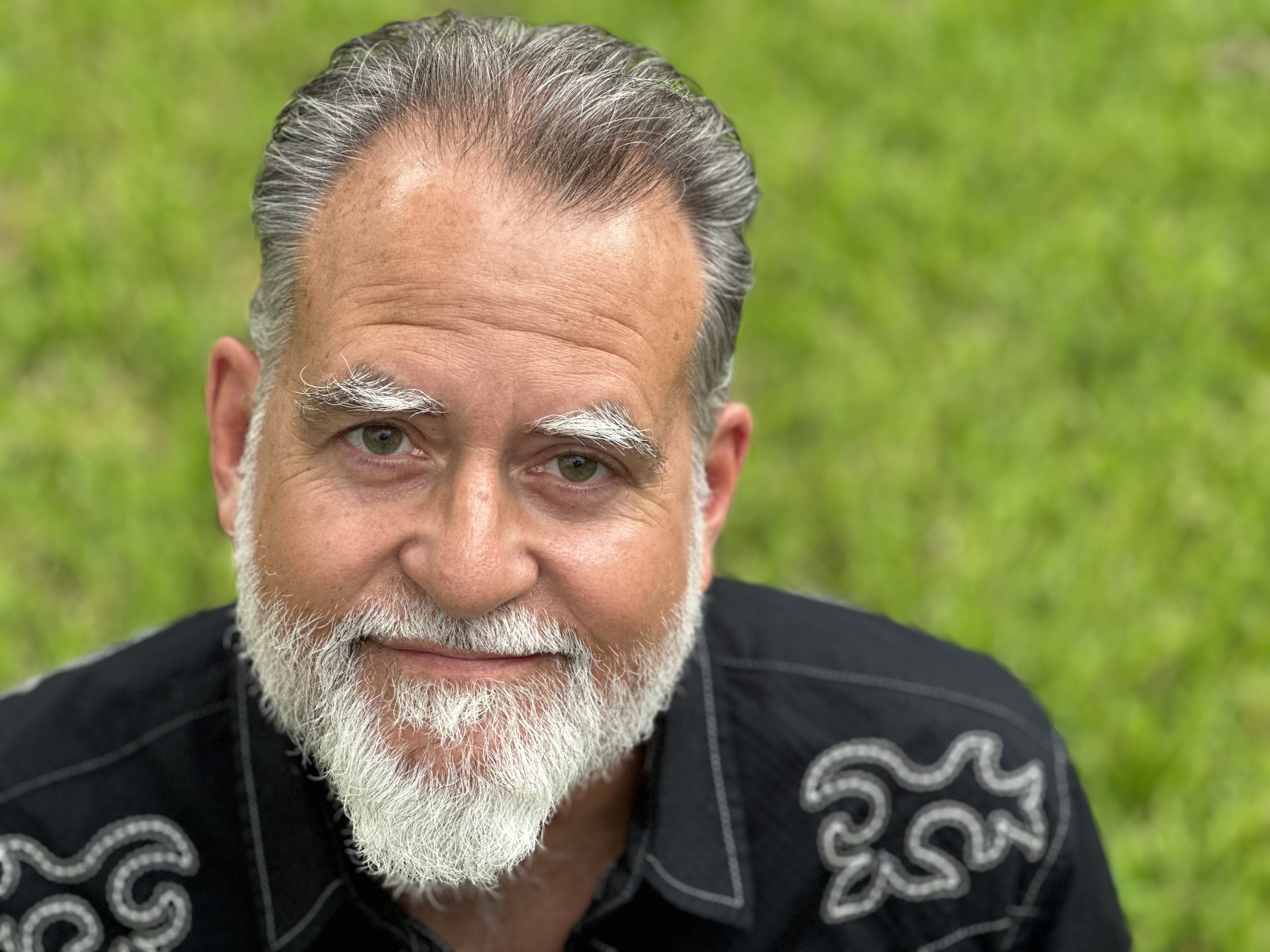 Welcome to the blog of Richard Beck, author and professor of psychology at Abilene Christian University (beckr@acu.edu).